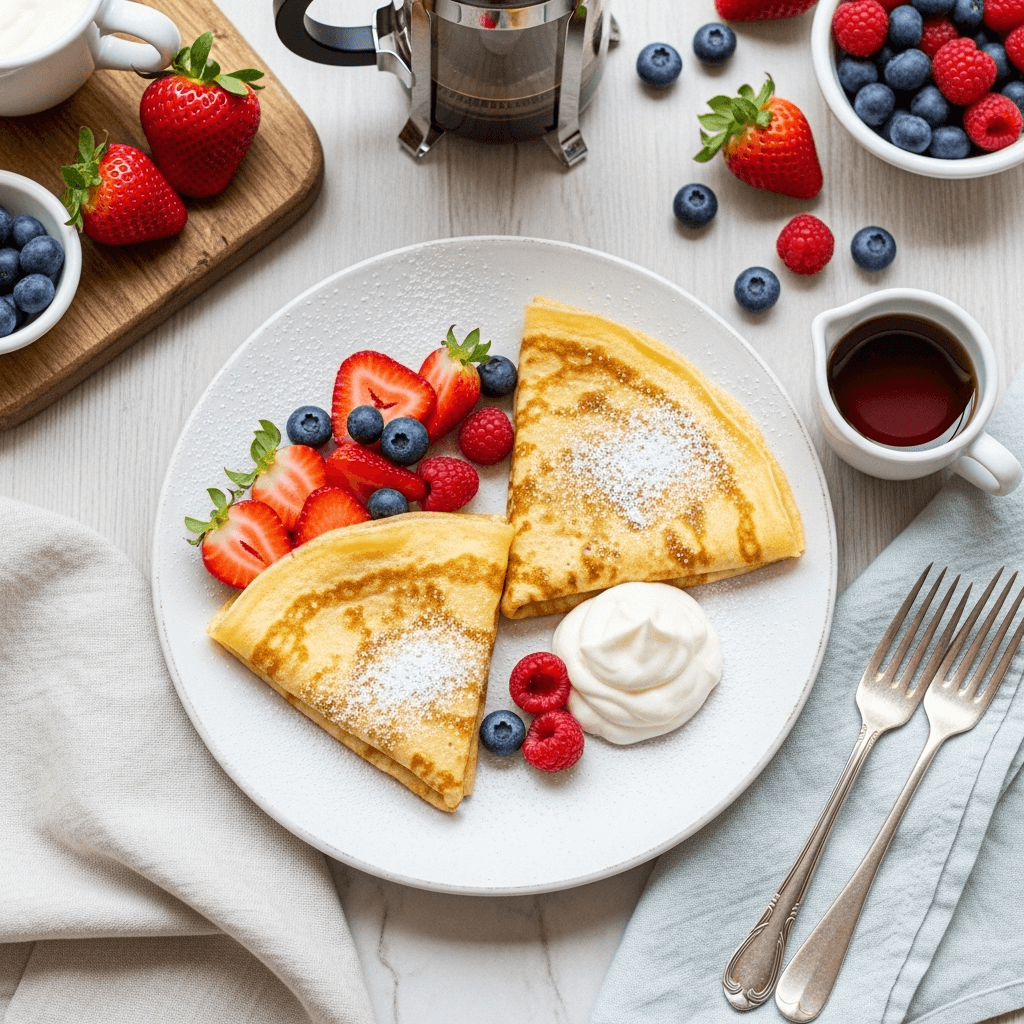

Get ready to master one of the most elegant yet surprisingly simple recipes in the culinary world—homemade crepes! These thin, delicate French pancakes are incredibly versatile, absolutely delicious, and far easier to make than you might think. With just a handful of basic ingredients and a non-stick pan, you can create restaurant-quality crepes right in your own kitchen that’ll impress everyone at your breakfast table.
What makes this easy crepe recipe truly special is how it transforms simple pantry staples—flour, eggs, milk, and butter—into something extraordinary. Unlike thick, fluffy American pancakes, crepes are paper-thin, tender, and have a subtle richness that makes them the perfect canvas for both sweet and savory fillings. The batter comes together in just 5 minutes (a blender makes it even easier!), and once you get the hang of swirling the pan, you’ll be making beautiful crepes like a pro.
These homemade crepes work for virtually any occasion: leisurely weekend breakfasts, elegant brunch gatherings, Mother’s Day celebrations, Valentine’s Day morning treats, or even as a light dinner option when filled with savory ingredients. Fill them with Nutella and bananas, fresh berries and whipped cream, lemon and sugar, ham and cheese, or sautéed vegetables—the possibilities are truly endless.
Whether you’re attempting crepes for the first time or looking to perfect your technique, this foolproof crepe recipe delivers consistent, delicious results every single time. Let’s make the most beautiful, delicate crepes you’ve ever tasted!
History / Background
Crepes (pronounced “krep”) are one of France’s most iconic culinary contributions to the world, though their history stretches back much further than French cuisine itself. The origin of thin pancakes can be traced to ancient times—the Romans made a dish called “alita dolcia” (another sweet), which was a thin pancake-like creation. Similar thin pancakes appear in cuisines around the world, from Russian blinis to Ethiopian injera to Chinese jianbing.
The French crepe as we know it today originated in Brittany, a region in northwestern France, around the 13th century. The word “crepe” comes from the Latin “crispa,” meaning “curled” or “wrinkled,” which perfectly describes the delicate, slightly ruffled edges of a well-made crepe. Initially, Breton crepes were made with buckwheat flour (called galettes) because wheat didn’t grow well in the region’s rocky soil. These savory buckwheat crepes are still popular today and typically filled with ingredients like ham, cheese, and eggs.
As crepes spread throughout France, wheat flour versions became more common, especially for sweet preparations. By the 19th century, crepes had become a beloved part of French culinary tradition, enjoyed by everyone from peasants to aristocrats. French street vendors sold crepes from carts, and crepe stands became fixtures at markets and festivals—a tradition that continues today.
The celebration of Chandeleur (Candlemas) on February 2nd is deeply tied to crepe culture in France. According to tradition, if you can flip a crepe in the pan while holding a gold coin in your other hand, you’ll have prosperity for the year. This charming custom has made crepe-making a festive activity passed down through generations.
Crepes came to America with French immigrants, but they really gained mainstream popularity in the 1960s and 70s when French cuisine became fashionable. Restaurants like The Magic Pan chain, which opened in 1965, introduced Americans to crepes as both sweet desserts and savory meals. Today, crepes have become globally beloved, with crepe cafes and restaurants in cities worldwide.
What makes crepes enduringly popular is their elegant simplicity and incredible versatility. They can be humble weekday breakfast fare or sophisticated dessert for special occasions. They represent the French culinary philosophy that simple, quality ingredients prepared with care can create something truly magical.
Why You’ll Love This Recipe
This isn’t just another crepe recipe—this is THE easy crepe recipe that will make you feel like a French chef, even if you’ve never made them before.
Here’s why this simple crepe recipe will become your new favorite:
- Incredibly easy – Uses basic ingredients and simple techniques that beginners can master
- Ready in 30 minutes – From mixing batter to serving, you’ll have crepes on the table fast
- Budget-friendly – Uses pantry staples you probably already have
- Versatile – Works for breakfast, brunch, dessert, or even savory dinners
- Impressive presentation – Looks fancy and restaurant-quality with minimal effort
- Customizable – Fill with sweet or savory ingredients to suit any taste
- Kid-approved – Children love the thin, delicate texture and fun fillings
- Make-ahead friendly – Batter improves with resting and crepes freeze beautifully
- No special equipment – Just a blender or whisk and a non-stick pan
- Healthier than you think – Thin crepes use less batter than thick pancakes
- Perfect for entertaining – Make a crepe bar and let guests customize their own
- Teaches technique – Learning to make crepes improves your overall cooking skills
- Naturally adaptable – Easy to make gluten-free, dairy-free, or vegan
Ingredient Notes
The beauty of crepes lies in their simplicity—just a few quality ingredients create magic:
All-Purpose Flour – The foundation of your crepe batter. All-purpose flour creates tender, delicate crepes with the perfect texture. Don’t use self-rising flour or bread flour, which have different protein contents. For gluten-free crepes, use a quality 1:1 gluten-free flour blend (though texture will differ slightly).
Eggs – Provide structure, richness, and help bind everything together. Large eggs are standard. Room temperature eggs incorporate more smoothly into the batter. The eggs also give crepes their beautiful golden color and subtle richness.
Milk – Creates the liquid base that makes crepes thin and pourable. Whole milk provides the best flavor and texture, but 2% or even skim milk work fine. For dairy-free crepes, use unsweetened almond milk, oat milk, or soy milk—any non-dairy milk works.
Water – Helps thin the batter to the perfect consistency. The combination of milk and water creates crepes that are tender but not too rich. Using all milk would make them too heavy; using all water would make them bland.
Melted Butter – Adds richness, flavor, and helps prevent crepes from sticking to the pan. Unsalted butter is preferred so you can control the salt level. For dairy-free, use melted coconut oil or vegetable oil.
Sugar – Just a small amount enhances flavor and helps with browning. If making savory crepes, you can reduce or omit the sugar. The touch of sweetness works even in savory applications, though.
Salt – Essential! Even a small amount enhances all the other flavors. Never skip the salt—it makes the difference between bland and delicious.
Vanilla Extract – Optional but recommended for sweet crepes. Adds wonderful aromatic flavor that complements fruit, chocolate, and sweet fillings. Omit for savory crepes.
Optional: Orange Zest or Lemon Zest – A teaspoon of citrus zest adds sophisticated flavor, especially for dessert crepes.
Optional: Liqueur – For adult crepes, 1-2 tablespoons of Grand Marnier, Cointreau, or rum adds depth and complexity.
Equipment Needed
Making crepes requires minimal equipment—just a few basic tools:
- Blender or mixing bowl and whisk – A blender creates the smoothest batter in seconds, but a whisk works perfectly fine. The blender is easier and reduces lumps.
- Measuring cups and spoons – Accurate measurements ensure consistent results
- Non-stick skillet or crepe pan – An 8-10 inch non-stick pan is ideal. Traditional crepe pans are shallow with sloped sides, but any non-stick skillet works. Cast iron can work but requires more butter/oil to prevent sticking.
- Ladle or measuring cup – For portioning batter consistently (about ¼ cup per crepe)
- Rubber spatula or crepe spreader – For folding and flipping crepes. A thin, flexible spatula works best.
- Pastry brush – For lightly buttering the pan between crepes
- Plate or platter – For stacking finished crepes
- Paper towels or clean kitchen towel – For wiping excess butter from the pan
Optional but useful:
- Crepe spreader tool – A wooden T-shaped tool for spreading batter, though the pan-swirling method works just as well
- Offset spatula – Makes flipping easier for beginners

Easy Crepe Recipe
- Total Time: 55 minutes
- Yield: 12-14 crepes 1x
- Diet: Vegetarian
Description
This easy crepe recipe creates thin, delicate French pancakes that are perfect for sweet or savory fillings. Made with simple ingredients in just 5 minutes, these homemade crepes are tender, delicious, and surprisingly simple to master. The batter rests for 30 minutes for the best texture, then cooks quickly in a non-stick pan. Perfect for breakfast, brunch, or dessert!
Ingredients
For the Crepe Batter:
- 1 cup all-purpose flour
- 2 large eggs, room temperature
- ½ cup whole milk
- ½ cup water
- 2 tablespoons melted butter, plus more for cooking
- 2 tablespoons granulated sugar (reduce to 1 tablespoon for savory crepes)
- ¼ teaspoon salt
- 1 teaspoon vanilla extract (omit for savory crepes)
For Serving (choose your favorites):
- Nutella and sliced bananas
- Fresh berries and whipped cream
- Lemon juice and powdered sugar
- Maple syrup and butter
- Ham, cheese, and eggs (savory)
- Sautéed vegetables and cheese (savory)
Instructions
- Make the batter (blender method): Add all ingredients to a blender in this order: milk, water, eggs, melted butter, vanilla (if using), then flour, sugar, and salt on top. This prevents flour from sticking to the bottom. Blend on medium-high speed for 10-15 seconds until completely smooth. Scrape down sides if needed and blend for another 5 seconds.
- Make the batter (whisk method): In a large bowl, whisk together flour, sugar, and salt. Make a well in the center. In a separate bowl, whisk together eggs, milk, water, melted butter, and vanilla. Pour wet ingredients into the well. Whisk from the center outward, gradually incorporating flour until you have a smooth batter with no lumps.
- Rest the batter: This step is important! Cover the batter and refrigerate for at least 30 minutes, or up to 24 hours. Resting allows the flour to fully hydrate and the gluten to relax, resulting in tender crepes. The batter will thicken slightly—this is normal.
- Check consistency: After resting, the batter should be thin and pourable, like heavy cream. If it’s too thick (should coat the back of a spoon but run off easily), whisk in water 1 tablespoon at a time until you reach the right consistency.
- Heat the pan: Place your non-stick skillet over medium heat (not high!). Let it heat for 2-3 minutes. Lightly brush with melted butter. The pan is ready when a drop of water sizzles gently.
- Pour and swirl batter: Hold the pan off the heat with one hand. With your other hand, ladle about ¼ cup of batter into the center of the pan (slightly less for 8-inch pan, slightly more for 10-inch). Immediately tilt and rotate the pan in a circular motion so the batter spreads in a thin, even layer covering the entire bottom. Work quickly—the batter sets fast!
- Cook the first side: Return pan to heat. Cook for 1-2 minutes until the edges start to look dry and golden, and you can easily slide a spatula underneath. The crepe should have light golden spots on the bottom.
- Flip the crepe: Using a thin spatula (or your fingers if you’re brave!), gently flip the crepe. Cook the second side for just 30-45 seconds until lightly golden. The second side cooks much faster and won’t brown as evenly—this is normal and fine!
- Transfer to plate: Slide the crepe onto a plate. The first crepe is often imperfect—consider it the “test crepe” for adjusting heat and batter amount. Don’t worry, it still tastes delicious!
- Continue cooking: Repeat the process with remaining batter, lightly buttering the pan every 2-3 crepes. Stack finished crepes on top of each other (they won’t stick). Adjust heat as needed—if browning too quickly, reduce heat; if not browning enough, increase heat slightly.
- Serve: Fill crepes with your chosen fillings. For sweet crepes, fold into quarters or roll into cylinders. For savory crepes, fold into quarters or fold edges toward center to create a square envelope. Serve immediately while warm.
Notes
- Resting time is important: Don’t skip the 30-minute rest. It makes crepes more tender and easier to work with.
- Batter consistency: Should be thin like heavy cream. Add water if too thick.
- Pan temperature: Medium heat works best. Too hot creates thick, rubbery crepes; too cool creates pale, tough crepes.
- First crepe syndrome: The first one or two crepes rarely turn out perfect as you’re adjusting temperature and technique. Don’t get discouraged!
- Butter the pan lightly: Too much butter makes crepes greasy. A light coating is all you need.
- Stack as you go: Finished crepes can be stacked without sticking. Keep them covered with a kitchen towel to stay warm.
- Practice makes perfect: Your technique will improve with each crepe. By the end of the batch, you’ll be a pro!
- Prep Time: 5 minutes (plus 30 minutes rest time)
- Cook Time: 20 minutes
- Category: Breakfast
- Method: Stovetop
- Cuisine: French
Nutrition
- Serving Size: 1 crepe (unfilled)
- Calories: 65
- Sugar: 2g
- Sodium: 65mg
- Fat: 2.5g
- Saturated Fat: 1.5g
- Unsaturated Fat: 1g
- Trans Fat: 0g
- Carbohydrates: 08g
- Fiber: 0.3g
- Protein: 2g
- Cholesterol: 35mg
Tips & Variations
The basic crepe recipe is perfect, but here are ways to customize it:
Chocolate Crepes – Add 2-3 tablespoons cocoa powder to the batter for rich chocolate crepes. Increase sugar to 3 tablespoons. Perfect filled with whipped cream, berries, or Nutella.
Whole Wheat Crepes – Replace half the all-purpose flour with whole wheat flour for nuttier flavor and more fiber. They’ll be slightly heartier but still delicious.
Buckwheat Crepes (Galettes) – Use half buckwheat flour and half all-purpose for authentic Breton-style savory crepes. Reduce sugar to just a pinch.
Lemon Crepes – Add 1-2 teaspoons lemon zest and 1 tablespoon lemon juice to the batter. Beautiful with berries and whipped cream.
Orange Crepes (Crepes Suzette) – Add 1-2 teaspoons orange zest and replace 2 tablespoons of water with orange juice. Classic French preparation often flambéed with Grand Marnier.
Coconut Crepes – Replace milk with coconut milk for tropical flavor. Delicious filled with mango, pineapple, or passion fruit.
Savory Herb Crepes – Omit sugar and vanilla. Add 2 tablespoons fresh chopped herbs (chives, parsley, thyme, or tarragon). Perfect for savory fillings.
Spinach Crepes – Blend ½ cup fresh spinach with the wet ingredients for beautiful green crepes packed with nutrients.
Protein Crepes – Add 2 tablespoons protein powder to increase protein content. May need to thin batter slightly with extra water.
Gluten-Free Crepes – Use 1:1 gluten-free flour blend. Let batter rest for 1 hour instead of 30 minutes. Texture will be slightly different but still delicious.
Vegan Crepes – Replace eggs with flax eggs (2 tablespoons ground flaxseed mixed with 5 tablespoons water), use non-dairy milk, and substitute oil for butter.
Dessert Crepe Cake – Stack 20-25 crepes with whipped cream, pastry cream, or Nutella between each layer for a stunning crepe cake.
Pro Chef Tips
These professional insights will elevate your crepe-making from good to exceptional:
Let batter rest—always – This isn’t optional! Resting allows gluten to relax and flour to fully hydrate, creating tender crepes instead of tough ones. Professional crepe makers often rest batter overnight for even better texture.
Get the temperature right – This is the most crucial factor. Medium heat (not medium-high, not low) creates crepes with beautiful golden spotting. Too hot and they’ll be rubbery and brown too fast; too cool and they’ll be pale and tough. If your first few crepes aren’t turning out, adjust heat before blaming your technique.
Master the swirl – The key to thin, even crepes is quickly swirling the batter around the pan immediately after pouring. Lift the pan off the heat, pour batter in the center, then tilt and rotate in a circular motion. The batter should coat the pan in one fluid motion. Practice this movement—it becomes muscle memory quickly.
Use the right amount of batter – Too much batter creates thick, pancake-like crepes; too little leaves gaps. Start with ¼ cup (2 oz) and adjust based on your pan size. You want the thinnest possible layer that still covers the pan completely.
Don’t over-butter the pan – Professional crepe makers use very little butter—just a light coating every few crepes. Too much butter makes crepes greasy and causes uneven browning. Use a paper towel to wipe excess butter from the pan, leaving just a thin film.
The first crepe is always imperfect – Accept this! The first crepe helps you gauge temperature and batter amount. Even professional chefs’ first crepes aren’t perfect. It’s still edible—enjoy it as a cook’s treat!
Flip with confidence – Hesitation causes torn crepes. Once the edges lift easily and the surface looks set, go for it! Slide your spatula under, lift quickly but smoothly, and flip. With practice, you can flip with just a flick of the wrist (or even toss them like French chefs do!).
Stack to keep warm – Crepes actually benefit from being stacked. The steam keeps them soft and pliable. Cover the stack with a clean kitchen towel to maintain warmth and moisture.
Thin is in – If your crepes seem thick, your batter is probably too thick. It should be thinner than American pancake batter—about the consistency of heavy cream. Add water or milk one tablespoon at a time until you achieve this consistency.
Make extra – Crepes freeze beautifully, so consider doubling the recipe. Having crepes in the freezer means you can have an elegant breakfast or dessert ready in minutes.
Common Mistakes to Avoid
Even simple recipes have pitfalls. Here’s what to watch out for:
Skipping the resting time – This is the most common mistake beginners make. Batter that hasn’t rested creates tough, rubbery crepes that tear easily. The gluten needs time to relax and the flour needs time to fully hydrate. Always rest for at least 30 minutes, preferably longer.
Using too much batter – More batter doesn’t mean better crepes! Crepes should be paper-thin. If yours are thick like pancakes, you’re using too much batter per crepe. Start with ¼ cup and reduce if needed. Remember, you want to see through a crepe when you hold it up to the light.
Pan too hot or too cold – Temperature control is everything. If your pan is too hot, crepes will brown instantly before spreading properly, creating thick centers and burnt edges. Too cold, and they’ll be pale, tough, and stick to the pan. Medium heat is your friend—adjust as needed as you cook.
Not swirling fast enough – The batter sets quickly! You must swirl immediately after pouring. If you hesitate, the batter will start setting before it spreads, leaving you with thick, uneven crepes. Pour with one hand, swirl with the other, and move quickly.
Flipping too early or too late – Flip when the edges are golden and lift easily, and you can slide a spatula underneath without resistance. Too early and the crepe tears; too late and it becomes crispy instead of tender. The sweet spot is about 1-2 minutes on the first side.
Over-buttering the pan – A little butter goes a long way. Too much creates greasy crepes and causes uneven browning. After the initial buttering, you often only need to re-butter every 2-3 crepes. Use a paper towel to wipe excess and leave just a thin film.
Getting discouraged after the first attempt – Your first few crepes will likely be imperfect while you figure out the right heat, batter amount, and swirling technique. This is completely normal! Don’t give up. By crepe number 5 or 6, you’ll have it down.
Storage & Meal Prep
Crepes are excellent for meal prep and storage:
Room Temperature Storage – Freshly made crepes can sit at room temperature for up to 2 hours, stacked and covered with a kitchen towel. Perfect for serving at brunch parties.
Refrigerator Storage – Stack cooled crepes with parchment or wax paper between each one to prevent sticking. Wrap the entire stack tightly in plastic wrap or place in an airtight container. Refrigerate for up to 3 days. The parchment paper makes it easy to grab individual crepes as needed.
Reheating from Refrigerator – For individual crepes, microwave for 10-15 seconds until warm and pliable. For the whole stack, wrap in foil and warm in a 300°F oven for 10-15 minutes. You can also reheat in a dry skillet over low heat for 15-20 seconds per side.
Filled Crepes Storage – If filling crepes ahead (like for meal prep breakfasts), choose fillings that won’t make them soggy. Nutella, peanut butter, or firmer fillings work better than fresh fruit with juice. Wrap individually in plastic wrap and refrigerate for up to 2 days.
Batch Cooking – Make a double or triple batch on the weekend. Having crepes ready in the fridge or freezer means you can have an elegant breakfast ready in minutes throughout the week.
Portion Control – Stack crepes in groups of 4-6 for individual meal portions. This makes it easy to grab just what you need without unwrapping the entire batch.
Make-Ahead & Freezer Notes
Crepes are one of the best make-ahead breakfast items:
Make-Ahead Batter – The batter actually improves with time! Make it up to 24 hours ahead and store covered in the refrigerator. Let come to room temperature for 10 minutes before cooking, and whisk gently to recombine (it may separate slightly).
Freezing Crepes (Highly Recommended!) – This is a game-changer for easy breakfasts. Let crepes cool completely, then stack with parchment or wax paper between each one. Wrap the entire stack tightly in plastic wrap, then place in a freezer bag. Freeze for up to 3 months. Label with the date and number of crepes.
Freezing in Portions – Stack crepes in smaller groups (4-6 per stack) before freezing. This lets you thaw only what you need without defrosting the entire batch.
Thawing Instructions – For best results, thaw overnight in the refrigerator. For faster thawing, leave at room temperature for 1-2 hours. You can also separate frozen crepes and microwave individually for 15-20 seconds until thawed and warm.
Reheating Frozen Crepes – Thaw first for best texture. Then reheat in the microwave (10-15 seconds), in a low oven wrapped in foil (300°F for 10 minutes), or in a dry skillet over low heat (15-20 seconds per side).
Freezing Filled Crepes – You can freeze crepes that are already filled, though texture may change slightly. Use dry fillings (Nutella, peanut butter, cheese for savory) rather than wet ones (fresh fruit). Wrap individually in plastic wrap, then freeze in a container. Thaw and reheat as needed.
Party Prep Timeline – Make crepes 2-3 days ahead and refrigerate, or weeks ahead and freeze. On the day of your event, simply reheat and set up a filling bar. This allows you to serve impressive food without last-minute stress.
Serving Suggestions
Crepes are incredibly versatile. Here are delicious ways to serve them:
Classic Sweet Fillings:
- Sugar and lemon – Sprinkle with sugar, squeeze fresh lemon juice, fold into quarters
- Nutella and banana – Spread Nutella, add banana slices, fold or roll
- Berries and cream – Fill with mixed berries and whipped cream
- Strawberries and Nutella – A match made in heaven
- Cinnamon sugar – Sprinkle cinnamon sugar, drizzle with butter
- Apple cinnamon – Sautéed apples with cinnamon and caramel
- Dulce de leche – Spread dulce de leche, add sliced bananas
Elegant Dessert Preparations:
- Crepes Suzette – Orange sauce with Grand Marnier, often flambéed
- Chocolate ganache – Warm chocolate ganache with raspberries
- Lemon curd – Tangy lemon curd with fresh berries
- Caramelized pears – Pears cooked in butter and brown sugar
Savory Filling Ideas:
- Ham and Gruyere – Classic French combination
- Spinach and feta – Mediterranean-inspired vegetarian option
- Egg and cheese – Scrambled eggs with cheddar for breakfast
- Smoked salmon – Cream cheese, salmon, capers, and dill
- Mushroom and herb – Sautéed mushrooms with fresh thyme
- Chicken and vegetables – Shredded chicken with sautéed veggies and cheese
- Ratatouille – Traditional French vegetable stew
Beverage Pairings:
- Hot coffee or café au lait
- Fresh orange juice
- Champagne or mimosas for brunch
- Hot chocolate for dessert crepes
- Tea (black tea or herbal)
Presentation Ideas:
- Folded quarters – Classic triangular presentation
- Rolled – Roll into cylinders, top with sauce and garnishes
- Stacked – Layer multiple filled crepes for impressive height
- Crepe cake – Stack 20+ crepes with filling between for a show-stopping dessert
FAQs Section
Why is my crepe batter lumpy?
Lumps usually form when dry and wet ingredients aren’t mixed properly. Using a blender creates the smoothest batter. If whisking by hand, make sure to pour wet ingredients into a well in the dry ingredients and whisk from the center outward gradually. If you have lumps, strain the batter through a fine-mesh sieve. Also, letting batter rest helps lumps dissolve.
Can I make crepes without a blender?
Absolutely! A whisk works perfectly fine. Just whisk together the dry ingredients first, then make a well in the center and add wet ingredients. Whisk from the center outward, gradually incorporating the flour until smooth. It takes a bit longer but produces equally good results.
Why are my crepes thick and rubbery?
This usually means your batter is too thick or your pan is too hot. The batter should be thin like heavy cream—add water or milk to thin it if needed. Also, rubbery texture often indicates the pan temperature is too high. Reduce to medium heat and let crepes cook gently. Finally, make sure you’re using only ¼ cup of batter (or less) per crepe.
Do I need a special crepe pan?
No! While traditional crepe pans have shallow, sloped sides that make flipping easier, any non-stick skillet works beautifully. An 8-10 inch non-stick pan is ideal. Cast iron can work but requires more butter and careful heat management to prevent sticking.
How do I prevent crepes from sticking?
Make sure your pan is properly heated before adding batter, use a non-stick pan or well-seasoned cast iron, lightly butter the pan (but not too much), and ensure your batter has enough fat (don’t reduce the butter in the recipe). If crepes stick, your pan may not be hot enough or you need a tiny bit more butter.
Can I make crepes ahead for a party?
Yes! This is one of the best make-ahead breakfast items. Make crepes up to 3 days ahead, stack with parchment paper between layers, wrap tightly, and refrigerate. Reheat gently before serving. You can even freeze them for up to 3 months. This allows you to set up a beautiful crepe bar without last-minute cooking.
What’s the difference between crepes and pancakes?
Crepes are much thinner and more delicate than American pancakes. They contain more liquid and less leavening (no baking powder), creating a thin, tender texture. Pancakes are thick and fluffy from baking powder/soda. Crepes are also typically filled or topped, while pancakes are usually stacked and topped with syrup.
Conclusion
And there you have it—everything you need to make perfect, delicate, restaurant-quality crepes right in your own kitchen! This easy crepe recipe proves that elegant French cooking doesn’t have to be intimidating or complicated. With just a handful of simple ingredients, a basic pan, and a little practice, you can create something truly special that will impress your family and friends.
What I love most about homemade crepes is their incredible versatility. Make them for a fancy Mother’s Day brunch with champagne, serve them at a casual weekend breakfast, fill them with Nutella for a kid-friendly treat, or create savory dinner crepes with vegetables and cheese. The same simple batter transforms into countless delicious possibilities based on how you fill and serve it.
The make-ahead and freezer-friendly nature means you can batch cook on a lazy Sunday and enjoy elegant breakfasts all week long without any morning stress. Just reheat, fill, and enjoy! It’s the kind of smart cooking that makes your life easier while making you look like a culinary genius.
Now I want to hear from YOU! Have you made crepes before? What’s your favorite filling combination? Are you team sweet or team savory? Do you have any special crepe-making tips or family traditions? Drop a comment below and share your crepe adventures—I love hearing from fellow home cooks and learning about your creative variations!
If this recipe helped you master the art of crepe-making, please give it a 5-star rating and leave a review. Your feedback helps other readers and lets me know what recipes you’d like to see more of. And don’t forget to PIN this recipe to your Breakfast Recipes, Brunch Ideas, or French Cooking boards on Pinterest so you can find it easily whenever you’re ready to impress someone with homemade crepes!
Happy crepe making, and may your swirls always be perfect and your fillings always be delicious!