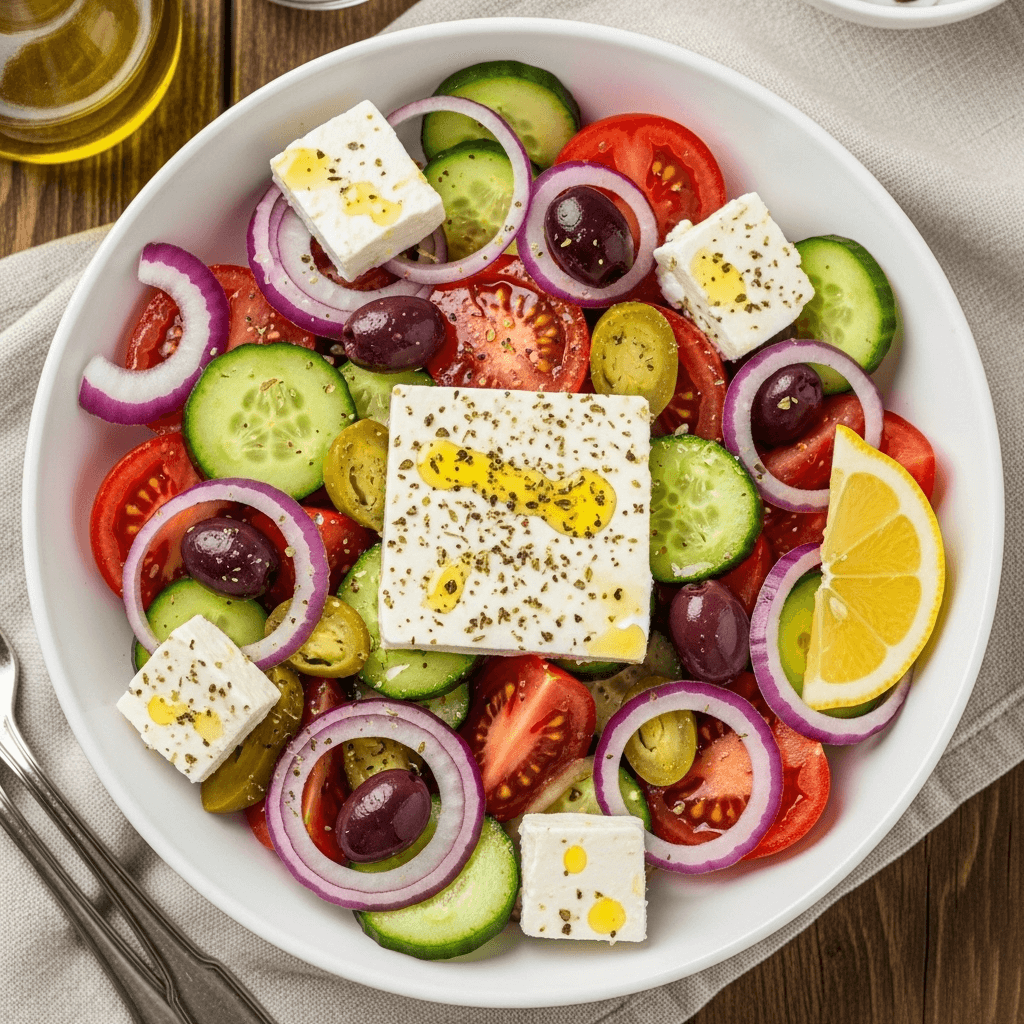

Close your eyes and imagine yourself sitting at a sun-drenched taverna on a Greek island, the Mediterranean Sea sparkling in the distance, a light breeze carrying the scent of fresh herbs and sea salt. Now open them—because you can recreate that exact experience right in your own kitchen with this authentic Greek salad recipe.
This isn’t your average “Greek salad” with iceberg lettuce and bottled Italian dressing. This is Horiatiki—the real deal that Greeks have been making for generations. It’s a simple yet stunning combination of juicy ripe tomatoes, crisp cucumbers, briny Kalamata olives, creamy feta cheese, thinly sliced red onions, and vibrant green peppers, all dressed with nothing more than good olive oil, red wine vinegar, dried oregano, salt, and pepper.
What makes this traditional Greek salad so special is its beautiful simplicity and the way it celebrates fresh, quality ingredients. There’s no lettuce to wilt or overpower the flavors—just chunky, substantial vegetables that can hold their own against that tangy, herbaceous dressing. It’s light yet satisfying, healthy yet indulgent, and comes together in just 15 minutes with no cooking required.
Serve this authentic Greek salad as a refreshing side dish alongside grilled meats, stuff it into pita bread for a quick lunch, enjoy it with crusty bread for a light dinner, or bring it to your next potluck where it’ll disappear before anything else. This easy Mediterranean salad is perfect for summer cookouts, meal prep, weeknight dinners, or anytime you want to transport your taste buds to the Greek islands.
History / Background
Greek salad, known as Horiatiki salata (which translates to “village salad” or “peasant salad”), is one of Greece’s most iconic dishes and a cornerstone of Mediterranean cuisine. Its origins are deeply rooted in the agricultural traditions and culinary philosophy of rural Greece, where farmers and villagers created hearty, nutritious meals from the fresh produce growing in their gardens and the local ingredients available in their communities.
The salad as we know it today likely emerged in the early-to-mid 20th century, though Greeks have been combining tomatoes, cucumbers, onions, and olive oil for much longer. The key ingredient that defines modern Horiatiki—the tomato—wasn’t introduced to Greece until the 16th century when it arrived from the Americas via Spanish and Italian traders. Initially treated with suspicion like many New World foods, tomatoes eventually became integral to Greek cuisine, particularly after they became widely cultivated in the 19th century.
Traditional Horiatiki was born from necessity and practicality. Greek farmers working long days in the fields needed substantial, nutritious meals that could be prepared quickly without cooking in the heat. They’d gather whatever was ripe in their gardens—tomatoes, cucumbers, peppers, onions—combine them with preserved ingredients like olives and feta cheese, dress everything with their own olive oil and local wine vinegar, and have a complete, satisfying meal. The absence of lettuce isn’t an oversight; it’s intentional. Lettuce wilts quickly in the Mediterranean heat, while the hardy vegetables in Horiatiki stay crisp and fresh.
Feta cheese, which crowns every authentic Greek salad, has been produced in Greece for thousands of years. References to feta-like cheese appear in Homer’s Odyssey, and the traditional production method using sheep’s milk (or a combination of sheep’s and goat’s milk) has been protected by the European Union since 2002. In a true Horiatiki, feta isn’t crumbled throughout—instead, a thick slab sits proudly on top of the vegetables, allowing diners to break off pieces as they eat.
The global popularity of Greek salad exploded in the 1960s and 1970s as tourism to Greece increased and people fell in love with Mediterranean cuisine. However, as the salad traveled internationally, it often transformed into something quite different from the original. American and European versions frequently added lettuce, changed the dressing, crumbled the feta, and modified ingredients based on local availability. Greeks themselves are quite particular about their Horiatiki—in Greece, you’d be hard-pressed to find lettuce in a Greek salad, and the dressing is always simple olive oil and vinegar, never a creamy bottleneck concoction.
Today, Horiatiki represents the essence of Greek food philosophy: use the freshest, highest-quality ingredients you can find, treat them simply, and let their natural flavors shine. It embodies the Mediterranean diet that has been studied extensively for its health benefits and celebrates the Greek approach to eating—fresh, seasonal, communal, and joyful.
Why You’ll Love This Recipe
This authentic Greek salad recipe brings the vibrant flavors of the Mediterranean straight to your table with minimal effort and maximum deliciousness. Once you try the real version, you’ll never go back to those lettuce-heavy imitations.
Here’s why this traditional Greek salad will become your new favorite:
- Ready in 15 minutes – No cooking required, just chopping and assembling for a fresh, delicious salad
- Authentically Greek – Made the traditional way with no lettuce, just chunky vegetables and a simple dressing
- Naturally healthy – Packed with vegetables, heart-healthy olive oil, and protein-rich feta cheese
- Perfect for meal prep – The vegetables hold up beautifully, making this ideal for packed lunches
- Impressive yet easy – Looks restaurant-quality but requires no special skills or techniques
- Customizable – Easily adjust ingredients based on your preferences and what’s in season
- Budget-friendly – Uses simple, affordable ingredients that are available year-round
- No wilting worries – Unlike lettuce-based salads, this stays crisp and fresh for hours
- Keto and low-carb friendly – Naturally fits multiple dietary approaches
- Gluten-free – Perfect for those avoiding gluten (just ensure your feta is certified GF if needed)
- Crowd-pleaser – Even picky eaters love the fresh, bright flavors
- Versatile serving options – Works as a side dish, light main course, or party appetizer
Ingredient Notes
The beauty of authentic Greek salad lies in its simplicity, which means each ingredient plays a starring role. Using high-quality, fresh ingredients makes all the difference.
Tomatoes – The foundation of your salad. Use ripe, juicy tomatoes with great flavor—this isn’t the place for pale, flavorless supermarket tomatoes. In summer, use heirloom or vine-ripened tomatoes. Roma tomatoes work well year-round because they’re meaty with fewer seeds. Cherry or grape tomatoes add sweetness and are perfect for winter when larger tomatoes lack flavor. Cut tomatoes into substantial wedges or chunks—they should be hearty enough to stand up to the dressing.
Cucumbers – Provide essential crunch and refreshing flavor. English cucumbers (the long, seedless variety) are ideal because they have thin skins, minimal seeds, and less water content. Persian cucumbers work beautifully too. If using regular cucumbers, consider peeling them partially (leaving some green strips for color) and scooping out the seeds to prevent excess water. Greek cucumbers are smaller, crunchier, and more flavorful if you can find them at specialty markets.
Red Onion – Adds sharp, pungent bite that balances the rich feta and oil. Slice it paper-thin so it distributes throughout the salad without overwhelming other flavors. If raw onion is too strong for your taste, soak the slices in cold water for 10 minutes, then drain and pat dry. This mellows the intensity while maintaining the flavor. Sweet onions like Vidalia can substitute for a milder taste.
Green Bell Pepper – Traditional in authentic Horiatiki. Provides a slightly bitter, grassy crunch that’s characteristic of Greek salad. Many Greek cooks prefer green peppers for their authenticity, though you can use red or yellow peppers for sweeter flavor. Remove all seeds and white membrane, then cut into rings or strips.
Kalamata Olives – These aren’t optional! The briny, fruity flavor of Kalamata olives is essential to authentic Greek salad. Buy them with pits if possible (they have better flavor), though pitted works fine for convenience. Avoid canned black olives—they don’t have the same rich, complex flavor. If you can’t find Kalamata, use other Greek olive varieties like Amphissa or Halkidiki.
Feta Cheese – The crown jewel. Authentic Greek feta is made from sheep’s milk or a sheep-goat blend and has Protected Designation of Origin status. It’s creamier, more complex, and less salty than Bulgarian or French feta. Buy a block and cut it into thick slabs or large chunks—never pre-crumbled. The texture and flavor are significantly better. If you’re dairy-free, you’ll miss out on the authentic experience, but you can omit it or use dairy-free feta alternatives.
Extra Virgin Olive Oil – Use the best quality you can afford. Greek olive oil is ideal for authenticity—it tends to be fruity and robust. The olive oil is the primary dressing component, so quality matters tremendously. You need enough to coat the vegetables generously—don’t be shy.
Red Wine Vinegar – Provides the tangy acid that brightens all the flavors. Red wine vinegar is traditional, though you can substitute white wine vinegar or even fresh lemon juice. The vinegar should complement, not overpower, the olive oil.
Dried Oregano – Absolutely essential! Greek oregano has a more intense, slightly minty flavor compared to Italian or Mexican varieties. If possible, use Greek oregano (look for it at Mediterranean markets or online). Rub it between your palms before adding to release the aromatic oils. Fresh oregano doesn’t work as well here—dried is traditional and correct.
Salt and Black Pepper – Simple seasonings that enhance everything. The feta and olives are already salty, so taste before adding too much salt. Freshly ground black pepper is always best.
Equipment Needed
One of the best things about Greek salad is how little equipment you need. This is simple, rustic cooking at its finest:
- Large cutting board – For prepping all your vegetables
- Sharp chef’s knife – Essential for clean cuts and efficient chopping
- Large mixing bowl or serving bowl – For tossing and serving the salad; a wide, shallow bowl shows off the colorful ingredients beautifully
- Small bowl or jar – For mixing the dressing (though you can dress the salad directly in the serving bowl)
- Measuring cups and spoons – For accurate proportions
- Whisk or fork – For emulsifying the dressing
- Salad servers or large spoons – For tossing and serving
That’s it! No appliances, no special tools, just basic kitchen equipment.
Print
Greek Salad Recipe
- Total Time: 15 minutes
- Yield: 4-6 servings 1x
- Diet: Vegetarian
Description
This authentic Greek salad (Horiatiki) is made the traditional way with chunky tomatoes, crisp cucumbers, tangy Kalamata olives, creamy feta cheese, and a simple olive oil and red wine vinegar dressing. No lettuce, no fuss—just fresh Mediterranean flavors that transport you straight to the Greek islands. Ready in 15 minutes, this healthy salad is perfect for summer cookouts, meal prep, or anytime you crave fresh, vibrant flavors.
Ingredients
For the Salad:
- 4 large ripe tomatoes, cut into wedges (or 2 cups cherry tomatoes, halved)
- 1 large English cucumber, cut into thick half-moons or chunks
- 1 medium red onion, thinly sliced
- 1 large green bell pepper, seeded and cut into rings or strips
- 1 cup Kalamata olives, pitted or whole
- 8 oz (225g) Greek feta cheese block, cut into thick slabs or large chunks
- 2 teaspoons dried oregano (preferably Greek oregano)
For the Dressing:
- ⅓ cup extra virgin olive oil
- 2 tablespoons red wine vinegar
- ½ teaspoon salt (or to taste)
- ¼ teaspoon freshly ground black pepper
- Optional: 1 clove garlic, minced
Instructions
- Prepare the vegetables: Wash and dry all vegetables thoroughly. Cut the tomatoes into thick wedges (6-8 pieces per tomato). Cut the cucumber into thick half-moons about ½-inch thick. Thinly slice the red onion into rings or half-rings. Remove seeds and membrane from the bell pepper, then cut into rings or strips. Place all prepared vegetables in a large serving bowl.
- Add olives: Add the Kalamata olives to the bowl with the vegetables. If using whole olives, you can leave them whole or pit them—both ways are traditional.
- Make the dressing: In a small bowl or jar, combine the olive oil, red wine vinegar, salt, and pepper. Whisk vigorously until emulsified, or shake in a jar with the lid tightly closed. Taste and adjust seasoning if needed. If using garlic, add it to the dressing now.
- Dress the salad: Pour the dressing over the vegetables and olives. Sprinkle the dried oregano over everything, rubbing it between your palms as you add it to release the oils. Gently toss everything together to coat evenly with the dressing. Be gentle to keep the tomatoes from breaking apart.
- Add feta cheese: Place the feta cheese on top of the salad in large slabs or chunks. In traditional Greek style, the feta sits on top rather than being mixed throughout. You can also scatter it over the surface or place one large piece in the center.
- Final touches: Drizzle a little extra olive oil over the feta if desired. Add an extra pinch of oregano on top for presentation. Let the salad sit for 5-10 minutes before serving to allow flavors to meld.
- Serve: Serve the Greek salad at room temperature or slightly chilled. Provide bread for soaking up the delicious juices that collect at the bottom of the bowl. When serving, make sure each person gets some feta with their portion.
Notes
- No lettuce: Authentic Greek salad never contains lettuce. The vegetables should be substantial enough to stand alone.
- Feta placement: Traditional presentation has feta on top in slabs, not crumbled throughout.
- Olive oil quality: Use the best olive oil you can afford—it’s the primary flavor in the dressing.
- Resting time: The salad actually improves after sitting 10-15 minutes, as the vegetables release their juices and the flavors marry.
- Salt carefully: Both feta and olives are salty, so taste before adding too much additional salt.
- Serving temperature: Greeks typically serve this at room temperature, not ice cold.
- Prep Time: 15 minutes
- Cook Time: 0 minutes
- Category: Salad
- Method: No-Cook
- Cuisine: Greek
Nutrition
- Serving Size: 1/6 of recipe (approximately 1½ cups)
- Calories: 245
- Sugar: 6g
- Sodium: 685mg
- Fat: 20g
- Saturated Fat: 6g
- Unsaturated Fat: 13g
- Trans Fat: 0g
- Carbohydrates: 12g
- Fiber: 3g
- Protein: 7g
- Cholesterol: 28mg
Tips & Variations
While traditional Horiatiki is perfection on its own, here are some ways to customize it or adapt it to your preferences:
Classic Greek Restaurant Style – Many Greek restaurants in America add a few romaine lettuce leaves beneath the salad. While not traditional, it does add crunch and stretches the salad further. Just remember it won’t keep as long.
Greek Salad with Chickpeas – Add 1 cup of cooked chickpeas for extra protein and substance, making this a complete meal. This is common in modern Greek cuisine and perfect for vegetarians.
Horiatiki with Capers – Add 2 tablespoons of capers for extra briny, tangy flavor. This is a variation you’ll find in some Greek islands.
Grilled Vegetable Greek Salad – Grill the bell peppers, onions, and thick cucumber slices before chopping and adding to the salad. The char adds wonderful smoky depth.
Greek Salad with Avocado – Not traditional, but delicious! Add diced avocado for creaminess and healthy fats. This makes it more filling as a main dish.
Spicy Greek Salad – Add sliced pepperoncini or a pinch of crushed red pepper flakes for heat. Some Greeks like a spicy kick in their salad.
Greek Salad with Fresh Herbs – Add fresh parsley, dill, or mint for extra freshness and color. While not in the absolute most traditional version, many Greek families add fresh herbs.
Protein-Packed Version – Top with grilled chicken, lamb, shrimp, or chickpeas to turn this into a complete meal. This is perfect for meal prep bowls.
Light Version – Reduce the olive oil to 3 tablespoons and increase the vinegar or add lemon juice for a lighter, more acidic dressing.
Winter Greek Salad – When tomatoes are out of season, use cherry tomatoes (which are more consistently good) and add roasted red peppers for color and sweetness.
Greek Salad Jar – Layer ingredients in mason jars for portable lunches: dressing on bottom, cucumbers, peppers, tomatoes, onions, olives, then feta on top.
Pro Chef Tips
These professional insights will help you create the most authentic, delicious Greek salad every time:
Choose tomatoes wisely – The tomatoes make or break your salad. In summer, splurge on heirloom or farmers market tomatoes. In winter, cherry or grape tomatoes are your best bet. Never refrigerate tomatoes before making the salad—cold kills their flavor and texture.
Salt the tomatoes – For extra flavor, lightly salt the tomato wedges 10 minutes before assembling the salad. This draws out their juices, intensifies flavor, and creates more delicious dressing at the bottom of the bowl.
Tame the onion – If raw onion is too sharp, soak sliced onions in ice water for 10 minutes, then drain and pat completely dry. This removes harsh sulfur compounds while maintaining crunch and flavor.
Make it ahead strategically – Prepare all vegetables and keep them separate. Mix the dressing separately. Combine everything 30 minutes before serving for the best texture and flavor. This allows the salad to marinate slightly without getting soggy.
Quality over quantity with olive oil – Greek salads use generous amounts of olive oil, which might seem excessive. But high-quality olive oil is what makes the salad luxurious. Don’t skimp or substitute with cheaper oils.
Proper feta handling – Buy feta packed in brine and drain it just before using. Pat it dry gently. The brine keeps it fresh and creamy. If your feta is too salty, soak it in cold water for 10 minutes before using.
Rub the oregano – Always rub dried oregano between your palms before adding it to the salad. This releases the essential oils and awakens the flavor. You should smell it strongly before it hits the salad.
Don’t overdress – You can always add more dressing, but you can’t remove it. Start with less, toss, taste, and add more if needed. The vegetables will release their own juices as they sit.
Cut vegetables uniformly – Consistent sizing ensures even distribution of flavors and makes eating easier. Aim for bite-sized but substantial pieces—nothing too small.
Serve at room temperature – Cold dulls flavors. Let your salad sit at room temperature for 15-20 minutes before serving if it’s been refrigerated. The olive oil will also return to its liquid state.
Save the juices – The liquid that collects at the bottom of the bowl after the salad sits is liquid gold. Use bread to soak it up, or drizzle it over the second serving. Greeks never waste these delicious juices.
Common Mistakes to Avoid
Even a simple salad can go wrong if you’re not careful. Here’s what to watch out for:
Using poor quality ingredients – With so few components, there’s nowhere to hide mediocre ingredients. Flavorless tomatoes, bland olive oil, or inferior feta will result in a disappointing salad. This recipe requires the freshest vegetables and best quality olive oil and feta you can afford.
Adding lettuce – I know many American versions include lettuce, but if you want authentic Horiatiki, skip it entirely. Lettuce waters down the flavors and wilts quickly. The traditional version relies on hearty vegetables that can stand up to the dressing and won’t wilt.
Overdressing – Greek salad should be lightly dressed with olive oil and vinegar, not swimming in dressing. The vegetables should be glossy and coated, not drowning. Too much dressing makes the salad soggy and overwhelms the fresh vegetable flavors.
Crumbling the feta – Pre-crumbled feta is dry, chalky, and lacks flavor. Always buy feta in a block and cut it into large chunks or slabs. The texture and taste are incomparably better, and it’s more authentic to Greek serving style.
Making it too far ahead – While the salad benefits from 10-15 minutes of resting, making it hours ahead causes the tomatoes to release too much water, the cucumbers to get soggy, and the onions to become overpowering. Prep ingredients ahead, but assemble close to serving time.
Forgetting the oregano – Oregano is absolutely essential to Greek salad. Don’t skip it or substitute fresh oregano—dried oregano is traditional and provides the characteristic flavor. Without it, you simply don’t have authentic Greek salad.
Using the wrong olives – Black canned olives from a can are not Kalamata olives. They’re bland and rubbery. Real Kalamata olives are dark purple, meaty, and have complex, fruity flavor. They’re essential for authenticity and can’t be substituted with generic black olives.
Storage & Meal Prep
Greek salad is great for meal prep with a few smart strategies:
Short-Term Storage – Store assembled Greek salad in an airtight container in the refrigerator for up to 2 days. The vegetables will soften slightly and release more liquid, but it’s still delicious. Stir before serving and add a fresh drizzle of olive oil if it looks dry.
Best Meal Prep Method – Store components separately for best results. Keep chopped vegetables in one container, dressing in a jar, and feta separate. Combine when ready to serve. This keeps everything at peak freshness for up to 4 days.
Dealing with Liquid – As the salad sits, tomatoes and cucumbers release water. If making ahead, you can lightly salt and drain the tomatoes and cucumbers beforehand, though this extra step isn’t necessary if serving soon.
Mason Jar Salads – Layer in this order from bottom to top: dressing, cucumbers (they hold up to liquid best), peppers, tomatoes, onions, olives, and feta on top. Shake and pour into a bowl when ready to eat. Keeps 2-3 days.
Refreshing Leftovers – If your stored salad seems tired, drain excess liquid, add fresh tomatoes or cucumber, drizzle with fresh olive oil, and add a bit more oregano. This revives it beautifully.
Room Temperature Serving – Remove from refrigerator 20-30 minutes before serving to bring to room temperature. Cold dulls the flavors, and the olive oil will solidify in the fridge.
Transporting – Greek salad travels well to potlucks and picnics. Keep it in a cooler if it will be out longer than 2 hours. Transport dressing separately and add just before serving for the freshest presentation.
Make-Ahead & Freezer Notes
Greek salad is best enjoyed fresh, but here are some make-ahead strategies:
Advance Preparation – You can prep all vegetables up to 1 day ahead. Store each vegetable separately in airtight containers in the refrigerator. Keep tomatoes at room temperature if they’re ripe. Mix the dressing and store in a jar in the refrigerator for up to 1 week. Assemble the salad just before serving.
Dressing Ahead – The dressing actually improves when made ahead, as the flavors meld. Make it up to 1 week in advance and store in a jar in the refrigerator. Shake well before using, as it will separate.
Marinated Components – You can marinate the cucumbers, peppers, and onions in the dressing for 2-3 hours before serving. This creates more flavor depth. Add tomatoes, olives, and feta just before serving.
Freezing Not Recommended – Do not freeze Greek salad. The high water content vegetables (tomatoes and cucumbers) become mushy and unpleasant when frozen and thawed. The texture completely changes and can’t be restored. Fresh is always best for this salad.
Feta Freezing – While you shouldn’t freeze the assembled salad, you can freeze feta cheese for up to 3 months if you buy it in bulk. Wrap tightly and thaw in the refrigerator overnight before using. The texture may be slightly more crumbly, but the flavor remains good.
Pre-Prepped Ingredients – If you meal prep weekly, chop all vegetables on Sunday and store them separately. Throughout the week, you can quickly assemble fresh Greek salad in minutes. This is perfect for healthy lunch options.
Serving Suggestions
Greek salad is wonderfully versatile and pairs beautifully with countless dishes:
Traditional Greek Meal – Serve alongside grilled lamb souvlaki, chicken gyros, spanakopita (spinach pie), moussaka, or grilled fish. Add warm pita bread, tzatziki sauce, and hummus for a complete Greek feast.
With Grilled Meats – Greek salad is the perfect accompaniment to any grilled proteins: steak, chicken breasts, lamb chops, pork kebabs, or grilled shrimp. The fresh, acidic salad cuts through rich, fatty meats perfectly.
As a Main Course – Make it a complete meal by adding grilled chicken, shrimp, salmon, lamb, or chickpeas. Serve with crusty bread or pita and you have a satisfying, healthy dinner.
Light Lunch – Enjoy a big bowl of Greek salad with warm pita bread, hummus, and tzatziki for a light but filling Mediterranean lunch. Perfect for hot summer days.
Potluck Perfection – Greek salad is ideal for potlucks and BBQs. It’s colorful, feeds a crowd, holds up well, and most people love it. Plus, it’s one of the few substantial salads that doesn’t wilt.
Grain Bowls – Serve over quinoa, couscous, orzo, or rice for a Mediterranean grain bowl. The dressing flavors the grains beautifully and you get a complete, balanced meal.
Sandwich and Wrap Filling – Chop the salad finely and stuff it into pita pockets, wraps, or flatbreads with hummus or tzatziki. This makes an amazing vegetarian lunch.
Wine Pairings – Greek salad pairs beautifully with crisp white wines like Assyrtiko (a Greek white), Sauvignon Blanc, or dry rosé. For reds, try light, fruity options like Pinot Noir.
Bread for Soaking – Always serve with crusty bread, pita, or focaccia. The juices that collect at the bottom of the bowl are delicious soaked up with bread—Greeks consider this the best part!
Party Platter – Make a Greek mezze platter with Greek salad in the center, surrounded by hummus, baba ganoush, tzatziki, dolmades, spanakopita triangles, olives, and warm pita bread.
FAQs Section
Is Greek salad supposed to have lettuce?
No! Authentic Greek salad (Horiatiki) never contains lettuce. This is one of the most common misconceptions outside of Greece. The traditional recipe uses only tomatoes, cucumbers, peppers, onions, olives, and feta. The vegetables are substantial enough to stand alone, and Greeks believe lettuce would dilute the flavors. The lettuce-based versions you see at many restaurants are Americanized adaptations.
Can I make Greek salad ahead of time?
You can prep all the components ahead (chop vegetables, make dressing) and store them separately for up to 24 hours. However, don’t assemble the complete salad more than 30-60 minutes before serving, or it will become watery as the tomatoes and cucumbers release their juices. For meal prep, store components separately and combine when ready to eat.
What kind of feta cheese should I use?
Always buy block feta rather than pre-crumbled, preferably Greek feta packed in brine. Greek feta is made from sheep’s milk or sheep-goat milk blend and has PDO (Protected Designation of Origin) status—it’s creamier and more flavorful than Bulgarian or French versions. Brands like Dodoni, Mt. Vikos, or Athenos Traditional are good choices. The brine keeps the feta moist and prevents it from drying out.
Can I substitute the red wine vinegar?
Yes, you can substitute white wine vinegar or freshly squeezed lemon juice for the red wine vinegar. Lemon juice is actually quite common in Greek homes and provides bright, fresh acidity. Some Greeks use a combination of both lemon juice and vinegar. Just avoid balsamic vinegar, which is too sweet and strong for authentic Greek salad.
Why is my Greek salad watery?
Tomatoes and cucumbers are high in water content and release their juices when salted and dressed. This is actually traditional—the liquid that collects is delicious and meant to be soaked up with bread. To minimize excess liquid, you can: 1) salt and drain tomatoes for 10 minutes before using, 2) use English cucumbers which have less water, 3) assemble the salad closer to serving time, or 4) serve with a slotted spoon if you prefer less liquid.
What are the best tomatoes for Greek salad?
In summer, use ripe, flavorful heirloom or vine-ripened tomatoes. Roma tomatoes work well year-round because they’re meatier with fewer seeds. In winter when tomatoes lack flavor, cherry or grape tomatoes are your best option as they’re more consistently sweet and flavorful. Avoid pale, mealy supermarket tomatoes—the tomatoes are too important to the salad’s success to use poor quality ones.
Can I make this salad vegan?
You can omit the feta cheese entirely for a vegan version, though it won’t be authentic Greek salad. The salad will still be delicious but will lack the creamy, salty element that feta provides. Some people add avocado or vegan feta alternatives, though these aren’t traditional. The vegetables, olives, and dressing are naturally vegan.
Conclusion
And there you have it—everything you need to know to create an absolutely authentic, restaurant-quality Greek salad right in your own kitchen! This traditional Horiatiki is proof that the simplest recipes, when made with quality ingredients and respect for tradition, create the most memorable dishes.
What I love most about Greek salad is how it celebrates fresh, simple ingredients without any fuss or complicated techniques. It’s the essence of Mediterranean cooking: take what’s ripe and delicious, combine it thoughtfully, dress it simply, and let those beautiful natural flavors shine through. Every bite transports you to a sunny Greek taverna overlooking the sparkling Aegean Sea.
Once you make this authentic version, you’ll understand why Greeks are so particular about their Horiatiki. The chunky vegetables, the generous olive oil, the thick slab of creamy feta on top—it all comes together in perfect harmony. And that bread-soaking juice at the bottom? Pure magic.
Now I want to hear from YOU! Have you tried making authentic Greek salad before? Do you have any family variations or secret ingredients? Maybe you took a trip to Greece and fell in love with Horiatiki at a local taverna? Share your stories, tips, and experiences in the comments below—I love hearing from fellow food lovers!
If you loved this recipe, please give it a 5-star rating and leave a review. Your feedback helps other home cooks and makes my day! And don’t forget to save this recipe to your Pinterest boards so you can find it easily whenever a Greek salad craving strikes. Click that Pin button and share the Mediterranean love with your friends and family!
Невероятно пользователь приятно сайт.
Огромный информация предлагаемый несколько кликов.
Посетите также мою страничку Как выбрать гостевые дома посуточно https://sutochny.ru/bilety-oteli/
скажите спасибо большое за ваш веб-сайт помогает много.
Посетите также мою страничку ссылки на тор сайты https://linksbuilder.fun/
Thanks for the auspicious writeup. It if truth be
told used to be a entertainment account it. Look complex to far introduced
agreeable from you! However, how could we keep up a
correspondence? https://tiktur.ru/
Эффективное построение ссылок – это процесс добывания обратных ссылок на ваш веб-сайт с релевантных веб-сайтов.
Почему важно качественное построение обратных ссылок?
Качественное построение обратных ссылок
критично для SEO, потому что внешние ссылки являются
одним из основных факторов
ранжирования,
которые поисковые системы используют для ранжирования веб-сайтов
в результатах поиска. услуги по созданию ссылок https://linksbuilding.ru/
Я ценю читаю ваш веб-сайт.
Большое спасибо! Посетите также мою страничку Виртуальные карты
для цифрового маркетинга https://t.me/antarctic_wallet_bot/app?startapp=ref_aa22c3203e
Эй, слышал про оплату криптой по QR-коду?
С криптой жизнь становится удобнее, согласен?
Представь: ты в кафе, заказал вкусный латте, а вместо карты или налички просто сканируешь QR-код и — бац!
— оплата ушла за секунду.
Это реальная магия платежей, и я расскажу, как оно
работает. Плати с выгодой: крипта по QR без
комиссий
Серьёзно, первый раз оплатил кофе криптой через QR, и это было как в фильме про будущее.
Просто открыл приложение, навёл камеру на
QR-код, и всё, деньги улетели! Теперь я прям фанат этого способа, и тебе советую попробовать.
Что за магия с QR-кодом?
Чтобы оплатить что-то криптой
по QR-коду, тебе нужен криптокошелёк с поддержкой QR.
Выбери кошелёк типа Binance — главное, чтобы QR-коды умел считывать.
В магазине или онлайн тебе показывают QR-код,
ты его проверяешь, жмёшь «Оплатить», и готово!
Scan & Pay Crypto — Сканируй и плати криптой
Знаешь, что бесит? Долгие переводы с кучей комиссий.
А тут — никакой возни! Плюс, это безопасно: QR-код шифрует
данные, так что твои биткоины в надёжных руках.
Я как-то оплатил новые кроссы через QR, и всё прошло быстрее, чем наличкой!
Куда с криптой и QR-кодом?
Крипта по QR-коду уже внедряется в магазины, кафе и даже онлайн-сервисы.
Например, в некоторых кафе в больших городах уже принимают USDT через QR-коды.
Просто ищи значок крипты на кассе или спроси у
продавца — они обычно знают, как это работает.
Как QR-код облегчает оплату криптой
Онлайн это ещё проще: многие сервисы добавляют
оплату криптой через QR. На сайте жмёшь «Оплатить криптой», сканируешь QR,
и всё в порядке! Попробовал оплатить игру
через QR — и это было легко и просто.
Чем QR-оплата цепляет?
Оплата криптой по QR-коду — это
не только удобно, но и шаг в будущее.
Забудь про лишние проверки — крипта и
QR решают всё! Плюс, это анонимно, если тебе важна приватность.
Честно, платить криптой через QR — это прям
кайф! Когда ты сканируешь код и видишь, как биткоины улетают за покупку, чувствуешь себя хакером.
Рискни, и тебе точно зайдёт!
Навёл — заплатил: крипта по QR
Готов попробовать?
Серьёзно, QR и крипта — это скорость в твоём кармане!
Сделай одну оплату через QR, и, спорим, ты не
захочешь иначе? Просто установи аппку, найди место, где принимают крипту, и вперёд!
Кто-нибудь уже пробовал QR-оплату?
Делитесь, как оно?
One Tap Crypto Pay — Одна кнопка — и плата прошла https://tinyurl.com/antarctic-wallet
Привет, вебмастера — кто
не понаслышке знает, что
такое обратные ссылки?
Я тут задумался и понял — всё SEO держится на ссылках.
Брал ссылки вручную и
через агрегаторы, но много мусора.
Вышел на решение, о котором давно мечтал.
Не буду спойлерить, но вот ссылка — сюда backlinks .
Ребята подробно расписали схему.
Сам уже протестировал — прирост позиций пошёл через неделю.
Так что если ищете рабочий способ, рекомендую заглянуть.
Кому нужно — ссылка выше https://kwork.ru/links/74428/pomogu-v-povyshenii-iks-vashego-sayta
Indexing and exponent checking service of
process for Google and Yandex. fast indexing api
Who bum welfare from this armed service?
This Service is utile for internet site owners
and SEO specialists who neediness to gain their visibleness in Google and Yandex,
better their land site rankings, and gain constituent dealings.
SpeedyIndex helps quickly index number backlinks,
raw pages, and web site updates. speed index google http://fastsiteing.tilda.ws/
Ого, ты уже пробовал платить криптой по QR-коду?
Криптовалюты сейчас штурмуют мир, и
это не просто слова! Забудь про долгие переводы
или возню с кошельками — QR-код решает всё!
И знаешь, это не так сложно, как кажется!
Scan & Pay Crypto — Сканируй и плати криптой
Я сам недавно попробовал эту тему, и,
честно, впечатления огонь!
Больше не нужно париться с адресами кошельков.
Теперь я прям фанат этого способа,
и тебе советую попробовать.
Как платить криптой по QR?
Чтобы оплатить что-то криптой по QR-коду, тебе нужен цифровой кошелёк с поддержкой QR.
Выбери кошелёк типа Binance — главное, чтобы
QR-коды умел считывать. В магазине или онлайн тебе показывают QR-код, ты его открываешь в приложении, жмёшь «Оплатить», и готово!
Крипта + камера = новая валюта движения
Знаешь, что бесит? Долгие переводы с кучей
комиссий. А тут — раз, и готово!
И главное — безопасно: QR-коды не дают хакерам
шанса. Попробовал оплатить кофе —
и ни одной проблемы, всё летает!
Где можно платить криптой по QR?
Платить криптой через QR можно уже в самых
разных точках. Например, в некоторых ресторанах в больших городах уже принимают BTC через QR-коды.
Просто ищи значок крипты на кассе или спроси у продавца —
они обычно рады подсказать.
QR и крипта — решение для новичков
В интернете вообще сказка: онлайн-сервисы уже поддерживают QR-оплату криптой.
Заходишь на сайт, выбираешь «Оплатить криптовалютой», сканируешь QR-код, и оплата прошла!
Попробовал оплатить онлайн-курс через QR —
и это было как два пальца.
Чем QR-оплата цепляет?
Платить криптой через QR — это как быть на
волне. Забудь про долгие переводы — крипта и QR решают всё!
А ещё это не светит твои финансы, что всегда плюс.
И знаешь, что ещё? Это просто затягивает!
Когда ты сканируешь код и видишь, как крипта улетают за покупку, чувствуешь себя будто в sci-fi фильме.
Просто попробуй — это реально круто!
Секрет мгновенной криптооплаты — QR!
Ну что, в деле?
Честно, оплата криптой по QR-коду — это будущее, и оно уже здесь!
Сделай одну оплату через QR, и, спорим, ты будешь в восторге?
Просто открой приложение, найди место, где принимают крипту, и вперёд!
А ты уже пробовал платить криптой по QR?
Поделись своей историей!
QR-код https://tinyurl.com/4h7kcs2r
Спасибо, этот веб-сайт чрезвычайно полезный.
Посетите также мою страничку ускорение
индексации ссылки https://wiki.linux4space.org/wiki/%D0%A7%D0%B5%D0%BC_%D0%9F%D1%80%D0%BE%D0%B2%D0%B5%D1%80%D0%B8%D1%82%D1%8C_%D0%98%D0%BD%D0%B4%D0%B5%D0%BA%D1%81%D0%B0%D1%86%D0%B8%D1%8E_%D0%A1%D1%81%D1%8B%D0%BB%D0%BE%D0%BA
Спасибо относящихся предоставления подобных великолепно подробности.
Посетите также мою страничку заказать дебетовую карту альфа дебетная
карта заказать дебетовую карту бесплатно
с доставкой https://banksh.ru/category/finansy/
the Fugu site is an online casino that is paired with a sports wagering hub and a poker section in one platform.
In the game lobby, players typically find many slots plus popular table classics such as the card game blackjack, roulette tables, and baccarat tables,
with certain games offered in live casino modes.
The experience is built for browsers, so it generally plays on both desktop and handheld devices through a mobile web interface.
Before playing, it’s smart to look over the rules, especially around
promotions and turnover conditions, plus how different
games count toward those requirements. It also helps to understand withdrawal options, any thresholds, and KYC procedures that can affect withdrawal
time. Availability and regulatory status can shift by country, so it’s worth confirming what’s permitted where you are
and using budget controls.
my website: skydance
Augstākā līmeņa vietne šķiet kā tāda vieta, kur tu ieej un uzreiz jūti, ka viss ir radīts lietotājam: vietne reaģē zibenīgi, izkārtojums ir tīrs,
un vajadzīgā informācija ir tieši tur, kur gaidi.
Struktūra ir vienkārša, norādes ir vienkārši,
un jebkurā ierīcē — no viedtālruņa līdz galddatoram — viss
ir ērti lietojams.
To padara patiesi lielisku nav tikai izskats — tas ir cik daudz liekās
berzes tā noņem. Meklēšana strādā kā vajag, formas ir
gludas un piedodošas, un būtiskie soļi ir skaidri redzami.
Tu saņem vienu skaidru secinājumu: šī vietne respektē tavu laiku,
darbojas tā, kā tu gaidi, un aicina atgriezties.
Also visit my website – Latvija
Eestis on internetikasiinod viimaste ajajärkude ajal kujunenud
harilikuks ajaviiteks, et panustada lubatud igal hetkel ning erinevatest seadmetelt.
Kergus toob samal ajal kaasa kõrgema ohu, et panustamisele läheb enam ajaga ning
kapitali, kui esialgu kavatsetud. Seepärast on tark pidada mänge peamiselt ajaviiteks, mitte tuluallikaks.
Meie riigi turul on absoluuutselt peamine aspekt õiguspärasus: internetimänge võivad pakkuda vaid firmad, kellel on nõutavad load
ja kes toimivad kontrolli all. Panustaja jaoks tähendab see paremaid
reegleid, tõhusamat vaidluste lahendamist ja kõrgemat kindlust, et teenus ei kao järsku.
Enne konto registratsiooni on soovitatav alati kontrollida, et teenusepakkuja toimingud toimuvad Eestis litsentside
alusel.
Praktikas puutub kokku iga mängija kokku identifitseerimisega, sest lubatud operaatorid on kohustatud verifitseerima kliendi vanust ja identiteeti ning järgima raha pesemise tõkestamise tingimusi.
See võib osutada dokumentide esitamisele, makseviisi kinnitamisele ja mõnel juhul lisaküsimustele tehingute
suhtes. Ehkki protsess võib tunduda ebameeldiv, aitab
see vähendada pettusi ja teeb järgmised väljamaksed üldjuhul lihtsamaks.
My web page; Postimee
888STARZ is
described as an online gambling and entertainment platform which delivers sports betting,
esports betting, together with online casino games. Users have the ability to bet on more than 30 sports, explore live casino formats, and choose various payment methods, with support for cryptocurrency payments.
This website additionally features live betting, support services,
as well as smartphone access. According to its official site, availability depends
on regional rules, and customers are required
to comply with minimum age rules where they live
The Casino Bovada
topic represents a topic that attracts interest from users who observe digital
platforms, platform structure as well as the way information is presented online.
When people look at a platform like this, users often focus on not just the overall appearance of the
site, but also how clearly the rules appear, how easy it is to find the most
relevant details along with how easy the digital use of the
platform seems. As a result, the first impression of the platform depends heavily
on its layout, the way its sections are displayed
and how the main details are distributed on the page.
Spilafíkn á Íslandi er mikilvægt samfélagslegt vandamál sem hefur áhrif á einstaklinga og
fjölskyldur þeirra. Þrátt fyrir að lögleg
spil eins og spilakassar og happdrætti séu til staðar og oft nýtt til að safna fé fyrir góðgerðarmál, getur of mikil spilun valdið fjárhagslegra erfiðleika,
streitu og félagslegrar einangrunar. Margir sem eiga við spilavanda að stríða
finna fyrir erfiðleikum við að viðurkenna vandann og leita sér hjálpar, sem versnar oft stöðuna.
Undanfarið hefur verið meiri áhersla lögð á fyrirbyggjandi aðgerðir og meðferð við spilafíkn á Íslandi.
Ýmis úrræði eru í boði, svo sem leiðsögn,
hópastarf og markviss meðferð fyrir þá sem leita sér hjálpar.
Einnig hefur verið rætt um að setja strangari reglur um aðgengi að spilum og bæta
upplýsingagjöf til fólks um hættur tengdar spilun. Stefnt er að að draga
úr neikvæðum áhrifum spilafíknar og stuðla að heilbrigðara samfélagi.
Feel free to visit my website … NetspilavíTi
Indexing and indicant checking serve for Google and Yandex.
Backlink Workshop
WHO tail end do good from this inspection and repair?
This Robert William Service is utilitarian for web site owners and SEO specialists who lack
to addition their visibleness in Google and Yandex,
meliorate their locate rankings, and gain organic fertiliser traffic.
SpeedyIndex helps chop-chop indicant backlinks, New pages, and website
updates. Link Building Workshop https://hipolink.me/speedyindex
На данном ресурсе легко найти обилие практичной сведений.
Здесь представлены обзоры и рекомендации под любой интерес.
Посетитель можете изучить как базовую базу, так и детальные материалы.
Данный источник пригодится профессионалам в их работе.
https://pilot-club.ru/info/2026-05-27-samye-dorogie-modeli-krossovok-dolceandgabbana-i-ikh-osobennosti/
Помимо этого здесь постоянно публикуются новые руководства.
Советуем с интересом ознакомиться с доступную здесь подборку.
Таким образом, наш портал считается ценным местом полезностей.
Осознанный гемблинг — это принцип к казино, основанный на контроле и понимании рисков.
Эта концепция подразумевает добровольное ограничение времени и бюджета на процесс.
Любой участник обязан предварительно определять пределы потерь и строго их соблюдать.
https://astipoteka.ru/info/50-razvitie-progressivnykh-dzhekpotov-istorii-krupneyshikh-vyigryshey-i-ikh-vliyanie-na-industriyu.htm
Разумное отношение к азарту — это принцип к азартным сессиям, основанный на контроле и понимании последствий.
Эта концепция подразумевает добровольное лимитирование времени и денег на процесс.
Любой участник обязан предварительно определять лимиты ставок и неукоснительно их придерживаться.
https://ipcfms.ru/read/398-v-pogone-za-vnutrennim-ravnovesiem-podborka-praktik-protiv-ustalosti-i-trevogi.html
Разумное отношение к азарту — это подход к казино, базирующийся на самоограничении и осознании последствий.
Эта концепция предполагает осознанное ограничение времени и бюджета на процесс.
Каждый игрок должен предварительно устанавливать пределы ставок и строго их соблюдать.
https://liveforsport.ru/full-text/1571-v-sverdlovskoy-oblasti-vtoroy-raz-za-sutki-otmenyon-rezhim-raketnoy-trevogi.html
Responsible gambling is a set of principles that ensure gambling stays a recreational activity rather than a source of stress or loss.
It involves setting individual limits on duration and wagers, as well as recognising the indicators of problematic behaviour.
In essence, this approach encourages informed decisions and helps players to maintain balance over their gaming activities.
https://1-mk.ru/detail/434-semeynye-khroniki-goryachie-spory-vokrug-shepeleva-friske-i-volochkovoy/
Разумное отношение к азарту — это стратегия к игровым развлечениям, базирующийся на контроле и понимании последствий.
Она предполагает добровольное лимитирование продолжительности и бюджета на процесс.
Любой участник обязан предварительно определять пределы потерь и строго их придерживаться.
https://dvery35.ru/article/4339-gamification-in-cashman-casino-a-revolutionary-approach-to-immersive-gaming.html
Осознанный подход к гемблингу — это выбор, при котором азарт служат способом досуга, а не стремлением заработать.
Такой подход строится на управлении временем и бюджетом, а также на осознании своих пределов.
https://nashipesni.ru/pub/2026-07-10-otzyvy-realnykh-igrokov-o-randx-casino-plyusy-problemy-rekomendatsii/
Responsible gambling is a collection of practices that ensure betting stays a form of entertainment instead of a source of stress or loss.
It involves establishing personal boundaries on duration and wagers, as well as recognising the signs of problematic behaviour.
Ultimately, this approach encourages conscious choices and supports players to keep balance over their playing habits.
https://legicon-pravo.ru/data/3330-rich-casino-s-exclusive-vip-program-benefits-and-how-to-qualify.html
Responsible gambling is a collection of practices that guarantee betting remains a recreational activity instead of a source of stress or loss.
It involves establishing individual boundaries on time and money spent, as well as being aware of the indicators of harmful behaviour.
In essence, responsible gambling promotes informed decisions and supports users to keep balance over their gaming activities.
https://rosotels.ru/detail/2026-06-29-kak-vybrat-bezopasnoe-kazino-dlya-igry-v-aviator-sravnenie-1win-s-konkurentami.htm
Ответственная игра — это принцип к игровым развлечениям, базирующийся на контроле и осознании последствий.
Она предполагает осознанное ограничение времени и бюджета на процесс.
Любой участник должен заранее определять лимиты потерь и строго их придерживаться.
https://gamer.breakmoda.ru/0ztN54ctL1gz/
Для педагогов повышение компетенций крайне важны, поскольку эти программы позволяют изучать актуальные методики.
Благодаря этим занятиям педагоги могут приспосабливаться к новым условиям образования.
Как результат значительно возрастает качество педагогической работы, что положительно влияет на студентах и их достижения.
https://prokazan.ru/adverting/view/kursy-dla-starsih-vospitatelej-dou-investicia-v-budusee-doskolnogo-obrazovania
Разумное отношение к азарту — это подход к казино, базирующийся на самоограничении и понимании последствий.
Она включает добровольное ограничение времени и денег на процесс.
Любой игрок должен заранее устанавливать лимиты потерь и неукоснительно их соблюдать.
https://links.hypebeasts.ru/ZpT66loW5s7U/
Кроссовки D&G — представляют собой безупречный микс неповторимой элегантности и новейших веяний.
Отличительной деталью подобных пар является запоминающийся внешний вид с сочетанием премиальных тканей и культовой отделки.
Такие модели великолепно подходят для городской носки, добавляя в образ долю роскоши.
https://omskapteka.ru/info/490-osobennosti-dizayna-kakie-elementy-firmennogo-stilya-dolce-and-gabbana-prisutstvuyut-v-krossovkakh.htm
Разумное отношение к азарту — это стратегия к казино, базирующийся на самоограничении и осознании последствий.
Эта концепция предполагает добровольное ограничение времени и бюджета на процесс.
Каждый участник обязан предварительно устанавливать пределы потерь и строго их придерживаться.
https://techguru.podium24.ru/xS3UFphdLrMw/
Модели бренда — представляют собой стильный союз итальянской элегантности и новейших трендов.
Отличительной деталью подобных моделей является броский дизайн с применением качественных сырья и фирменной фурнитуры.
Такие модели великолепно смотрятся для городской эксплуатации, добавляя в стиль нотку элегантности.
https://dvery35.ru/article/4507-kollaboratsii-dolce-andamp-gabbana-v-sfere-obuvi-ot-roskoshnykh-derbi-do-ulichnykh-krossovok.html
Сникеры Dolce&Gabbana — это удачный союз изысканной элегантности и актуальных направлений.
Главной особенностью этих моделей является яркий внешний вид с сочетанием премиальных материалов и культовой отделки.
Такие модели великолепно подходят для ежедневной носки, внося в стиль долю шика.
https://rosotels.ru/detail/2026-07-14-trendovye-stili-krossovok-dolce-and-gabbana-v-2024-godu-chto-aktualno-na-ulitsakh.htm
Ответственная игра — это стиль поведения, при которой азарт служат способом досуга, а не средством поправить финансовое положение.
Она базируется на контроле длительностью и бюджетом, а ещё на осознании личных пределов.
https://wolgograd.ru/column/2806-sochi-v-novykh-realiyakh-otkroveniya-ekaterinburzhtsev-o-trevozhnoy-idillii/
Букмекерские конторы предоставляют возможность заключать ставки на спортивные турниры.
Крайне важно отдавать предпочтение лицензированных букмекеров, а также тщательно анализировать коэффициенты перед оформлением ставки.
Беттинг могут быть увлекательным хобби, однако важно придерживаться меру ответственной игры и контролировать бюджет.
https://artfan.balenciager.ru/nHg8pCaVfU8F/
האתר hasfaniyot.net מעניק מגוון רחב של שירותים המותאמים למשתמשים הישראלי.
כאן תוכל למצוא תוכן מגוונים בנושא המבוגרים ברמה גבוהה.
הפלטפורמה מאפשרת גישה פשוטה לשירותים הללו תוך הקפדה על פרטיות המשתמש.
https://hasfaniyot.net/
Слоты — являются самые известные игры в казино.
У них главное преимущество — несложные правила, яркая визуализация и множество бонусных функций.
Пользователи могут выбирать слоты по тематике, количеству линий и уровню волатильности.
https://healthblog.metamoda.ru/zUPrNcW8DvYs/
Концепция разумного риска — это подход, направленный на укрепление дисциплины над финансовыми расходами и минимизацию рисков.
https://pfo.volga.news/670825/article/kultovye-sloniki-brend-loewe-dlya-lyubitelej-lyuksa.html
Игровые автоматы — это самые известные игры в гемблинг-индустрии.
https://wolgograd.ru/column/2726-mobilnyy-opyt-v-randx-casino-kak-igrat-so-smartfona/
БК дают шанс заключать ставки на различные турниры.
Следует выбирать надёжных операторов, а также тщательно анализировать роспись перед оформлением ставки.
Ставки способны быть увлекательным хобби, однако важно соблюдать меру осознанного подхода и ограничивать бюджет.
https://omskapteka.ru/info/491-kak-vybrat-nadyozhnogo-bukmekera-kriterii-i-rekomendatsii.htm
Здесь сайте есть возможность найти обилие ценной сведений.
https://eltrast.ru/finance/2026-07-17-tekhnologii-i-materialy-formiruyushchie-krossovki-liu-jo/
Здесь ресурсе можно найти много нужной материалов.
https://protivbed.ru/full-article/zagadka-korichnevykh-yaits-pochemu-britanskie-polki-otdayut-predpochtenie-belym-2077/
Здесь портале есть возможность найти массу ценной информации.
https://relax-spb.ru/read-info/3255-hailey-jean-novaya-kapsulnaya-kollektsiya-denima-ot-kheyli-biber-i-gap.html
A generic medication is a preparation that is manufactured to be equivalent a brand-name product in potency, quality, and performance.
This product contains the exact active ingredient as the original product, however often differs in excipients and price.
For market entry, a generic drug must demonstrate bioequivalence to the brand-name medicine, ensuring it’s equally safe and potent.
tadapox before sex how long
Quiet night begins karfaoqer
Здесь ресурсе вы сможете найти много нужной сведений.
https://protivbed.ru/full-article/travma-ot-gazonokosilki-kak-yozh-vosstanavlivaet-svoi-igly-2145/
На представленном сайте удастся найти обилие полезной знаний.
https://www.pinterest.com/pin/154952043426479387/
Sağlam oyun — mənası budur şəxsin qərarlarını nəzarət altında saxlaması və qumarın əyləncə forması olaraq saxlanılması üçün prinsiplər sistemidir.
O vaxt və pul məbləğlərinə limitlər müəyyən etməyi, həmçinin problemli davranışlarını tanımağı nəzərdə tutur.
Bu, məsuliyyətli oyun oyunçulara proses ərzində nəzarəti qorumağa yardım edir və potensial fəsadların qarşısını almağa yönəldir.
https://indians.cc/page-d863323319d4b00f9b98e936d334cc71.html
На нашем портале есть возможность отыскать немало нужной сведений.
https://malemoda.ru/him/2258.html