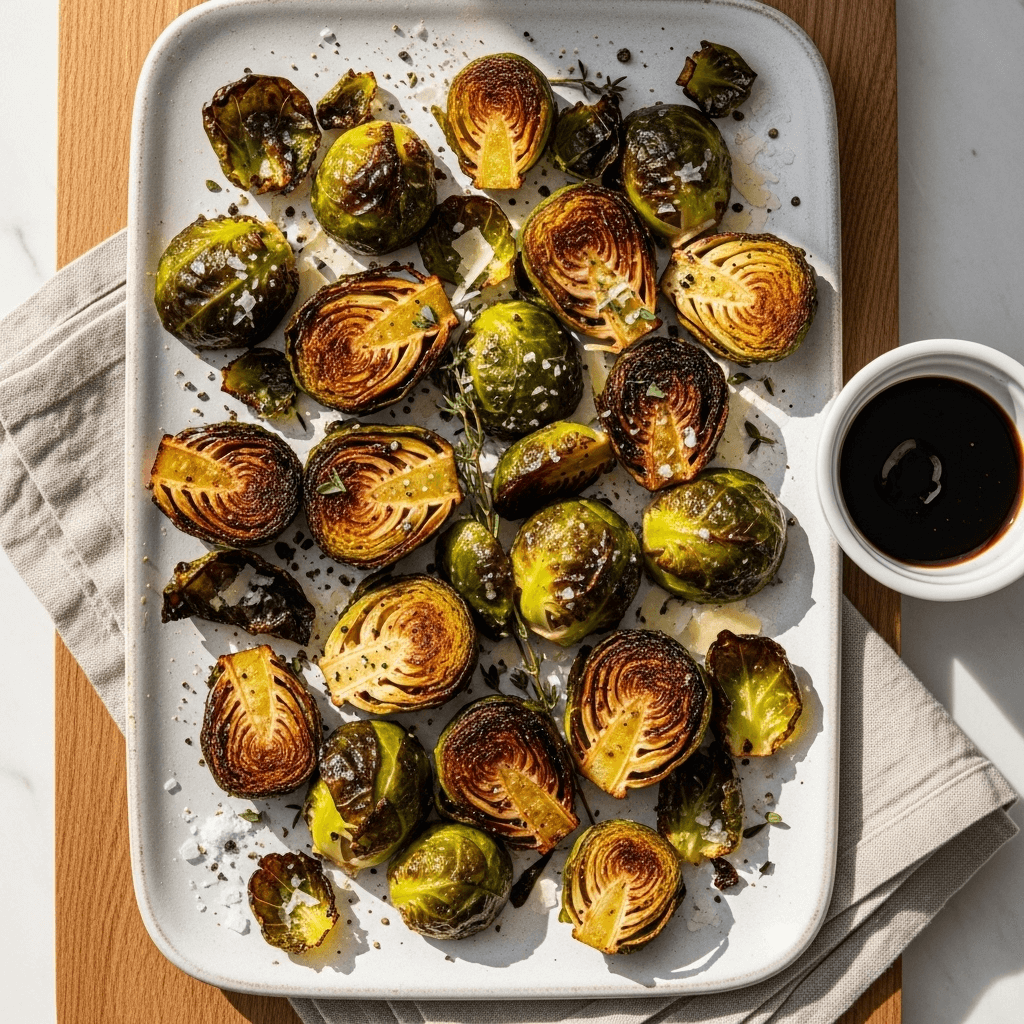

If you think you don’t like Brussels sprouts, you haven’t tried them roasted! These roasted Brussels sprouts are an absolute game-changer – crispy on the outside, tender on the inside, with beautifully caramelized edges that are slightly sweet and utterly addictive. This simple recipe transforms what many consider a boring vegetable into something so delicious that even the pickiest eaters come back for seconds.
The secret to perfect roasted Brussels sprouts lies in high heat and proper preparation. When roasted at the right temperature, Brussels sprouts develop crispy, almost chip-like outer leaves while the interior becomes tender and sweet. The natural sugars caramelize during roasting, creating deep, complex flavors with a hint of nuttiness that’s worlds away from the mushy, bitter Brussels sprouts you might remember from childhood.
This roasted Brussels sprouts recipe is incredibly versatile and works beautifully for so many occasions. Serve them as a healthy side dish for weeknight dinners alongside roasted chicken or grilled steak. They’re elegant enough for holiday meals like Thanksgiving and Christmas, impressive at dinner parties, and perfect for meal prep since they reheat wonderfully. They’re also fantastic tossed into salads, grain bowls, or pasta dishes.
What makes this recipe truly special is its simplicity. With just Brussels sprouts, olive oil, salt, and pepper, you can create something extraordinary. The minimal ingredient list means the natural flavor of the Brussels sprouts really shines through, enhanced by the caramelization from roasting. You can easily customize with garlic, parmesan, bacon, or balsamic glaze, but they’re absolutely perfect in their simplest form.
History / Background
Brussels sprouts have a fascinating history that dates back to ancient Rome, though they weren’t called Brussels sprouts at that time. The vegetables we recognize today as Brussels sprouts were cultivated and popularized in Belgium, specifically around Brussels (hence the name), during the 16th century. Belgian farmers developed these miniature cabbage-like vegetables through careful cultivation and selective breeding.
The vegetable gained popularity throughout Europe during the 18th and 19th centuries, particularly in France and England. Thomas Jefferson, known for his passion for gardening and introducing European vegetables to America, is credited with bringing Brussels sprouts to the United States in the late 1700s. However, they didn’t become widely popular in America until after World War I, when returning soldiers had developed a taste for European vegetables.
For much of the 20th century, Brussels sprouts had a terrible reputation, especially among children. This was largely due to how they were prepared – typically boiled or steamed until mushy, which brought out their bitter sulfurous compounds while destroying their natural sweetness and texture. The overcooked Brussels sprouts served in school cafeterias and at family dinners became the stuff of childhood nightmares, leading generations to believe they simply didn’t like this vegetable.
The Brussels sprouts renaissance began in the early 2000s when chefs started experimenting with different cooking methods, particularly roasting and pan-frying. Restaurants began serving Brussels sprouts that were crispy, caramelized, and delicious – often topped with bacon, parmesan, or drizzled with balsamic reduction. These restaurant preparations revealed what Brussels sprouts could be when cooked properly, and home cooks quickly followed suit.
Today, Brussels sprouts have undergone a complete image transformation. They’ve become trendy, appearing on restaurant menus everywhere from casual bistros to fine dining establishments. Sales have increased dramatically over the past two decades as people discovered that properly cooked Brussels sprouts are actually delicious. Modern agricultural techniques have also developed sweeter, less bitter varieties, making them more appealing to contemporary palates.
The roasting method specifically has become the gold standard for Brussels sprouts preparation. High-heat roasting caramelizes the natural sugars, creates crispy texture, and develops complex, nutty flavors that make Brussels sprouts not just tolerable, but genuinely crave-worthy. This cooking method has single-handedly changed millions of minds about this once-maligned vegetable.
Why You’ll Love This Recipe
This roasted Brussels sprouts recipe has been perfected to deliver the absolute best texture and flavor every single time. The key is achieving that perfect balance: crispy, almost charred outer leaves that provide satisfying crunch, tender interiors that are sweet and nutty, and beautifully caramelized edges that add depth and complexity. This isn’t your grandmother’s mushy, bitter Brussels sprouts – these are crispy, golden, and genuinely delicious.
What sets this recipe apart is the technique. By cutting the Brussels sprouts in half, tossing them generously with olive oil, and roasting at high heat, you create maximum surface area for caramelization. The cut sides face down on the baking sheet, developing a gorgeous golden-brown crust. The outer leaves get wonderfully crispy (almost like chips!), while the inside stays tender and sweet.
Here’s why these roasted Brussels sprouts will become your new favorite side dish:
- Incredibly simple – just 4 basic ingredients and 30 minutes total time
- Healthy and nutritious – packed with vitamins, fiber, and antioxidants
- Low-carb and keto-friendly – naturally fits into various dietary lifestyles
- Budget-friendly – Brussels sprouts are affordable and available year-round
- Foolproof technique – hard to mess up once you know the basics
- Naturally vegan and vegetarian – suitable for plant-based diets
- Converts Brussels sprouts haters – even skeptics love these crispy, caramelized sprouts
- Versatile and customizable – works with countless flavor variations
- Perfect for meal prep – stays delicious for days and reheats beautifully
- Elegant yet easy – impressive enough for holidays but simple enough for weeknights
- Crispy texture – satisfying crunch that’s completely addictive
- No special equipment needed – just a baking sheet and your oven
Ingredient Notes
The beauty of roasted Brussels sprouts is the minimal ingredient list. Here’s what you need:
Brussels Sprouts: Fresh Brussels sprouts are essential for the best results. Look for firm, compact sprouts with bright green color and tightly packed leaves. Small to medium sprouts (about 1 to 1.5 inches in diameter) work best as they cook more evenly and develop better texture. Avoid any with yellowing leaves, soft spots, or an unpleasant odor. You’ll need about 1.5 to 2 pounds for 4-6 servings. While frozen Brussels sprouts can technically be used, they contain more moisture and won’t achieve the same crispy texture, so fresh is strongly recommended.
Extra Virgin Olive Oil: Good quality olive oil is worth the investment here. The oil facilitates caramelization, helps achieve crispy texture, and adds its own subtle flavor. You need enough oil to coat the Brussels sprouts generously – skimping on oil results in dry, unevenly roasted vegetables. Extra virgin olive oil provides the best flavor, but regular olive oil or avocado oil work well too. Avocado oil has a higher smoke point, making it ideal for very high-heat roasting.
Salt: Essential for drawing out moisture and enhancing natural sweetness. Kosher salt or sea salt are preferred over table salt for their clean flavor and better texture. Salt generously – Brussels sprouts can handle it and need proper seasoning to taste their best. You can always add more after roasting if needed, but underseasoned Brussels sprouts taste bland.
Black Pepper: Freshly ground black pepper adds subtle heat and aromatic complexity. The amount is flexible based on preference, but don’t skip it entirely – it provides important flavor dimension. Pre-ground pepper works in a pinch, but freshly cracked has significantly better flavor.
Optional Flavor Enhancers:
- Fresh garlic cloves (whole or minced) for aromatic depth
- Grated Parmesan cheese for salty, umami richness
- Balsamic vinegar or glaze for tangy-sweet contrast
- Lemon juice and zest for brightness
- Red pepper flakes for heat
- Fresh herbs like thyme or rosemary
- Crispy bacon bits for smoky, savory notes
- Honey or maple syrup for extra caramelization
Equipment Needed
You’ll need minimal equipment for this simple recipe:
- Large rimmed baking sheet – preferably half-sheet size (18×13 inches) for proper air circulation
- Sharp knife – for trimming and halving Brussels sprouts
- Cutting board – for prep work
- Large mixing bowl – for tossing Brussels sprouts with oil and seasonings
- Measuring spoons – for oil and seasonings
- Spatula or tongs – for flipping Brussels sprouts halfway through roasting
Optional but helpful:
- Parchment paper or aluminum foil for easier cleanup
- Kitchen scale for precise measurement of Brussels sprouts
- Small bowl for mixing optional glaze or toppings
Avoid using:
- Glass baking dishes (they don’t conduct heat as well as metal)
- Crowded baking sheets (this creates steam instead of roasting)
Roasted Brussels Sprouts Recipe
- Total Time: 35 minutes
- Yield: 4-6 servings 1x
- Diet: Vegetarian
Description
These perfectly roasted Brussels sprouts are crispy on the outside, tender on the inside, with beautifully caramelized edges. Made with just four simple ingredients and roasted to golden perfection, they’re a healthy, delicious side dish that converts even Brussels sprouts skeptics.
Ingredients
- 1.5 to 2 pounds fresh Brussels sprouts
- 3 tablespoons extra virgin olive oil
- ¾ teaspoon kosher salt (or ½ teaspoon table salt)
- ¼ teaspoon freshly ground black pepper
- Optional: 3-4 whole garlic cloves, unpeeled
- Optional: 2 tablespoons grated Parmesan cheese (for serving)
- Optional: 1 tablespoon balsamic glaze (for drizzling)
Instructions
Step 1: Preheat Oven
Preheat your oven to 425°F (220°C). Position the rack in the center of the oven for even heat distribution. This high temperature is crucial for achieving crispy, caramelized Brussels sprouts.
Step 2: Prepare Brussels Sprouts
Rinse the Brussels sprouts under cold water and pat them completely dry with a clean kitchen towel or paper towels. Moisture is the enemy of crispiness, so make sure they’re thoroughly dry. Trim off the stem ends (about ¼ inch), and remove any yellowed or damaged outer leaves. Cut each Brussels sprout in half lengthwise from top to bottom. If you have any very large sprouts (over 2 inches), cut them into quarters so all pieces are roughly the same size for even cooking.
Step 3: Season Brussels Sprouts
Place the halved Brussels sprouts in a large mixing bowl. Drizzle with the olive oil, making sure to use all of it. Sprinkle with salt and black pepper. Using your hands or a large spoon, toss everything together thoroughly until every Brussels sprout is evenly coated with oil and seasoning. Don’t be shy with the oil – properly coated Brussels sprouts roast better and develop superior texture.
Step 4: Arrange on Baking Sheet
Spread the Brussels sprouts in a single layer on a large rimmed baking sheet, arranging them cut-side down. This is important! The flat cut side against the hot pan creates maximum caramelization and crispiness. Make sure the Brussels sprouts aren’t crowded – they should have space between them. If they’re touching too much, use two baking sheets. Overcrowding causes steaming instead of roasting. If adding whole garlic cloves, nestle them among the Brussels sprouts.
Step 5: Roast
Place the baking sheet in the preheated oven and roast for 20-25 minutes. After about 12-15 minutes, remove the pan from the oven and use a spatula to flip the Brussels sprouts, checking the bottoms first – they should be deep golden brown and caramelized. If they’re not browned yet, return to the oven without flipping and check again in 3-5 minutes. Once properly caramelized on one side, flip them over and return to the oven.
Step 6: Check for Doneness
The Brussels sprouts are done when they’re tender when pierced with a fork, golden brown with some charred edges, and the outer leaves are crispy. Total cooking time is usually 20-25 minutes, but this varies based on size and your oven. The outer leaves should look almost burnt – this is perfect! They’ll be crispy and delicious.
Step 7: Season and Serve
Remove from the oven and taste one Brussels sprout. If needed, add more salt and pepper while they’re hot. If using Parmesan cheese, sprinkle it over the hot Brussels sprouts immediately so it melts slightly. Drizzle with balsamic glaze if desired. Transfer to a serving dish and serve immediately for maximum crispiness.
Notes
- Size matters: Choose Brussels sprouts that are roughly the same size so they cook evenly. If some are much larger, quarter them.
- Don’t skip drying: Wet Brussels sprouts won’t crisp up properly. Pat them completely dry after washing.
- Cut-side down is crucial: Always place the flat cut side against the baking sheet for maximum caramelization.
- High heat is essential: Don’t reduce the temperature thinking it will prevent burning. High heat (425°F) is what creates crispy texture and caramelization.
- Charred leaves are good: Those dark, crispy outer leaves are the best part! They’re not burnt – they’re perfectly caramelized.
- Adjust roasting time: Smaller Brussels sprouts need less time (18-20 minutes), while larger ones may need up to 30 minutes.
- Fresh is best: Frozen Brussels sprouts contain too much moisture and won’t achieve the same crispy texture.
- Prep Time: 10 minutes
- Cook Time: 25 minutes
- Category: Vegetable
- Method: Roasting
- Cuisine: American
Nutrition
- Serving Size: About 1 cup (approximately)
- Calories: 95
- Sugar: 2g
- Sodium: 245mg
- Fat: 7g
- Saturated Fat: 1g
- Unsaturated Fat: 6g
- Trans Fat: 0g
- Carbohydrates: 9g
- Fiber: 4g
- Protein: 3g
- Cholesterol: 0mg
Tips & Variations
Garlic Parmesan Brussels Sprouts:
Add 3-4 minced garlic cloves to the Brussels sprouts before roasting, or toss whole unpeeled cloves in with the sprouts (they’ll become sweet and caramelized). After roasting, immediately toss with ½ cup freshly grated Parmesan cheese. The residual heat will melt the cheese slightly, creating an irresistible coating. Add a squeeze of fresh lemon juice for brightness.
Balsamic Glazed Brussels Sprouts:
After roasting, drizzle with 2-3 tablespoons of balsamic glaze (reduced balsamic vinegar) or toss with 1 tablespoon of good quality balsamic vinegar. The tangy-sweet flavor complements the caramelized Brussels sprouts beautifully. You can also add a drizzle of honey for extra sweetness.
Bacon Brussels Sprouts:
Cook 4-6 strips of bacon until crispy, crumble, and toss with the roasted Brussels sprouts. For even more flavor, use 1 tablespoon of the bacon fat in place of some of the olive oil when tossing the raw Brussels sprouts. This creates smoky, savory richness that’s absolutely delicious.
Asian-Inspired Brussels Sprouts:
After roasting, toss with 1 tablespoon sesame oil, 1 tablespoon soy sauce or tamari, and 1 teaspoon rice vinegar. Sprinkle with sesame seeds and sliced green onions. Add a pinch of red pepper flakes for heat. This gives the Brussels sprouts an umami-rich, Asian-fusion flavor profile.
Maple Dijon Brussels Sprouts:
Whisk together 2 tablespoons maple syrup, 1 tablespoon Dijon mustard, and 1 tablespoon olive oil. Drizzle over the Brussels sprouts during the last 5 minutes of roasting. The maple adds sweetness while the mustard provides tangy complexity. This combination is especially popular for holiday meals.
Lemon Herb Brussels Sprouts:
Toss roasted Brussels sprouts with fresh lemon zest, 2 tablespoons lemon juice, and 2 tablespoons chopped fresh herbs (parsley, thyme, or rosemary). The bright citrus cuts through the richness and adds freshness. Finish with extra olive oil for a light, Mediterranean-inspired dish.
Spicy Brussels Sprouts:
Add ½ teaspoon red pepper flakes before roasting, or toss finished Brussels sprouts with sriracha, chili oil, or your favorite hot sauce. For extra heat, add sliced fresh jalapeños during roasting. The spice complements the natural sweetness beautifully.
Brussels Sprouts with Nuts:
Toss roasted Brussels sprouts with ⅓ cup toasted pecans, walnuts, or almonds. The nuts add crunch and richness. Dried cranberries or pomegranate seeds make a beautiful, festive addition for holiday meals.
Pro Chef Tips
Tip #1: Size Uniformity is Critical
The secret to evenly cooked Brussels sprouts is ensuring all pieces are roughly the same size. Small sprouts can be halved, while larger ones should be quartered. When pieces vary dramatically in size, small ones overcook and burn while large ones remain undercooked. Take the extra minute to sort your Brussels sprouts by size and cut accordingly – it makes a huge difference in the final result.
Tip #2: Dry Them Thoroughly
This cannot be overstated – moisture prevents crisping. After washing your Brussels sprouts, use a clean kitchen towel or several layers of paper towels to dry them completely. Even better, wash and dry them an hour before cooking and let them air-dry on the counter. Surface moisture creates steam during roasting, which results in soft, soggy Brussels sprouts instead of crispy, caramelized ones. Think of it like getting crispy skin on chicken – dry surface is essential.
Tip #3: Don’t Crowd the Pan
Brussels sprouts need space to roast properly. When crowded on the baking sheet, they release moisture that has nowhere to evaporate, creating steam that makes them soft instead of crispy. Each Brussels sprout should have a little breathing room around it. If your baking sheet looks packed, divide the Brussels sprouts between two pans. The difference in texture is dramatic.
Tip #4: The Cut Side Down Rule
Always place Brussels sprouts cut-side down on the baking sheet. The flat surface in direct contact with the hot pan develops maximum caramelization – that gorgeous golden-brown crust that makes roasted Brussels sprouts so addictive. This creates the Maillard reaction, where sugars and proteins brown and develop complex, savory flavors. Placing them cut-side up means you miss out on this crucial flavor development.
Tip #5: Embrace the Char
Those dark, almost-burnt outer leaves that look slightly crispy and charred? They’re not mistakes – they’re the best part! Don’t panic when you see dark edges; that’s exactly what you want. These crispy leaves add incredible texture and concentrated flavor. If your Brussels sprouts aren’t getting any charred edges, your oven isn’t hot enough or you’re not roasting them long enough.
Tip #6: Taste and Adjust Seasoning at the End
Brussels sprouts can handle quite a bit of salt, but different brands and types of salt vary in saltiness. Always taste a Brussels sprout right after roasting and adjust seasoning while they’re still hot. Hot vegetables absorb seasoning better than cold ones. If they taste flat or bland, they need more salt. A squeeze of lemon juice can also brighten the flavors if they seem heavy.
Common Mistakes to Avoid
Mistake #1: Roasting at Too Low a Temperature
The most common mistake is roasting Brussels sprouts at 350°F or 375°F, thinking it will cook them more gently. Low temperatures result in soft, steamed Brussels sprouts that never develop crispy texture or caramelization. You need high heat (425°F or even 450°F) to drive off moisture quickly and create that golden-brown crust. Don’t be afraid of the high temperature – Brussels sprouts need it to transform from ordinary to extraordinary.
Mistake #2: Not Using Enough Oil
Some cooks try to minimize oil for health reasons, using just a light spray or drizzle. Unfortunately, this results in dry, unevenly cooked Brussels sprouts that don’t caramelize properly. Oil is essential for achieving crispy texture, promoting even browning, and preventing sticking. You need about 3 tablespoons for 1.5-2 pounds of Brussels sprouts. Yes, it seems like a lot, but it’s distributed across many servings and is necessary for proper roasting.
Mistake #3: Overcrowding the Baking Sheet
When Brussels sprouts touch each other too much on the pan, they steam instead of roast. The moisture they release has nowhere to go, so it creates a humid environment that makes them soft and soggy. Give each Brussels sprout some personal space. If they don’t fit comfortably on one sheet with room between them, use two sheets. You can rotate the pans halfway through for even cooking.
Mistake #4: Not Flipping or Checking Progress
Some cooks put Brussels sprouts in the oven and forget about them until the timer goes off. This often results in burnt bottoms and undercooked tops, or missing the perfect moment of doneness. Check your Brussels sprouts after 12-15 minutes to see how the caramelization is progressing. Flip them once the bottom side is deeply golden brown. Keep an eye on them during the last few minutes as they can go from perfect to burnt quickly.
Mistake #5: Cutting Off Too Much Stem
While you need to trim the stem end, cutting off too much causes the Brussels sprouts to fall apart into individual leaves during roasting. Trim just the very end (about ¼ inch) where it’s dried out or discolored. The stem holds the leaves together and helps them maintain their shape. If Brussels sprouts are falling apart as you cut them, you’re trimming too much stem.
Storage & Meal Prep
Refrigerator Storage:
Store leftover roasted Brussels sprouts in an airtight container in the refrigerator for up to 4 days. They’ll lose some of their crispiness during storage (this is normal for roasted vegetables), but they remain delicious. The flavors actually develop further as they sit, becoming even more savory and sweet.
Reheating Instructions:
To restore crispiness, reheat Brussels sprouts in a 400°F oven for 5-8 minutes, spread on a baking sheet. This revives the crispy texture better than microwaving. For a quicker option, reheat in an air fryer at 375°F for 3-4 minutes. You can also reheat in a skillet over medium-high heat with a tiny bit of olive oil, stirring occasionally until warmed through and crisped up. Avoid microwaving if possible, as it makes them soggy.
Meal Prep Strategy:
Roasted Brussels sprouts are excellent for meal prep. Roast a large batch on Sunday and use them throughout the week in various ways: as a side dish for dinners, tossed into grain bowls, mixed into salads, added to pasta dishes, or even eaten cold as a snack. Divide into individual meal prep containers for grab-and-go convenience.
Cold Brussels Sprouts:
Don’t hesitate to eat leftover roasted Brussels sprouts cold! They’re delicious straight from the fridge, tossed into salads, or added to wraps and sandwiches. The texture changes but they remain flavorful and satisfying.
Prep-Ahead Option:
You can trim, halve, and dry the Brussels sprouts up to 24 hours in advance. Store them in an airtight container in the refrigerator until ready to roast. However, don’t toss them with oil and seasonings until just before roasting, or they’ll release moisture and become soggy.
Make-Ahead & Freezer Notes
Advance Preparation:
Brussels sprouts are best roasted fresh, but you can prepare them in stages to save time. Wash, trim, halve, and completely dry the Brussels sprouts up to 24 hours ahead. Store in an airtight container in the refrigerator. When ready to cook, bring them to room temperature (10-15 minutes on the counter), then toss with oil, season, and roast as directed.
Partial Roasting Method:
For entertaining, you can partially roast Brussels sprouts ahead of time. Roast for 15 minutes (instead of the full 20-25), let cool completely, and refrigerate for up to 24 hours. When ready to serve, finish roasting at 425°F for 8-10 minutes until crispy and heated through. This allows you to serve hot, crispy Brussels sprouts without last-minute stress.
Freezing Raw Brussels Sprouts:
Fresh Brussels sprouts can be frozen after trimming and halving. Blanch them in boiling water for 3 minutes, immediately transfer to ice water to stop cooking, drain thoroughly, and pat completely dry. Freeze in a single layer on a baking sheet, then transfer to freezer bags. They’ll keep for up to 3 months. Roast from frozen, adding 5-10 minutes to the cooking time. However, texture won’t be quite as good as fresh.
Freezing Cooked Brussels Sprouts:
While possible, freezing fully cooked roasted Brussels sprouts isn’t ideal as they lose their crispy texture. If you must freeze them, cool completely, freeze in airtight containers for up to 2 months, and reheat in a hot oven to crisp up. They work better mixed into casseroles or soups after freezing rather than served as a standalone side dish.
Best Make-Ahead Strategy:
For the absolute best results, roast Brussels sprouts fresh. They only take 35 minutes total (including prep), so it’s usually manageable even for busy weeknights or when entertaining. If you need to save time, prep them ahead but roast just before serving for maximum crispiness and best flavor.
Serving Suggestions
Roasted Brussels sprouts are incredibly versatile and pair beautifully with countless main dishes:
Protein Pairings:
- Roasted chicken – classic combination, especially with garlic roasted chicken
- Grilled or pan-seared steak – the crispy Brussels sprouts complement rich beef perfectly
- Pork chops or pork tenderloin – wonderful with maple-glazed or herb-crusted pork
- Baked salmon or other fish – provides textural contrast to flaky fish
- Roasted turkey – essential for Thanksgiving and holiday dinners
- Lamb chops – elegant pairing for special dinners
Complete Meal Ideas:
Roasted Brussels sprouts work beautifully as part of a complete dinner plate:
- Serve alongside roasted chicken, mashed potatoes, and gravy
- Pair with grilled steak, baked sweet potato, and a simple salad
- Include in a vegetarian dinner with quinoa, roasted chickpeas, and tahini sauce
- Add to a holiday spread with turkey, stuffing, and cranberry sauce
Bowl and Salad Additions:
- Toss into grain bowls with quinoa or farro, roasted chicken, and tahini dressing
- Add to winter salads with mixed greens, dried cranberries, pecans, and goat cheese
- Mix into warm salads with bacon, apples, and cider vinaigrette
- Include in Buddha bowls with brown rice, avocado, and your favorite protein
Pasta Dishes:
Roasted Brussels sprouts add wonderful texture and flavor to pasta:
- Toss with pasta, olive oil, garlic, and Parmesan
- Mix into carbonara for added vegetables
- Combine with brown butter, sage, and caramelized onions over penne
- Add to creamy pasta dishes for textural contrast
Holiday Menus:
Roasted Brussels sprouts are a holiday table staple:
- Thanksgiving: Alongside turkey, stuffing, mashed potatoes, and green bean casserole
- Christmas dinner: With prime rib, Yorkshire pudding, and roasted root vegetables
- Easter: Accompanying ham, scalloped potatoes, and spring vegetables
Beverage Pairings:
- Medium-bodied red wine like Pinot Noir or Merlot
- Crisp white wine like Sauvignon Blanc
- Belgian-style ale or wheat beer
- Sparkling apple cider for non-alcoholic option
FAQs Section
Q: Why are my Brussels sprouts bitter?
Bitterness in Brussels sprouts usually comes from overcooking (especially boiling) or using old, yellowed sprouts. Fresh Brussels sprouts roasted properly are naturally sweet with just a hint of pleasant bitterness. To minimize bitterness: choose fresh, bright green sprouts; roast at high heat to caramelize their natural sugars; remove any yellowed outer leaves; and don’t overcook. A drizzle of balsamic glaze or squeeze of lemon juice after roasting can also balance any residual bitterness.
Q: Can I roast Brussels sprouts at a lower temperature?
While technically possible, roasting at lower temperatures (under 400°F) won’t achieve the same crispy, caramelized results. Low heat causes Brussels sprouts to steam in their own moisture rather than developing that golden-brown crust and crispy texture. You’ll end up with soft, tender Brussels sprouts that lack the complex flavors created by high-heat caramelization. Stick with 425°F or even 450°F for best results.
Q: Should I use frozen or fresh Brussels sprouts?
Always use fresh Brussels sprouts for roasting. Frozen Brussels sprouts contain significantly more moisture and often come already halved or quartered, making them too small. The excess moisture prevents proper crisping and caramelization. Fresh Brussels sprouts are essential for achieving that perfect crispy-outside, tender-inside texture. Save frozen Brussels sprouts for soups or casseroles where texture is less critical.
Q: How do I know when Brussels sprouts are done?
Perfectly roasted Brussels sprouts should be tender when pierced with a fork, deep golden brown on the cut side, and have crispy, charred outer leaves. Total cooking time is usually 20-25 minutes at 425°F. The outer leaves should look almost burnt – this is perfect! If they’re still bright green all over, they need more time. If you can’t easily pierce them with a fork, continue roasting. Don’t be afraid of some charring – it’s delicious.
Q: Why do my Brussels sprouts fall apart when I cut them?
Brussels sprouts fall apart if you trim too much of the stem end. The stem holds all the leaves together. Trim only the very bottom (about ¼ inch) where it’s dried out or discolored. If you cut off too much stem, the leaves will separate during cooking. Also, very fresh Brussels sprouts with tight, compact leaves hold together better than older ones with loose leaves.
Q: Can I add other vegetables to the pan with Brussels sprouts?
Yes, but choose vegetables with similar cooking times and moisture content. Good options include: cauliflower florets, halved baby potatoes, carrot chunks, or cubed butternut squash. Avoid high-moisture vegetables like zucchini or tomatoes, as they release too much liquid and prevent crisping. Keep each vegetable type to about the same size for even cooking, and don’t overcrowd the pan.
Q: How can I make Brussels sprouts less gassy?
Brussels sprouts contain compounds that can cause digestive discomfort in some people. To minimize this: don’t overcook them (overcooked Brussels sprouts produce more sulfur compounds); remove any yellowed leaves; soak trimmed Brussels sprouts in cold water with a squeeze of lemon juice for 20 minutes before roasting; and pair them with digestive-friendly herbs like fennel or ginger. Building up tolerance by eating Brussels sprouts more regularly also helps.
Conclusion
There you have it – everything you need to create the most perfectly crispy, golden, caramelized roasted Brussels sprouts that will convert even the staunchest Brussels sprouts skeptics! This simple recipe proves that with proper technique and high heat, these mini cabbages transform into something genuinely delicious and even addictive.
The beauty of roasted Brussels sprouts lies in their versatility and simplicity. They work equally well for casual weeknight dinners and elegant holiday celebrations, they’re healthy enough for regular rotation yet indulgent-tasting enough to feel special, and they require minimal ingredients while delivering maximum flavor. Once you master the basic technique – high heat, generous oil, cut-side down, and don’t crowd the pan – you’ll find yourself making them again and again.
I hope these roasted Brussels sprouts become a staple in your kitchen just like they have in mine! They’ve converted countless Brussels sprouts haters in my family and friend circle, proving that it’s all about the preparation method. Those crispy, caramelized edges are absolutely irresistible, and the tender, sweet interior is nothing like the mushy Brussels sprouts of the past.
I’d love to hear about your experience making these! Did you try any of the variations? What did you serve them with? Leave a comment below and let me know how they turned out. If this recipe helped you fall in love with Brussels sprouts (or convinced your family to eat their veggies!), please give it a five-star rating. Don’t forget to save this recipe to your Pinterest boards so you can make them again and again. Share with friends who need a good vegetable side dish in their life! Happy roasting!