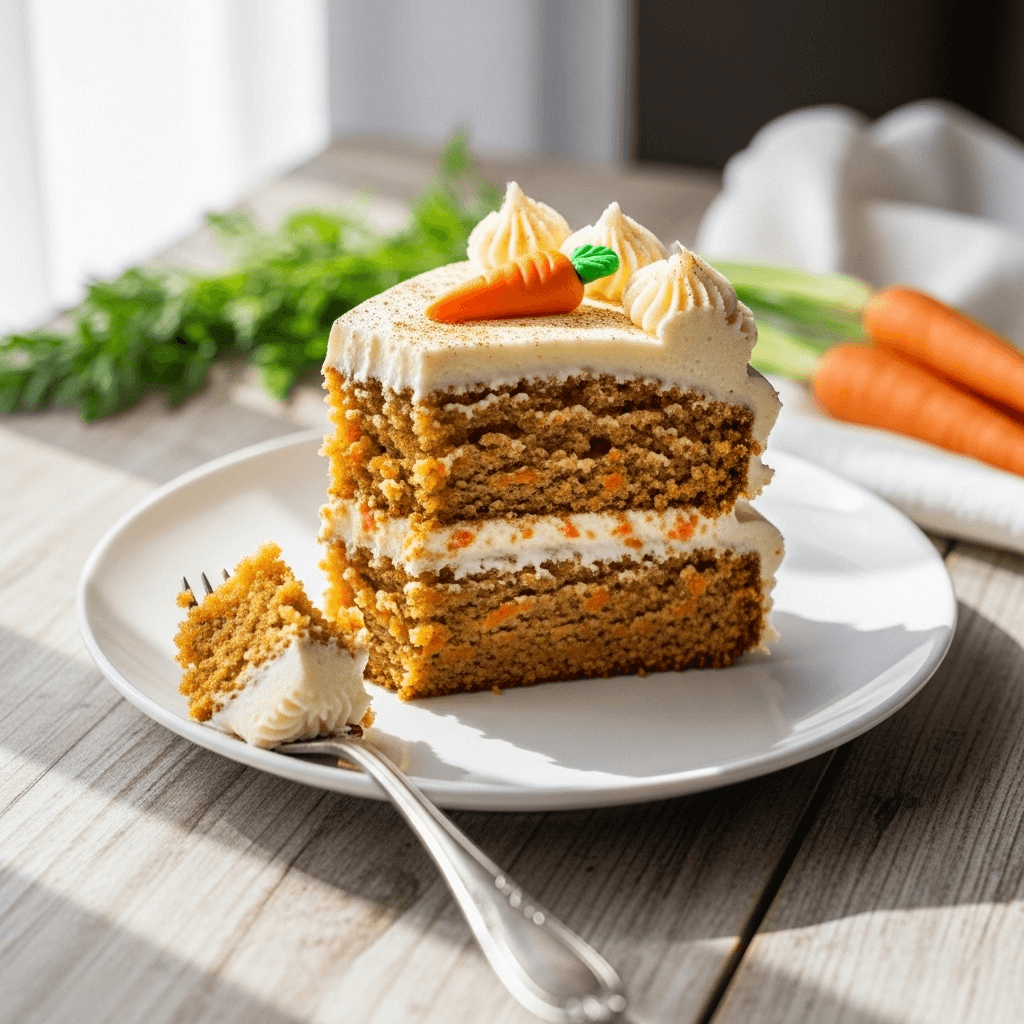

If there’s one cake that brings pure joy to any celebration, it’s a perfectly moist, spiced carrot cake topped with tangy cream cheese frosting. This isn’t just any carrot cake—it’s the ultimate version that’s incredibly moist, perfectly spiced, and packed with freshly grated carrots that keep it tender for days.
Carrot cake holds a special place in American baking culture, beloved for its unique combination of sweet and savory flavors, warming spices, and that irresistible cream cheese frosting that perfectly balances the cake’s sweetness. Whether you’re celebrating a birthday, Easter, spring gathering, or just craving something special for dessert, this homemade carrot cake delivers bakery-quality results every single time.
What makes this recipe truly special is its foolproof method that guarantees a moist, flavorful cake without being overly sweet or dense. The generous amount of freshly grated carrots keeps the cake incredibly tender, while cinnamon, nutmeg, and vanilla create layers of warm, cozy flavor. Perfect for holidays, potlucks, family dinners, or whenever you want to impress with a classic American dessert.
History / Background
Carrot cake has a surprisingly rich and fascinating history that spans several centuries. While it might seem like a modern health-conscious dessert, carrots have been used in sweet dishes since the Middle Ages. During medieval times in Europe, sweeteners were expensive and hard to come by, so naturally sweet vegetables like carrots and parsnips were often used in cakes and puddings.
The carrot cake we know and love today, however, has its roots in early 20th century America. During World War II, when sugar was strictly rationed, carrot cake experienced a major resurgence in both Britain and America. Home bakers rediscovered that carrots’ natural sweetness could reduce the amount of precious sugar needed in baking, making it a practical and patriotic choice during wartime.
But the real carrot cake revolution happened in the 1960s and 1970s in the United States. As the health food movement gained momentum, carrot cake became wildly popular because it seemed like a “healthier” dessert option—after all, it contained vegetables! Restaurants and bakeries across America began featuring carrot cake on their menus, and it quickly became a staple at celebrations and special occasions.
The addition of cream cheese frosting—now considered absolutely essential to carrot cake—became standard in American bakeries during this same period. This tangy, rich frosting perfectly complements the spiced sweetness of the cake, creating that iconic flavor combination we all crave today.
Interestingly, traditional European carrot cakes are often less sweet and don’t include frosting at all, while American carrot cake is known for its generous layers of cream cheese frosting, nuts, and sometimes pineapple or coconut. Today, carrot cake remains one of America’s most beloved desserts, especially popular for Easter celebrations and spring gatherings.
Why You’ll Love This Recipe
This carrot cake recipe is truly something special—it’s the result of testing and perfecting the ratios to create the moistest, most flavorful carrot cake you’ve ever tasted. Unlike dense, heavy carrot cakes or ones that dry out quickly, this version stays incredibly moist for days while maintaining a perfect, tender crumb.
Here’s why this recipe will become your go-to:
- Incredibly Moist – Stays fresh and tender for up to 5 days thanks to the generous amount of freshly grated carrots
- Perfectly Spiced – Balanced blend of cinnamon, nutmeg, and vanilla creates warm, complex flavor
- Not Too Sweet – The tangy cream cheese frosting balances the sweetness beautifully
- Foolproof Method – Easy-to-follow instructions ensure success every time, even for beginner bakers
- Impressive Presentation – Looks and tastes like it came from an expensive bakery
- Crowd-Pleaser – Loved by both kids and adults, perfect for any celebration
- Make-Ahead Friendly – Can be baked in advance and even freezes beautifully
- Customizable – Easy to add nuts, pineapple, coconut, or other mix-ins
- Room Temperature Stable – The frosting holds up well at room temperature for serving
- Healthier Than Most Cakes – Contains real vegetables, can be made with whole wheat flour
- Perfect Texture – Light and fluffy, never dense or gummy
- Versatile Serving Options – Great as a layer cake, sheet cake, or even cupcakes
Ingredient Notes
Understanding your ingredients is the key to baking success. Here’s what goes into this amazing carrot cake and why each component matters:
Carrots – The star ingredient! Use freshly grated carrots, not pre-shredded bags from the store. Fresh carrots release moisture as the cake bakes, keeping it incredibly tender. Pre-shredded carrots are drier and often coated with anti-caking agents that affect texture. You’ll need about 3-4 medium carrots to get 2 cups of grated carrots. Grate them finely using a box grater or food processor for the best texture.
All-Purpose Flour – Provides structure to the cake. You can substitute up to half with whole wheat flour for a heartier, slightly more nutritious version. For gluten-free carrot cake, use a 1:1 gluten-free baking flour blend.
Granulated Sugar – Sweetens the cake and helps create a tender crumb. The amount in this recipe is perfectly balanced—not too sweet. You can reduce it slightly if you prefer less sweetness, but don’t reduce by more than 1/4 cup or the texture will be affected.
Brown Sugar – Adds moisture, depth of flavor, and a subtle molasses note that complements the spices beautifully. Light or dark brown sugar both work, though dark brown sugar gives a richer flavor.
Vegetable Oil – The secret to this cake’s incredible moisture! Oil creates a more tender crumb than butter and keeps the cake moist for days. Use a neutral-flavored oil like canola, vegetable, or light olive oil. Avoid strongly flavored oils like coconut or extra virgin olive oil.
Eggs – Provide structure, richness, and help bind everything together. Room temperature eggs incorporate better into the batter. Large eggs are standard for this recipe.
Vanilla Extract – Pure vanilla extract adds warmth and enhances all the other flavors. Don’t skip this or use imitation vanilla—the real stuff makes a difference.
Cinnamon – The dominant spice in carrot cake. Use fresh ground cinnamon for the best flavor, as old cinnamon loses its potency.
Nutmeg – Adds complexity and warmth. Freshly grated nutmeg is far superior to pre-ground, but either works.
Baking Soda & Baking Powder – The leavening agents that make the cake rise and create a light, fluffy texture. You need both for the perfect lift and texture.
Salt – Enhances all the flavors and balances the sweetness. Don’t skip it!
Cream Cheese – For the frosting. Use full-fat brick-style cream cheese, not the spreadable kind in a tub. It must be softened to room temperature for smooth, lump-free frosting.
Butter – Adds richness to the cream cheese frosting. Use unsalted butter so you can control the salt level.
Powdered Sugar – Sweetens and thickens the frosting while creating that classic smooth texture. Also called confectioners’ sugar or icing sugar.
Optional Add-ins:
- Chopped Walnuts or Pecans – Adds crunch and nutty flavor (1 cup)
- Crushed Pineapple – Makes the cake even moister (1/2 cup, well-drained)
- Shredded Coconut – Adds tropical flavor and texture (1/2 cup)
- Raisins – Traditional addition for extra sweetness (1/2 cup)
Equipment Needed
You don’t need professional baking equipment to make this carrot cake, just a few standard kitchen tools:
- Two 9-inch round cake pans or one 9×13-inch pan – For a layer cake, use round pans; for a sheet cake, use the rectangular pan
- Parchment paper – To line the bottom of pans for easy release
- Box grater or food processor – For grating carrots (food processor is faster)
- Large mixing bowls (2) – One for dry ingredients, one for wet ingredients
- Whisk – For combining dry ingredients and beating eggs
- Rubber spatula – For folding and scraping down bowls
- Electric mixer (stand or hand) – For making the cream cheese frosting smooth and fluffy
- Measuring cups and spoons – For accurate measurements
- Sifter or fine-mesh strainer – For sifting powdered sugar into frosting (prevents lumps)
- Cooling racks – Essential for cooling cakes evenly
- Offset spatula or butter knife – For frosting the cake smoothly
- Toothpicks – For testing doneness
- Cake leveler or serrated knife – For trimming cake layers if needed
Pro tip: If you’re making a layer cake and want professional-looking results, a turntable (rotating cake stand) makes frosting much easier, though it’s not essential!
Print
Carrot Cake Recipe
- Total Time: 55 minutes (plus cooling and frosting time)
- Yield: 12 servings 1x
- Diet: Vegetarian
Description
This is the ultimate moist carrot cake recipe with the perfect blend of warm spices, freshly grated carrots, and tangy cream cheese frosting. The cake stays incredibly tender for days and tastes even better than bakery versions. Perfect for celebrations, holidays, or whenever you’re craving a classic American dessert.
Ingredients
For the Carrot Cake:
- 2 cups all-purpose flour
- 2 teaspoons baking powder
- 1 1/2 teaspoons baking soda
- 1 teaspoon salt
- 2 teaspoons ground cinnamon
- 1/2 teaspoon ground nutmeg
- 1/4 teaspoon ground ginger (optional)
- 1 cup granulated sugar
- 1 cup packed light brown sugar
- 1 cup vegetable oil
- 4 large eggs, at room temperature
- 2 teaspoons pure vanilla extract
- 3 cups freshly grated carrots (about 4 medium carrots)
- 1 cup chopped walnuts or pecans (optional)
- 1/2 cup crushed pineapple, drained (optional)
For the Cream Cheese Frosting:
- 16 ounces (2 blocks) cream cheese, softened to room temperature
- 1/2 cup (1 stick) unsalted butter, softened to room temperature
- 4 cups powdered sugar, sifted
- 2 teaspoons pure vanilla extract
- Pinch of salt
Instructions
- Preheat and prepare pans: Preheat your oven to 350°F (175°C). Grease two 9-inch round cake pans and line the bottoms with parchment paper circles. Grease the parchment paper as well. For a sheet cake, grease and line a 9×13-inch pan.
- Mix dry ingredients: In a large bowl, whisk together the flour, baking powder, baking soda, salt, cinnamon, nutmeg, and ginger (if using) until well combined. Set aside.
- Prepare wet ingredients: In another large bowl, whisk together the granulated sugar, brown sugar, and oil until well combined. Add the eggs one at a time, whisking well after each addition until the mixture is smooth and emulsified. Stir in the vanilla extract.
- Combine wet and dry: Pour the wet ingredients into the dry ingredients. Using a rubber spatula or wooden spoon, gently fold together until just combined. Don’t overmix—a few small lumps are fine. Overmixing develops gluten and makes the cake tough.
- Add carrots and mix-ins: Fold in the grated carrots until evenly distributed throughout the batter. If using nuts and/or pineapple, fold them in now. The batter will be thick but pourable.
- Divide and bake: Divide the batter evenly between the prepared pans (or pour into the sheet pan). Smooth the tops with a spatula. Bake for 30-35 minutes for layer cakes (40-45 minutes for a sheet cake), or until a toothpick inserted into the center comes out clean or with just a few moist crumbs. The tops should spring back when lightly pressed.
- Cool completely: Remove from oven and let the cakes cool in the pans for 10 minutes. Then turn them out onto wire racks, peel off the parchment paper, and let cool completely before frosting—at least 1-2 hours. This is crucial! Frosting warm cake will cause the frosting to melt and slide off.
- Make the cream cheese frosting: While the cakes cool, make the frosting. In a large bowl using an electric mixer (stand or hand), beat the softened cream cheese and butter together on medium speed for 2-3 minutes until completely smooth and fluffy with no lumps.
- Add powdered sugar: Reduce mixer speed to low and gradually add the sifted powdered sugar, about 1 cup at a time, beating well after each addition. Scrape down the sides of the bowl as needed.
- Finish frosting: Add the vanilla extract and pinch of salt. Increase speed to medium-high and beat for 2-3 minutes until the frosting is light, fluffy, and smooth. If the frosting is too thick, add 1 tablespoon of milk or cream. If it’s too thin, add more powdered sugar, 1/4 cup at a time.
- Assemble layer cake: Place one cake layer on a serving plate or cake stand. Spread about 1 cup of frosting evenly over the top. Place the second layer on top, pressing down gently. Spread a thin layer of frosting all over the cake (this is the crumb coat—it doesn’t need to be perfect). Refrigerate for 15-20 minutes to set the crumb coat.
- Final frosting: Remove from refrigerator and spread the remaining frosting generously over the top and sides of the cake, creating swirls and texture as desired. For a sheet cake, simply spread all the frosting evenly over the cooled cake.
- Decorate and serve: If desired, garnish with chopped walnuts, a sprinkle of cinnamon, or small marzipan carrots for decoration. Slice and serve! The cake can sit at room temperature for a few hours before serving.
Notes
- Room temperature ingredients: Make sure eggs, cream cheese, and butter are at room temperature for the best texture. Cold ingredients don’t incorporate properly.
- Don’t skip the parchment paper: This ensures your cakes release perfectly from the pans without sticking.
- Grate carrots finely: Fine shreds distribute better and create a more uniform texture than large shreds.
- Measure flour correctly: Spoon flour into measuring cups and level off—don’t scoop directly from the bag or you’ll pack in too much.
- Test for doneness: Ovens vary, so start checking at 30 minutes. The toothpick test is reliable—it should come out clean or with a few moist crumbs.
- Cool completely before frosting: This cannot be stressed enough! Warm cake will make your frosting melt and slide right off.
- Frosting consistency: The frosting should be spreadable but hold its shape. Adjust with powdered sugar or milk as needed.
- Prep Time: 20 minutes
- Cook Time: 35 minutes
- Category: Dessert
- Method: Baking
- Cuisine: American
Nutrition
- Serving Size: 1 slice (1/12 of cake with frosting)
- Calories: 645
- Sugar: 58g
- Sodium: 465mg
- Fat: 35g
- Saturated Fat: 12g
- Unsaturated Fat: 21g
- Trans Fat: 0g
- Carbohydrates: 78g
- Fiber: 2g
- Protein: 7g
- Cholesterol: 105mg
Tips & Variations
Make this carrot cake recipe your own with these creative twists and helpful tips:
Flavor Variations:
- Pineapple Carrot Cake – Add 1/2 cup well-drained crushed pineapple to the batter for extra moisture and tropical flavor
- Coconut Carrot Cake – Fold in 1/2 cup shredded sweetened coconut and top frosting with toasted coconut
- Spiced Carrot Cake – Add 1/4 teaspoon ground cardamom and 1/4 teaspoon ground cloves for deeper spice flavor
- Maple Cream Cheese Frosting – Replace 1/4 cup of powdered sugar with pure maple syrup
- Orange Carrot Cake – Add 1 tablespoon fresh orange zest to the batter and 1 teaspoon to the frosting
- Zucchini Carrot Cake – Replace 1 cup of grated carrots with grated zucchini (squeeze out excess moisture)
- Apple Carrot Cake – Add 1 cup finely chopped apple along with the carrots
Texture Add-Ins:
- Chopped walnuts or pecans (1 cup)
- Shredded coconut (1/2 cup)
- Raisins or golden raisins (1/2 cup)
- Chopped dates (1/2 cup)
- Mini chocolate chips (1/2 cup)
Format Variations:
- Carrot Cake Cupcakes – Divide batter among 24 lined cupcake tins and bake for 18-22 minutes
- Carrot Cake Loaf – Bake in two 9×5-inch loaf pans for 50-60 minutes
- Mini Bundts – Bake in greased mini bundt pans for 25-30 minutes
- Three-Layer Cake – Divide batter among three 8-inch pans and bake for 25-28 minutes
Healthier Modifications:
- Use half whole wheat flour for added fiber and nutrients
- Replace half the oil with unsweetened applesauce (cake will be slightly less moist)
- Reduce sugar by up to 1/4 cup in the cake
- Use Greek yogurt cream cheese frosting (mix in 1/2 cup Greek yogurt)
- Add ground flaxseed or chia seeds for extra nutrition
Frosting Alternatives:
- Maple cream cheese frosting
- Brown butter cream cheese frosting
- Whipped cream cheese frosting (lighter and fluffier)
- Cinnamon buttercream
- Salted caramel frosting
- Simple dusting of powdered sugar (no frosting)
Pro Chef Tips
Take your carrot cake from homemade to professional bakery quality with these expert techniques:
The Carrot Secret: Grate your carrots as finely as possible for the moistest, most tender cake. Large carrot shreds can create an unpleasant stringy texture. Use the smallest holes on your box grater or pulse in a food processor until finely grated but not pureed. Fresher carrots have more moisture and sweetness—avoid old, dried-out carrots.
Oil Temperature Matters: Make sure your oil is at room temperature, not cold from the pantry. Cold oil doesn’t emulsify properly with the eggs and sugar, which can lead to a denser cake. Similarly, room-temperature eggs incorporate much better than cold eggs straight from the fridge.
The Folding Technique: When combining wet and dry ingredients, use a gentle folding motion with a rubber spatula rather than stirring vigorously. Fold from the bottom of the bowl upward in a circular motion. This prevents overmixing, which develops gluten and creates a tough, dense cake. Stop as soon as you don’t see any more dry flour streaks.
Perfect Pan Preparation: For layer cakes that release perfectly every time, butter the pans generously, line with parchment paper, then butter the parchment. Dust with a light coating of flour and tap out the excess. This double insurance ensures your cakes will never stick.
Even Baking: For perfectly flat layers, use baking strips (or make DIY versions with wet paper towels wrapped in foil) around your pans. This slows down the exterior baking, preventing doming. Alternatively, slightly lower the oven temperature to 325°F and increase baking time by 5-8 minutes.
The Toothpick Test: Insert a toothpick into the center of the cake—it should come out with a few moist crumbs, not wet batter. If you wait until it’s completely clean, your cake will be slightly overbaked. The residual heat will finish cooking it as it cools.
Frosting Like a Pro: For the smoothest cream cheese frosting, ensure your cream cheese and butter are truly at room temperature (about 68-72°F). Beat them together for a full 2-3 minutes before adding any sugar—this creates a silky base with no lumps. When adding powdered sugar, sift it first to eliminate any lumps that will show in your finished frosting.
The Crumb Coat Technique: Always apply a thin “crumb coat” of frosting first, sealing in all the crumbs. Refrigerate for 15-20 minutes to firm it up, then apply the final, thicker layer of frosting. This professional technique ensures a pristine, crumb-free finish.
Flavor Development: Carrot cake actually tastes better the day after it’s made. The flavors meld and develop, and the moisture from the carrots distributes more evenly throughout the cake. If time allows, bake the cake layers a day ahead, wrap well in plastic wrap, and frost the next day.
Common Mistakes to Avoid
Don’t let these common carrot cake pitfalls ruin your baking success:
Using Pre-Shredded Carrots: Store-bought pre-shredded carrots are a tempting shortcut, but they’re too dry and often coated with preservatives and anti-caking agents that affect the cake’s moisture and texture. Always grate fresh carrots yourself—it only takes 5 extra minutes and makes a massive difference in the final result.
Overmixing the Batter: Once you add the wet ingredients to the dry ingredients, mix only until just combined. Overmixing develops gluten in the flour, resulting in a tough, dense, chewy cake instead of a tender, moist one. A few small lumps in the batter are completely fine and will bake out.
Frosting a Warm Cake: This is probably the most common mistake! If you try to frost your cake while it’s even slightly warm, the frosting will melt, slide off, and mix with crumbs, creating a messy disaster. Always let your cake cool completely—at minimum 1-2 hours on wire racks. Touch the bottom of the pan to ensure it’s completely cool.
Lumpy Cream Cheese Frosting: This happens when your cream cheese and butter aren’t at true room temperature (they should be soft enough to leave an indentation when pressed). Cold cream cheese will create lumps that are nearly impossible to beat out. Set your cream cheese and butter out 1-2 hours before making frosting, or use the microwave in 5-second bursts on very low power to soften (not melt!).
Overbaking: Carrot cake continues cooking from residual heat after you remove it from the oven, so slightly underbaking is better than overbaking. Start checking for doneness 5 minutes before the minimum baking time. The toothpick should have a few moist crumbs—not wet batter, but definitely not bone dry. Overbaked carrot cake is dry and crumbly.
Wrong Pan Size: Using pans that are too small causes the batter to overflow and bake unevenly. Too-large pans create thin, dry layers that overbake. Always use the exact pan size specified in the recipe, or adjust baking time accordingly (shallower cakes bake faster, deeper cakes take longer).
Skipping the Parchment Paper: Even in well-greased pans, carrot cake can stick stubbornly due to the moisture from the carrots. Always line the bottom of your pans with parchment paper for easy release every single time.
Storage & Meal Prep
Proper storage keeps your carrot cake fresh, moist, and delicious for days:
Room Temperature Storage: If you plan to serve the cake within 24 hours and your kitchen isn’t too warm, you can keep frosted carrot cake at room temperature under a cake dome or loosely tented with aluminum foil. Cream cheese frosting is stable at room temperature for several hours but shouldn’t sit out for extended periods in warm weather.
Refrigerator Storage: For longer storage, carrot cake should be refrigerated because of the cream cheese frosting. Store in an airtight container or cover tightly with plastic wrap to prevent the cake from drying out or absorbing refrigerator odors. Properly stored, carrot cake stays fresh in the refrigerator for 5-7 days. The cake actually stays incredibly moist in the fridge!
Bringing to Room Temperature: Cold cake straight from the fridge isn’t as flavorful. Remove slices about 30 minutes before serving to allow them to come to room temperature, which brings out all the flavors and creates a better texture. If you’re serving the whole cake, remove it from the fridge 1 hour before serving.
Unfrosted Cake Storage: If you’ve baked the cake layers but haven’t frosted them yet, let them cool completely, then wrap each layer individually in two layers of plastic wrap. These will keep at room temperature for 1 day or refrigerated for up to 3 days before frosting.
Frosting Storage: Extra cream cheese frosting can be stored in an airtight container in the refrigerator for up to 1 week. Bring to room temperature and re-whip before using to restore its fluffy texture.
Make-Ahead & Freezer Notes
Carrot cake is incredibly freezer-friendly, making it perfect for advance preparation:
Freezing Unfrosted Cake Layers: This is the best make-ahead method! Bake and completely cool the cake layers. Wrap each layer tightly in plastic wrap (two layers), then wrap in aluminum foil or place in a freezer-safe bag. Freeze for up to 3 months. To use, thaw layers overnight in the refrigerator while still wrapped (this prevents condensation from making them soggy), then bring to room temperature before frosting.
Freezing Frosted Cake: You can freeze a fully frosted cake, though the texture of the frosting may change slightly upon thawing. First, place the frosted cake in the freezer uncovered for 1-2 hours until the frosting is firm. Then wrap carefully in plastic wrap and aluminum foil. Freeze for up to 2 months. Thaw overnight in the refrigerator, still wrapped.
Freezing Individual Slices: Perfect for portion control! Cut the cake into individual slices, wrap each slice in plastic wrap, then place all wrapped slices in a freezer-safe bag or container. Freeze for up to 3 months. Thaw individual slices at room temperature for 1-2 hours or in the refrigerator overnight. This is perfect for having a slice of cake whenever you want without thawing the whole thing!
Make-Ahead Assembly: You can bake the cake layers up to 2 days in advance and keep them wrapped at room temperature (1 day) or refrigerated (2 days). Make the frosting up to 1 week in advance and refrigerate in an airtight container. Bring the frosting to room temperature and re-whip until fluffy before assembling and frosting the cake.
Thawing Tips: Always thaw frozen cake in the refrigerator rather than at room temperature to maintain food safety (because of the cream cheese frosting) and prevent condensation. Keep it wrapped during thawing to trap any moisture against the cake rather than letting it evaporate. Once thawed, the cake will taste just as fresh as the day it was baked!
Serving Suggestions
Turn your carrot cake into a complete dessert experience with these delicious pairings and presentation ideas:
Classic Accompaniments:
- Freshly brewed coffee or espresso (the slight bitterness balances the sweetness perfectly)
- Hot tea—chai, Earl Grey, or English breakfast pair beautifully
- Cold milk (especially loved by kids!)
- Vanilla ice cream or whipped cream alongside warm cake
- Fresh whipped cream as an alternative to cream cheese frosting
Elegant Plating for Special Occasions:
- Drizzle individual slices with salted caramel sauce
- Add a small scoop of cinnamon or vanilla ice cream
- Garnish with fresh berries (strawberries, raspberries, or blueberries)
- Dust with a sprinkle of cinnamon or edible flowers
- Top with candied pecans or walnuts
- Add a dollop of maple whipped cream
Holiday Serving Ideas:
- Easter: Decorate the top with small marzipan carrots, edible flowers, and pastel sprinkles
- Spring gatherings: Garnish with fresh flowers and serve on pretty floral plates
- Fall celebrations: Top with spiced pecans and a drizzle of maple glaze
- Winter holidays: Add a sprinkle of cinnamon and serve with warm apple cider
Beverage Pairings:
- Spiced chai latte
- Vanilla cream soda
- Hot apple cider
- Cinnamon dolce latte
- Sweet dessert wine like Moscato or late-harvest Riesling
- Irish coffee for adult gatherings
Create a Dessert Table: Serve your carrot cake as the centerpiece of a spring or Easter dessert spread alongside lemon bars, sugar cookies, and fresh fruit. The contrast of flavors and textures makes for an impressive display that guests will love.
Make It Interactive: For casual gatherings, set up a “build your own” carrot cake slice station with various toppings—extra frosting, chopped nuts, coconut flakes, caramel sauce, whipped cream, and fresh berries. Let guests customize their perfect slice!
FAQs Section
Why is my carrot cake dense and heavy?
Dense carrot cake usually results from overmixing the batter, using too much flour (pack down flour when measuring), or not using enough leavening agents. Make sure you’re measuring flour correctly—spoon it into the measuring cup and level off, don’t scoop directly from the bag. Mix the batter only until just combined after adding the dry ingredients. Also ensure your baking powder and baking soda are fresh (less than 6 months old) for proper leavening. Finally, make sure your oven is fully preheated to the correct temperature.
Can I make carrot cake without eggs?
Yes, you can make egg-free carrot cake using substitutes, though the texture will be slightly different. For each egg, you can use: 1/4 cup unsweetened applesauce, 1/4 cup mashed banana, or a “flax egg” (1 tablespoon ground flaxseed mixed with 3 tablespoons water, let sit 5 minutes). The applesauce substitute works best for carrot cake as it doesn’t add extra flavor. The cake may be slightly denser but will still be delicious and moist.
How do I know when my carrot cake is done baking?
There are several ways to test doneness. The most reliable is the toothpick test—insert a toothpick or cake tester into the center of the cake. It should come out with a few moist crumbs attached, not wet batter, but also not completely clean (which indicates overbaking). The cake should spring back when lightly pressed in the center, the edges should pull away slightly from the pan sides, and the top should be golden brown. If you have an instant-read thermometer, the internal temperature should read 205-210°F.
Why is my cream cheese frosting runny?
Runny cream cheese frosting happens for several reasons: the cream cheese or butter was too warm/soft when mixed, not enough powdered sugar was added, or it was overbeaten, which can cause it to break down. To fix runny frosting, refrigerate it for 20-30 minutes, then re-beat briefly. If it’s still too soft, gradually beat in more sifted powdered sugar, 1/4 cup at a time. For future batches, ensure cream cheese and butter are softened but still cool to the touch (not warm or greasy-looking), and don’t overbeat once all ingredients are added.
Can I use pre-shredded carrots from a bag?
While you technically can, it’s not recommended. Pre-shredded carrots are significantly drier than freshly grated carrots because they sit in the package for days or weeks, losing moisture. They’re also coated with preservatives and anti-caking agents that can affect the cake’s texture and moisture level. Fresh carrots release natural moisture as the cake bakes, which is what keeps it incredibly tender. Grating fresh carrots only takes 5 extra minutes and makes a dramatic difference in the final result. If you must use pre-shredded, add 2-3 tablespoons of extra oil to compensate for the dryness.
How long does carrot cake last?
When stored properly in the refrigerator in an airtight container or well-covered with plastic wrap, carrot cake stays fresh for 5-7 days. In fact, many people think carrot cake tastes even better on day 2 or 3 because the flavors have time to meld and develop. The cake actually gets more moist over time because the moisture from the carrots continues to distribute throughout. At room temperature, frosted carrot cake should be eaten within 24 hours because of the cream cheese frosting. Frozen carrot cake (properly wrapped) can last up to 3 months.
Can I make this recipe as cupcakes instead of a layer cake?
Absolutely! This recipe makes approximately 24 standard cupcakes. Line two muffin tins with cupcake liners and fill each liner about 2/3 full with batter. Bake at 350°F for 18-22 minutes, or until a toothpick inserted in the center comes out with just a few moist crumbs. Let cupcakes cool in the pan for 5 minutes, then transfer to a wire rack to cool completely before frosting. You can pipe the cream cheese frosting on with a pastry bag for a beautiful bakery-style look, or simply spread it on with a knife.
Conclusion
And there you have it—everything you need to create the most incredible, moist carrot cake with luscious cream cheese frosting! This recipe has been tested and perfected to deliver bakery-quality results in your own kitchen, whether you’re an experienced baker or just starting out.
The beauty of this carrot cake is that it’s just as perfect for a casual family dinner as it is for special celebrations. The warm spices, tender crumb, and that iconic cream cheese frosting create a flavor combination that never goes out of style. Plus, knowing you can make it ahead and even freeze it means you can always have this impressive dessert ready whenever the craving strikes or an occasion arises.
I hope you love this carrot cake recipe as much as my family and I do! It’s been a staple in our home for years, and I’m so excited to share it with you. The best part? It gets better with each passing day, so don’t hesitate to make it in advance.
Now it’s your turn! Get in the kitchen, grate those carrots, and create some carrot cake magic. When you do, I’d absolutely love to hear how it turned out! Leave a comment below sharing your experience, any variations you tried, or what occasion you made it for.
Don’t forget to pin this recipe to your favorite Pinterest dessert board so you’ll have it saved for the next time you need an impressive, crowd-pleasing cake! Share it with your baking friends who would love a foolproof carrot cake recipe. And if you make it, snap a photo and tag me on social media—nothing makes me happier than seeing your beautiful baking creations!
Happy baking, and may your carrot cake be forever moist and delicious! 🥕🍰✨