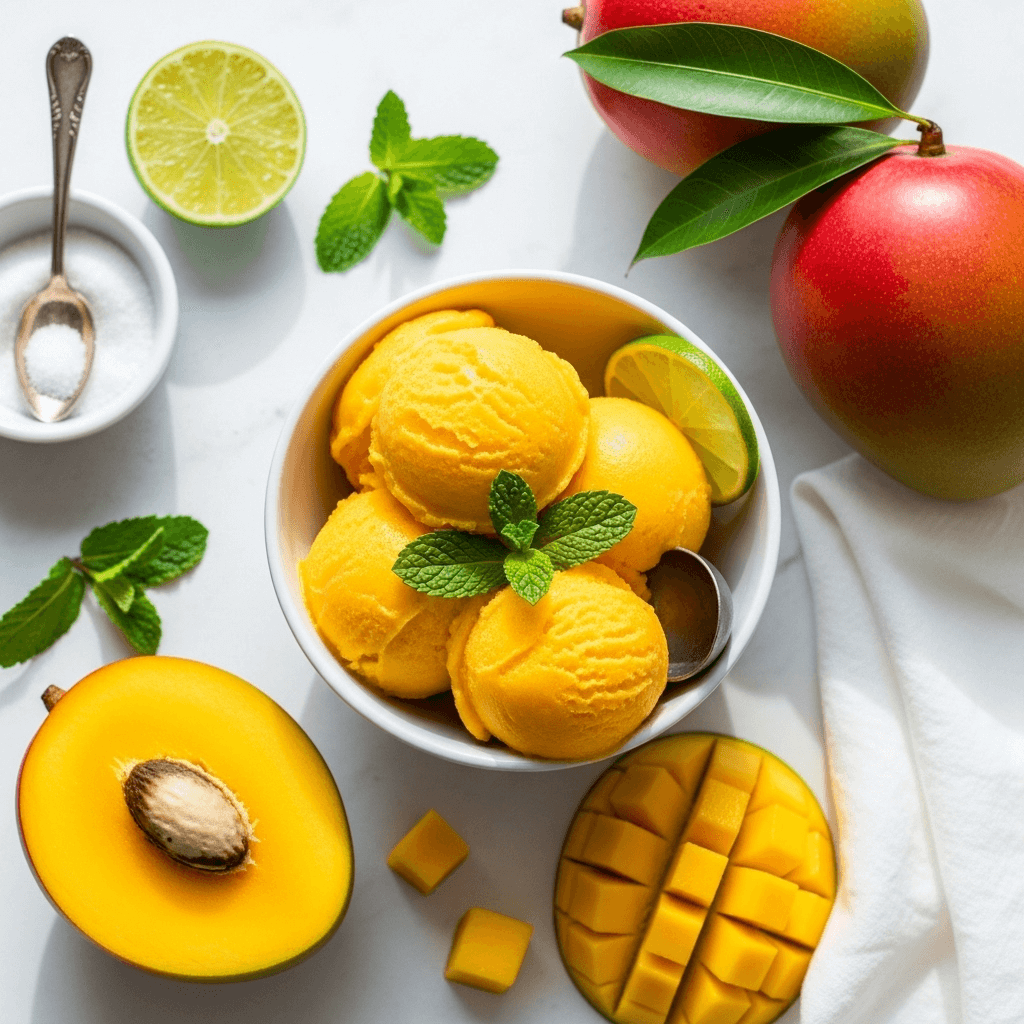

There’s nothing quite like the pure, tropical bliss of homemade mango sorbet on a warm day. This refreshing frozen dessert captures the essence of sweet, ripe mangoes in a smooth, icy treat that’s both elegant and incredibly simple to make. Unlike heavy ice cream, this easy mango sorbet recipe is light, naturally dairy-free, and lets the bright, sunny flavor of mangoes absolutely shine through. With just three basic ingredients and no ice cream maker required, you can create a restaurant-quality frozen dessert right in your own kitchen that rivals anything you’d find at a high-end gelato shop.
This homemade mango sorbet is perfect for so many occasions—serve it as a palate cleanser between courses at dinner parties, offer it as a refreshing dessert after spicy meals, enjoy it as a healthy afternoon snack, or scoop it into cones for the kids on hot summer days. It’s also wonderful for special occasions like birthday parties, bridal showers, or poolside gatherings where you want something light and refreshing. The best part? While most frozen desserts require specialized equipment, this recipe works beautifully with just a blender or food processor and your freezer. The active prep time is minimal—just 10 minutes of work—and then the freezer does the rest while you go about your day. This makes it one of those magical recipes that looks and tastes impressive but is secretly one of the easiest desserts you’ll ever make.
History / Background
Sorbet has a fascinating history that spans centuries and continents. The concept of frozen fruit desserts dates back to ancient times, with historical records suggesting that the Chinese were creating ice and snow-based treats as early as 3000 BCE. The Romans and Greeks also enjoyed frozen desserts made with snow from the mountains, mixed with honey and fruit juices.
The word “sorbet” itself comes from the Turkish “şerbet,” which derived from the Arabic “sharbat,” referring to a sweet, chilled drink. These frozen treats made their way to Europe through Middle Eastern trade routes during the medieval period. Italian Renaissance courts embraced sorbetto as a palate cleanser between elaborate multi-course meals, a tradition that continues in fine dining today.
Mango sorbet specifically represents a beautiful fusion of European frozen dessert techniques and tropical Asian ingredients. Mangoes originated in South Asia over 4,000 years ago, where they’ve long been revered as the “king of fruits.” As global trade expanded and mangoes became more accessible worldwide during the 19th and 20th centuries, creative cooks began incorporating this beloved fruit into traditional sorbet recipes.
In modern cuisine, mango sorbet has become popular across cultures—from French patisseries to Latin American paleterías to Asian dessert shops. The rise of health-conscious eating in recent decades has boosted sorbet’s popularity even further, as people seek lighter, naturally dairy-free alternatives to traditional ice cream. Today’s easy mango sorbet recipes reflect this evolution, stripping away complex techniques to focus on what matters most: pure fruit flavor and refreshing texture that anyone can achieve at home.
Why You’ll Love This Recipe
This simple mango sorbet recipe checks every box for what makes a dessert truly special—it’s delicious, healthy, easy, and guaranteed to impress everyone who tries it.
- Only 3 ingredients – Mangoes, sugar, and lime juice are all you need for incredible tropical flavor
- No ice cream maker required – Just a blender or food processor and your freezer—equipment you already have
- Naturally dairy-free and vegan – Perfect for guests with dietary restrictions or anyone avoiding dairy
- Healthier dessert option – Made with real fruit and no artificial ingredients, colors, or preservatives
- Incredibly refreshing – Light and icy, perfect for hot summer days or after spicy meals
- Kid-approved treat – Children love the bright color and sweet tropical taste
- Budget-friendly – Costs a fraction of store-bought sorbet and tastes infinitely better
- Make-ahead friendly – Stores beautifully in the freezer for weeks, ready whenever cravings strike
- Impressive presentation – Looks elegant and restaurant-quality despite being so easy to make
- Versatile serving options – Enjoy in bowls, cones, as palate cleansers, or blended into smoothies
- Customizable flavors – Easy to adapt with different fruits or flavor additions
Ingredient Notes
Fresh or Frozen Mangoes: You’ll need about 4 cups of mango chunks (roughly 3-4 medium mangoes if using fresh). Ripe mangoes should yield slightly to gentle pressure and smell sweet at the stem end. The beauty of this recipe is that frozen mango works just as well—actually, some argue it works even better since it’s already cold and often picked at peak ripeness. Frozen mango is also convenient year-round and eliminates the peeling and cutting work. Look for frozen mango chunks without added sugar or preservatives.
Granulated Sugar: Sweetens the sorbet and helps achieve the proper texture. Sugar isn’t just for sweetness—it also prevents the sorbet from freezing rock-solid by lowering the freezing point. You can adjust the amount based on your mango’s sweetness (taste and adjust after blending). For natural alternatives, use honey or agave nectar, though the texture will be slightly different. For sugar-free options, use erythritol or monk fruit sweetener, but note that the texture won’t be quite as smooth.
Fresh Lime Juice: Essential for balancing the sweetness and enhancing the mango flavor. The acidity brightens everything and prevents the sorbet from tasting flat or one-dimensional. Always use fresh lime juice, never bottled—the difference is significant. Lemon juice can substitute if needed, though lime’s flavor complements mango better.
Water (Optional): Some recipes include 2-4 tablespoons of water to help with blending and adjust consistency. This is especially helpful if your blender struggles with thick mixtures. You can also use coconut water for extra tropical flavor.
Equipment Needed
- High-powered blender or food processor
- Sharp knife and cutting board (if using fresh mangoes)
- Measuring cups and spoons
- Rubber spatula
- Freezer-safe container with lid (loaf pan, glass container, or ice cream tub)
- Ice cream scoop or large spoon for serving
- Citrus juicer or reamer (for lime juice)
Pro Tip: A high-powered blender like a Vitamix or Blendtec works best, but a regular blender or food processor will work too—you may just need to add a splash of water and blend in shorter bursts. For the smoothest texture, a food processor actually works wonderfully because the wider bowl processes frozen fruit more evenly.
Print
Mango Sorbet Recipe
- Total Time: 4 hours 10 minutes (including freezing)
- Yield: 6 servings (about 3 cups) 1x
- Diet: Vegan
Description
This easy homemade mango sorbet requires just 3 simple ingredients and no ice cream maker. Made with ripe mangoes, a touch of sugar, and fresh lime juice, it’s naturally dairy-free, refreshingly light, and bursting with pure tropical flavor. Perfect for hot summer days or as an elegant palate cleanser, this smooth and creamy sorbet is healthier than ice cream yet tastes absolutely divine.
Ingredients
- 4 cups (about 600g) mango chunks, frozen (or fresh mangoes, peeled and cubed, then frozen)
- ½ cup (100g) granulated sugar (adjust to taste based on mango sweetness)
- 2 tablespoons fresh lime juice (from 1–2 limes)
- 2–4 tablespoons water (optional, if needed for blending)
Instructions
- Prepare mangoes (if using fresh): If starting with fresh mangoes, peel and cut them into 1-inch chunks. You should have about 4 cups. Spread the mango chunks in a single layer on a parchment-lined baking sheet and freeze for at least 3-4 hours, or until completely solid. If using pre-frozen mango chunks, skip this step.
- Blend the mixture: Place the frozen mango chunks in a high-powered blender or food processor. Add the sugar and lime juice. Blend on high speed, stopping to scrape down the sides as needed. The mixture will initially be crumbly, then gradually become smooth and creamy as you blend. If your blender struggles, add 1-2 tablespoons of water at a time to help it process, but use as little liquid as possible for the creamiest texture. Blend for 2-3 minutes until completely smooth with no chunks remaining.
- Taste and adjust: Once smooth, taste the sorbet mixture. Add more sugar if needed for sweetness, or more lime juice for brightness. Blend again briefly to incorporate any additions.
- Serve immediately or freeze: At this point, you have two options. For soft-serve consistency, serve immediately—it will be perfectly scoopable and creamy right now. For firmer, traditional sorbet texture, transfer the mixture to a freezer-safe container with a lid, spreading it evenly and smoothing the top.
- Freeze until firm: If freezing for firmer texture, freeze for at least 3-4 hours, or until completely solid. For easier scooping later, press plastic wrap directly onto the surface before covering with the lid to prevent ice crystals from forming.
- Soften before serving: When ready to serve, let the sorbet sit at room temperature for 5-10 minutes to soften slightly, making it easier to scoop. Use an ice cream scoop dipped in warm water for the prettiest presentation.
Notes
- Fresh mangoes must be completely frozen before blending—partially frozen fruit won’t create the right texture.
- The less liquid you add during blending, the creamier and richer your sorbet will be. Be patient and let your blender work.
- For the smoothest texture with minimal ice crystals, transfer the blended sorbet to your freezer immediately without letting it sit at room temperature.
- Sorbet is best enjoyed within 2 weeks for optimal texture, though it will keep safely for up to 1 month.
- If your frozen sorbet becomes too hard, let it sit at room temperature for 10-15 minutes, or pulse briefly in the food processor to restore creaminess.
- Champagne mangoes (Ataulfo mangoes) create the smoothest, creamiest sorbet due to their texture and lower fiber content.
- Prep Time: 10 minutes
- Cook Time: 0 minutes
- Category: Dessert
- Method: Freezing
- Cuisine: International
Nutrition
- Serving Size: ½ cup (approximately 85g)
- Calories: 110
- Sugar: 26g
- Sodium: 2mg
- Fat: 0g
- Saturated Fat: 0g
- Unsaturated Fat: 0g
- Trans Fat: 0g
- Carbohydrates: 28g
- Fiber: 2g
- Protein: 1g
- Cholesterol: 0mg
Tips & Variations
Coconut mango sorbet: Replace 2 tablespoons of water with coconut cream for a richer, more tropical flavor with a hint of creaminess.
Spicy mango sorbet: Add a small pinch of cayenne pepper or a slice of fresh jalapeño to the blend for a sweet-heat combination that’s surprisingly addictive.
Passion fruit mango sorbet: Add 2 tablespoons of passion fruit pulp (fresh or frozen) for complex tropical flavor with beautiful seeds throughout.
Berry mango sorbet: Replace 1 cup of mango with frozen strawberries or raspberries for a beautiful color and flavor combination.
Herb-infused variation: Add 3-4 fresh mint or basil leaves during blending for an elegant, restaurant-style twist.
Lower sugar version: Reduce sugar to ⅓ cup and add 2 tablespoons of honey for natural sweetness with better texture than sugar-free alternatives.
Adult version: Add 2 tablespoons of rum, tequila, or Cointreau before freezing for a boozy frozen cocktail dessert (alcohol prevents it from freezing completely solid).
Pineapple mango sorbet: Use 3 cups mango and 1 cup frozen pineapple for even more tropical flavor.
Creamy mango sorbet: Add 2 tablespoons of coconut milk or regular milk (if not dairy-free) for a creamier, sherbet-like texture.
Pro Chef Tips
Choose the right mangoes: For the best flavor and texture, use Ataulfo (champagne) mangoes if available—they’re creamier and less fibrous than other varieties. However, any ripe, sweet mango will work. If using fresh mangoes, choose fruit that’s fragrant at the stem end and yields slightly to gentle pressure. Avoid mangoes with black spots or overly soft areas.
The frozen solid rule: Your mango chunks must be completely frozen solid before blending—this is non-negotiable for proper sorbet texture. Partially frozen fruit creates slush instead of smooth sorbet. If you’re impatient, spread chunks in a thin layer in the freezer for faster freezing (3-4 hours minimum).
Blender technique matters: Start on low speed and gradually increase to high. Use the tamper (if your blender has one) to push fruit down into the blades. Stop and scrape sides frequently. Be patient—proper blending takes 2-3 minutes. The mixture will sound different once it’s fully smooth and creamy.
Sugar is structural: Don’t skip or dramatically reduce the sugar thinking you’ll make it healthier. Sugar doesn’t just sweeten—it’s essential for preventing ice crystals and maintaining scoopable texture. Without enough sugar, your sorbet will freeze rock-hard.
The lime juice secret: Don’t skip the lime juice! Even if you think it doesn’t need acidity, lime juice is crucial for balancing sweetness and making the mango flavor pop. It prevents the sorbet from tasting flat or one-dimensional. This is a professional trick that makes all the difference.
Prevent ice crystals: Press plastic wrap directly onto the surface of the sorbet before sealing the container—this prevents air exposure that causes freezer burn and ice crystals. For long-term storage, this step is essential for maintaining smooth texture.
The test scoop method: Before transferring all your blended sorbet to a container, scoop a small amount and taste it. Remember that freezing dulls flavors slightly, so the mixture should taste a touch sweeter and more intense than you want the final product to be.
Common Mistakes to Avoid
Using underripe or flavorless mangoes: The quality of your mangoes directly determines your sorbet’s flavor. Underripe, bland, or low-quality mangoes create disappointing sorbet. If your fresh mangoes aren’t perfectly ripe and sweet, frozen mango is actually a better choice—it’s picked at peak ripeness. Always taste your mango before making sorbet to ensure it’s delicious on its own.
Adding too much liquid: The biggest texture mistake is adding excessive water during blending because your blender struggles. While a splash might be necessary, too much liquid creates icy, crystalline sorbet instead of smooth, creamy texture. Be patient with your blender and let it work—add liquid only if absolutely necessary, and then just a tablespoon at a time.
Not freezing mangoes completely solid: If you’re starting with fresh mangoes, they must be frozen completely solid—not just cold or partially frozen. Insufficient freezing results in a smoothie-like consistency rather than true sorbet texture. Plan ahead and freeze for at least 4 hours, or overnight for best results.
Letting blended sorbet sit before freezing: Once you’ve achieved that perfect smooth, creamy consistency in the blender, transfer it to your freezer container immediately. Letting it sit at room temperature for even 10-15 minutes allows it to start melting and reforming ice crystals when you refreeze it, which damages the texture.
Not softening before scooping: Pulling sorbet straight from the freezer and trying to scoop it immediately leads to bent spoons and frustration. Sorbet needs 5-10 minutes at room temperature to soften slightly for easy, attractive scooping. This patience creates those beautiful, round scoops instead of crumbly chunks.
Storage & Meal Prep
Initial freezing: Transfer freshly blended sorbet to a freezer-safe container immediately after blending. Press plastic wrap directly onto the surface to prevent ice crystals, then seal with an airtight lid. Freeze for at least 3-4 hours until completely firm.
Long-term storage: Homemade mango sorbet keeps well in the freezer for up to 1 month. For best quality and texture, enjoy within 2 weeks. After that, it’s still safe to eat but may develop ice crystals or lose some of its bright, fresh flavor. Always store in an airtight container to prevent freezer burn and absorbing other freezer odors.
Preventing freezer burn: The key to maintaining smooth texture is minimizing air exposure. Use a container that fits your sorbet amount closely—too much empty space allows ice crystals to form. Press plastic wrap directly onto the surface before sealing, creating an airtight barrier.
Texture maintenance: If your sorbet becomes too hard after extended freezing, you have several options. Let it soften at room temperature for 10-15 minutes before scooping, or break it into chunks and pulse briefly in your food processor to restore that creamy, just-made texture. This technique essentially “re-churns” it without adding liquid.
Portion control tip: Consider freezing sorbet in individual portions using muffin tins or small containers. Once frozen solid, transfer to a freezer bag. This makes it easy to pull out single servings without thawing and refreezing the entire batch.
Make-Ahead & Freezer Notes
Perfect make-ahead dessert: Mango sorbet is ideal for advance preparation since it must be frozen anyway. Make it up to 2 weeks before you need it for stress-free entertaining. It’s one of those wonderful recipes that requires advanced planning but zero last-minute work.
Freezing fresh mango for later: If you find perfectly ripe mangoes on sale or at the farmers market, peel, cube, and freeze them in single-layer portions on baking sheets. Once solid, transfer to freezer bags and store for up to 6 months. You’ll have ready-to-blend mango for sorbet (or smoothies) whenever you want it.
Pre-portioned servings: For parties, scoop sorbet into serving bowls or pretty glasses, cover with plastic wrap, and return to the freezer. When it’s time for dessert, simply unwrap and serve—no last-minute scooping required when you’re busy hosting.
Ice cream cake layers: Use this sorbet as a layer in ice cream cakes or between cake layers for elegant frozen desserts. Spread it while it’s soft-serve consistency, then freeze until firm.
Reprocessing hard sorbet: If your sorbet has been frozen for weeks and is rock-hard, don’t worry—it’s easily rescued. Break it into chunks with a knife, place in a food processor, and pulse until smooth and creamy again. Serve immediately as soft-serve or refreeze in fresh containers.
Serving Suggestions
This versatile mango sorbet shines in many different contexts and pairs beautifully with various accompaniments.
Classic presentation: Serve 1-2 scoops in chilled dessert bowls or coupe glasses. Garnish with fresh mint leaves, a lime wheel, or diced fresh mango for an elegant touch.
Palate cleanser: Serve small portions (golf ball-sized scoops) in shot glasses or small bowls between courses during multi-course dinners, especially before the main course. This is traditional in fine dining and incredibly refreshing.
After spicy meals: This sorbet is perfect following spicy Mexican, Indian, or Thai cuisine. The cool, sweet flavor and icy texture soothe the palate beautifully.
Tropical dessert board: Create a stunning dessert spread with mango sorbet alongside fresh tropical fruits (pineapple, kiwi, papaya), coconut macaroons, and shortbread cookies.
Float creation: Scoop sorbet into glasses and pour sparkling water, champagne, or prosecco over it for an elegant frozen cocktail or mocktail.
With fresh fruit: Serve alongside fresh berries, sliced kiwi, or passion fruit for a simple, elegant fruit dessert plate.
Waffle cone classic: Scoop into ice cream cones for a fun, portable treat that kids and adults love. Sugar cones or waffle cones work beautifully.
Smoothie bowl base: Use soft-serve consistency sorbet as a thick smoothie bowl base topped with granola, coconut flakes, fresh fruit, and chia seeds for a tropical breakfast.
Beverage addition: Add a scoop to iced tea, lemonade, or cocktails for instant tropical flavor and natural sweetness as it melts.
FAQs Section
Do I really need an ice cream maker?
Absolutely not! This recipe is specifically designed to work without any special equipment. All you need is a blender or food processor and your freezer. The technique of blending frozen fruit creates a texture similar to churned sorbet without the machinery. Ice cream makers do create a slightly airier texture, but the difference is minimal and certainly not worth purchasing equipment for.
Why is my sorbet rock-hard and difficult to scoop?
This typically happens for two reasons: insufficient sugar or the sorbet has been frozen too long. Sugar acts as an antifreeze, keeping sorbet scoopable. If you reduced the sugar significantly, that’s likely the culprit. The fix: let it sit at room temperature for 10-15 minutes before scooping, or break into chunks and reprocess in your food processor to restore creaminess. For future batches, don’t reduce sugar by more than 25%.
Can I use other fruits instead of mango?
Absolutely! This method works beautifully with many frozen fruits. Try strawberries, peaches, pineapple, raspberries, blueberries, or any combination. Adjust the sugar based on fruit sweetness—berries need more sugar than mango, while pineapple needs less. Bananas create an extra creamy texture (often called “nice cream”). The key is using frozen fruit and minimal liquid.
What’s the difference between sorbet and sherbet?
Sorbet is completely dairy-free, made only with fruit, sugar, and water/juice. Sherbet contains a small amount of dairy (usually milk or cream), typically 1-2%, which makes it creamier and slightly richer. This recipe is true sorbet—100% dairy-free and vegan. If you want sherbet-like texture, add 2-3 tablespoons of coconut cream or regular cream during blending.
Can I make this without sugar for a healthier option?
While you can reduce the sugar somewhat, eliminating it entirely creates problems. Sugar isn’t just for sweetness—it’s structurally important for preventing rock-hard texture and ice crystals. Better alternatives: reduce sugar to ⅓ cup and rely on very ripe, sweet mangoes, or use honey/maple syrup (though texture differs slightly). Sugar substitutes like erythritol work but create grainier texture and different mouthfeel.
How do I prevent ice crystals from forming?
Ice crystals form when sorbet is exposed to air or temperature fluctuations. Prevention tips: Press plastic wrap directly onto the sorbet surface before sealing the container, store in the coldest part of your freezer (back, not the door), use an airtight container, and avoid repeated thawing and refreezing. Eating within 2 weeks ensures minimal crystal formation.
Can I add alcohol to this recipe?
Yes! Adding 2-3 tablespoons of liquor (rum, tequila, vodka, Cointreau) creates a boozy dessert and helps maintain scoopable texture since alcohol doesn’t freeze solid. However, too much alcohol will prevent the sorbet from freezing properly. Limit to 3 tablespoons maximum per batch. The sorbet will be slightly softer but still freezes well.
Conclusion
This easy homemade mango sorbet proves that the most delicious desserts are often the simplest ones. With just three basic ingredients and your blender, you can create a frozen treat that’s naturally dairy-free, refreshingly light, and bursting with pure tropical mango flavor. No complicated techniques, no expensive equipment, no lengthy ingredient lists—just pure fruit goodness transformed into something absolutely magical.
Whether you’re cooling down on a hot summer day, impressing dinner guests with an elegant palate cleanser, or simply treating yourself to something sweet and healthy, this mango sorbet recipe delivers every single time. The best part? Once you master this basic technique, you’ll find yourself making sorbet with all different fruits, creating your own custom flavors and becoming known as the person who always has incredible homemade frozen desserts on hand.
I’d love to hear about your mango sorbet adventures! Did you try any of the flavor variations? What did you serve it with? How did your family react to this tropical treat? Drop a comment below sharing your experience, and please rate the recipe so other home cooks know what to expect. If this recipe brought a little tropical sunshine to your kitchen, share it on Pinterest—your pins help other food lovers discover this easy, delicious frozen dessert!
Now go grab those mangoes and get ready to make the easiest, most refreshing dessert you’ve ever tasted. Happy blending, friend! 🥭