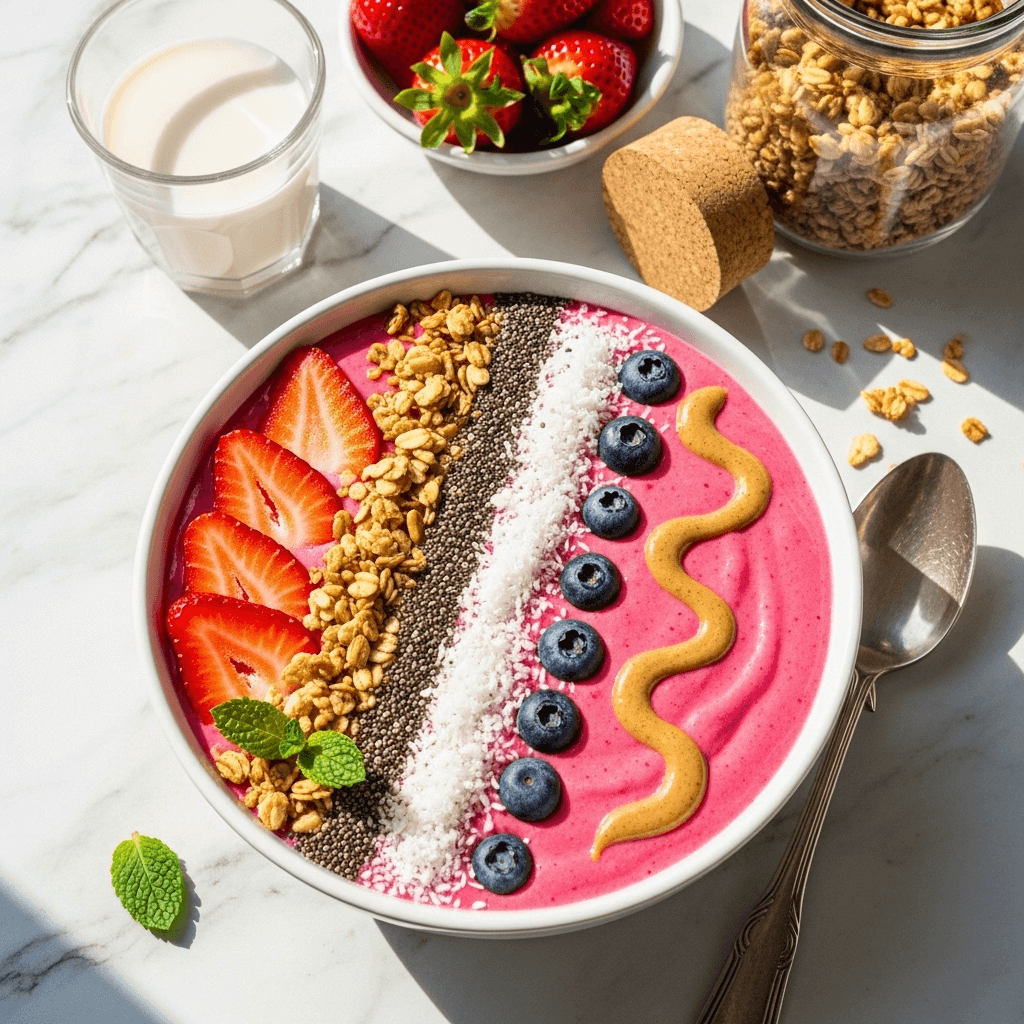

If you’re looking for a breakfast that’s as beautiful as it is nutritious, this strawberry smoothie bowl is exactly what you need. Imagine a thick, creamy, ice-cream-like base made from frozen strawberries and banana, topped with colorful fresh fruit, crunchy granola, and drizzles of nut butter. It’s like eating dessert for breakfast, except it’s packed with vitamins, fiber, and natural energy to fuel your entire morning.
Smoothie bowls have taken the breakfast world by storm, and for good reason. This healthy strawberry smoothie bowl transforms a regular smoothie into an interactive, satisfying meal that you eat with a spoon. The thick texture makes it feel more substantial than a drinkable smoothie, keeping you full longer while delivering incredible flavor. It’s perfect for busy weekday mornings when you need something quick yet nourishing, lazy weekend brunches when you want to enjoy every colorful bite, post-workout refueling, or even as a light, refreshing dinner on hot summer evenings. Kids absolutely love the vibrant pink color and fun toppings, making it a win for the whole family.
History / Background
While smoothie bowls might seem like a modern Instagram trend, their roots trace back to traditional fruit-based dishes from various cultures around the world. The concept of blended frozen fruit as a meal base has existed for decades, but the smoothie bowl as we know it today gained mainstream popularity in the early 2010s, particularly in health-conscious communities in California, Hawaii, and Australia.
The Brazilian “açaí bowl” is often credited as the original inspiration for the smoothie bowl phenomenon. In Brazil, açaí berries have been consumed for centuries by indigenous tribes in the Amazon rainforest. The traditional preparation involved blending frozen açaí pulp with guarana syrup and serving it in a bowl topped with granola and sliced banana. When surfers discovered this energizing, nutrient-dense meal in the 1980s, they brought the concept to California and Hawaii, where it evolved and adapted.
The strawberry smoothie bowl emerged as a more accessible, budget-friendly variation of the açaí bowl. Strawberries are widely available year-round in the United States, significantly less expensive than imported açaí, and equally delicious and nutritious. As social media platforms like Instagram and Pinterest exploded in popularity, smoothie bowls became a visual sensation. Their vibrant colors, artistic topping arrangements, and photogenic appeal made them perfect for sharing online.
The health and wellness movement of the 2010s further propelled smoothie bowls into the spotlight. As people became more conscious about eating whole foods, reducing processed ingredients, and creating balanced meals, the smoothie bowl fit perfectly into this lifestyle. It offered a way to pack multiple servings of fruits and vegetables into one beautiful, satisfying meal.
Today, the strawberry smoothie bowl represents more than just a food trend—it’s a symbol of mindful eating, creative expression in the kitchen, and the joy of nourishing your body with real, wholesome ingredients. It bridges the gap between convenience and nutrition, proving that healthy eating doesn’t have to be boring or time-consuming.
Why You’ll Love This Recipe
This isn’t your average smoothie dumped into a bowl. This thick strawberry smoothie bowl recipe has been perfected to achieve that ideal ice-cream-like consistency that makes every spoonful absolutely delightful. The naturally sweet strawberries combine with creamy banana to create a flavor that tastes indulgent while being completely wholesome.
Here’s why this healthy smoothie bowl will become your new breakfast obsession:
- Ready in 5 Minutes – Seriously, that’s all it takes from start to finish, making it perfect even on your busiest mornings
- Naturally Vegan & Dairy-Free – No animal products needed, yet it’s incredibly creamy and satisfying
- Customizable Toppings – Make it your own with endless topping combinations to suit your taste and nutritional needs
- Kid-Approved – The vibrant pink color and sweet flavor make this a favorite with even the pickiest eaters
- Meal Prep Friendly – Pre-portion your smoothie packs for grab-and-blend convenience throughout the week
- Packed with Nutrients – Loaded with vitamin C, antioxidants, fiber, and natural energy without any refined sugar
- Budget-Friendly – Uses affordable, readily available ingredients you can find at any grocery store
- Satisfying & Filling – The thick texture and fiber-rich toppings keep you full until lunch, unlike thin smoothies
- No Added Sugar Needed – The natural sweetness from fruit means you’re not consuming empty calories
- Instagram-Worthy Presentation – Create stunning, colorful bowls that look as amazing as they taste
Ingredient Notes
The secret to an exceptional strawberry smoothie bowl lies in understanding your ingredients and how they work together. Let’s break down each component so you can make the best bowl possible.
Frozen Strawberries – The star ingredient that gives this bowl its gorgeous pink color and sweet-tart flavor. Using frozen strawberries instead of fresh is crucial for achieving that thick, spoonable consistency. Frozen berries act like natural ice cubes, creating a frosty texture without diluting the flavor. Buy pre-frozen strawberries or freeze fresh ones yourself when they’re in season and on sale. Organic strawberries are ideal if your budget allows, as conventionally grown strawberries can have high pesticide residues.
Frozen Banana – This is your secret weapon for creaminess. Frozen banana adds natural sweetness, a smooth texture, and helps bind everything together. Always use ripe bananas with brown spots before freezing—they’re sweeter and blend more easily. To freeze bananas, peel them, slice into coins, and freeze in a single layer on a baking sheet before transferring to a freezer bag. If you’re allergic to bananas, substitute with frozen mango, cauliflower (you won’t taste it!), or avocado for creaminess.
Liquid Base – You need just a small amount to help everything blend smoothly. Unsweetened almond milk is my go-to for its neutral flavor and creamy texture, but any plant-based milk works beautifully—oat milk adds extra creaminess, coconut milk provides tropical richness, and cashew milk is wonderfully smooth. Regular dairy milk works too if you’re not dairy-free. For a protein boost, use protein-enhanced milk. Start with less liquid than you think you need; you can always add more, but you can’t take it away.
Greek Yogurt (Optional) – Adding a spoonful of Greek yogurt or non-dairy yogurt alternative creates an even thicker, tangier bowl while boosting the protein content significantly. This makes your smoothie bowl more filling and satisfying. For vegan versions, use coconut yogurt, almond yogurt, or cashew yogurt.
Natural Sweetener (Optional) – If your strawberries and banana are perfectly ripe, you likely won’t need any added sweetener. However, if you prefer extra sweetness, add a teaspoon of honey, maple syrup, agave nectar, or a pitted date. Avoid artificial sweeteners as they can affect the taste and don’t provide any nutritional benefits.
Toppings – This is where creativity shines! Fresh strawberries add color and more berry flavor. Granola provides essential crunch and makes the bowl more satisfying. Chia seeds, hemp seeds, or flax seeds contribute omega-3 fatty acids and protein. Nut butter adds healthy fats and richness. Coconut flakes, fresh berries, sliced banana, kiwi, or edible flowers make your bowl photogenic and delicious. Choose toppings based on your nutritional goals and preferences.
Equipment Needed
Making a perfect strawberry smoothie bowl requires minimal equipment, but having the right tools makes the process significantly easier:
- High-Speed Blender – This is the most important tool. A powerful blender like a Vitamix, Blendtec, or Ninja is ideal for creating that ultra-smooth, thick consistency. Regular blenders can work but may struggle with frozen fruit, requiring more liquid and resulting in a thinner consistency.
- Tamper (If Your Blender Has One) – A tamper helps push frozen ingredients down into the blades without adding extra liquid, which is key to maintaining that thick texture.
- Measuring Cups and Spoons – For accurately portioning ingredients, especially the liquid to ensure you get the perfect consistency.
- Sharp Knife and Cutting Board – For slicing fresh fruit toppings.
- Bowl – A wide, shallow bowl works best for displaying your beautiful toppings. Coconut bowls are trendy and Instagram-worthy, but any cereal bowl works perfectly fine.
- Spoon – A regular spoon for eating your thick, ice-cream-like creation.
- Spatula – Helpful for scraping every bit of smoothie out of the blender and transferring it to your bowl.
Strawberry Smoothie Bowl Recipe
- Total Time: 5 minutes
- Yield: 1 serving (can easily be doubled) 1x
- Diet: Gluten Free
Description
A thick and creamy strawberry smoothie bowl with the consistency of soft-serve ice cream. This healthy breakfast bowl is naturally sweetened, packed with nutrients, and topped with fresh fruit, granola, and your favorite toppings. Ready in just 5 minutes for a satisfying start to your day.
Ingredients
For the Smoothie Base:
- 2 cups frozen strawberries (about 10–12 large strawberries)
- 1 large frozen banana, sliced
- ¼ cup unsweetened almond milk (or milk of choice)
- 2 tablespoons Greek yogurt or coconut yogurt (optional, for extra thickness)
- 1 teaspoon honey or maple syrup (optional, for extra sweetness)
For the Toppings:
- ¼ cup fresh strawberries, sliced
- 2–3 tablespoons granola
- 1 tablespoon almond butter or peanut butter
- 1 tablespoon chia seeds
- 1 tablespoon unsweetened coconut flakes
- Fresh mint leaves (optional)
- Other optional toppings: sliced banana, blueberries, kiwi slices, hemp seeds, cacao nibs, edible flowers
Instructions
- Prepare Your Ingredients: Ensure your strawberries and banana slices are completely frozen. If using fresh fruit, freeze them for at least 3-4 hours or overnight. Having properly frozen fruit is the key to achieving that thick, spoonable consistency.
- Add to Blender in Order: Pour the almond milk into your blender first (liquid always goes in first to help the blades move). Add the Greek yogurt if using, then add the frozen banana slices, and finally top with the frozen strawberries. This order helps create a vortex that pulls ingredients down toward the blades.
- Blend on Low, Then High: Start blending on the lowest setting to break up the frozen fruit. Use your blender’s tamper to push ingredients toward the blades if needed, keeping the tamper in motion to avoid creating air pockets. Once the mixture starts moving, increase to high speed and blend for 30-45 seconds, or until completely smooth and thick. Stop blending as soon as it’s smooth—over-blending will thin it out.
- Check Consistency: The mixture should be extremely thick, like soft-serve ice cream or frozen yogurt. It should hold its shape when you scoop it and not be pourable. If it’s too thick to blend, add liquid one tablespoon at a time. If it’s too thin, add a few more frozen strawberries or ice cubes and blend again.
- Transfer to Bowl: Use a spatula to scrape all the smoothie into your serving bowl. The mixture should pile up slightly rather than spreading out flat, indicating the perfect thickness.
- Add Toppings Artistically: This is the fun part! Arrange your toppings in sections, rows, or patterns for an Instagram-worthy presentation. Slice the fresh strawberries and place them on one section. Add a line of granola, then chia seeds, then coconut flakes. Drizzle the almond butter over the top or create small dollops. Add any additional toppings you desire.
- Serve Immediately: Smoothie bowls are best enjoyed right away while the base is cold and thick. The toppings add textural contrast to the creamy base, making each bite interesting and satisfying.
Notes
- Thickness is Key: The less liquid you use, the thicker your bowl will be. Start with just ¼ cup and only add more if absolutely necessary for blending.
- Frozen Fruit is Essential: Fresh fruit will not create the proper thick consistency. Always use frozen.
- Blender Power Matters: If you have a less powerful blender, you may need to add slightly more liquid or let the frozen fruit thaw for 5 minutes before blending.
- Adjust Sweetness: Taste your base before pouring into the bowl. If it needs more sweetness, blend in a pitted date or a drizzle of maple syrup.
- Topping Quantities: Use as many or as few toppings as you like. The nutrition facts include all suggested toppings, so adjust based on what you actually use.
- Prep Time: 5 minutes
- Cook Time: 0 minutes
- Category: Breakfast
- Method: Blending
- Cuisine: American
Nutrition
- Serving Size: 1 bowl (with all suggested toppings)
- Calories: 385
- Sugar: 42g
- Sodium: 105mg
- Fat: 12g
- Saturated Fat: 3g
- Unsaturated Fat: 8g
- Trans Fat: 0g
- Carbohydrates: 65g
- Fiber: 12g
- Protein: 10g
- Cholesterol: 0mg
Tips & Variations
The beauty of smoothie bowls is their incredible versatility. Once you master the basic strawberry version, you can customize it endlessly to suit your preferences, dietary needs, or what you have on hand.
Mixed Berry Smoothie Bowl – Combine strawberries with frozen blueberries, raspberries, and blackberries for an antioxidant-packed purple bowl. Use 1½ cups total mixed berries plus the banana.
Tropical Strawberry Bowl – Add ½ cup frozen mango or pineapple to the strawberries for a tropical twist. Top with coconut flakes, fresh mango, and kiwi slices.
Chocolate Strawberry Bowl – Blend in 1 tablespoon unsweetened cocoa powder or cacao powder for a chocolate-covered strawberry flavor. Top with cacao nibs and dark chocolate shavings.
Green Smoothie Bowl – Add a large handful of fresh spinach or kale to your strawberry base. The fruit masks the taste completely while boosting nutrition. The color will be more brownish-pink than bright pink.
Protein-Packed Bowl – Add a scoop of your favorite vanilla or strawberry protein powder to the base for a post-workout meal. Increase the liquid slightly to accommodate the powder.
Peanut Butter & Jelly Bowl – Swirl 2 tablespoons of peanut butter through the strawberry base before adding toppings for a nostalgic PB&J flavor. Top with crushed peanuts.
Lower Sugar Version – Replace half the strawberries with frozen cauliflower or zucchini. Sounds strange, but you won’t taste the vegetables, and it significantly reduces the sugar while maintaining thickness.
Açaí Strawberry Hybrid – Blend ½ packet of frozen açaí with your strawberries for an authentic açaí bowl flavor with better accessibility and lower cost.
Nut-Free Version – Use sunflower seed butter instead of almond butter, and top with pumpkin seeds instead of nuts. Use oat milk or rice milk for the liquid base.
Pro Chef Tips
Want to elevate your strawberry smoothie bowl from good to absolutely exceptional? These professional techniques will help you create café-quality results every single time:
Freeze Fruit at Peak Ripeness – The sweetness and flavor of your smoothie bowl depends entirely on the quality of your fruit. Freeze strawberries when they’re perfectly ripe and fragrant, not when they’re already past their prime. Overripe fruit can taste fermented or dull.
Use a High-Speed Blender and the Tamper – This makes all the difference. A powerful blender can pulverize frozen fruit without requiring extra liquid. Use the tamper aggressively, pushing and stirring the ingredients toward the blades. This prevents air pockets and ensures even blending without dilution.
Add Frozen Fruit in Stages – If your blender struggles, don’t add all the frozen fruit at once. Blend half the fruit until smooth, then add the remaining half. This prevents the motor from straining and results in a smoother texture.
Chill Your Bowl – Place your serving bowl in the freezer for 10 minutes before using. A cold bowl keeps your smoothie thick longer, giving you more time to arrange toppings and enjoy your meal without it melting into soup.
Cut Toppings Into Uniform Pieces – Professional-looking smoothie bowls have evenly sized topping pieces. Take the extra 30 seconds to slice strawberries uniformly and measure out your seeds and granola for consistent presentation.
Use Contrast in Textures – Every great smoothie bowl has a balance of creamy (base), crunchy (granola, nuts), chewy (dried fruit), and fresh (fresh berries). This textural variety makes eating more enjoyable and satisfying.
Drizzle, Don’t Dump – When adding nut butter or other liquid toppings, transfer them to a small squeeze bottle or use a spoon to create artistic drizzles. This looks infinitely better than just plopping it on top.
Arrange Toppings in Sections – Create visual interest by arranging different toppings in distinct sections or lines rather than scattering everything randomly. This is what makes café smoothie bowls look so professional and photogenic.
Common Mistakes to Avoid
Even though smoothie bowls seem simple, there are several common pitfalls that can ruin your results. Here’s what to watch out for:
Adding Too Much Liquid – This is the number one mistake! Too much liquid creates a thin, pourable consistency that defeats the entire purpose of a bowl. Start with just ¼ cup and add more only if your blender absolutely cannot process the frozen fruit. Remember, you want to eat this with a spoon, not drink it with a straw.
Using Fresh Fruit Instead of Frozen – Fresh fruit creates a thin, room-temperature smoothie, not the thick, frozen consistency you want. Fresh fruit should only be used as toppings, never in the base. If you don’t have frozen fruit, use fresh fruit plus 1 cup of ice cubes, but the texture won’t be quite as creamy.
Not Using Ripe Enough Bananas – Green or barely ripe bananas lack sweetness and won’t blend as smoothly. Always freeze bananas that are fully ripe with lots of brown spots. They’re sweeter, creamier, and blend perfectly.
Over-Blending – Blend just until smooth and stop immediately. Over-blending generates heat from friction, which melts your frozen fruit and thins out the consistency. It also incorporates too much air, creating a fluffy, less dense texture.
Forgetting to Add Fat and Protein – A smoothie bowl made with just fruit won’t keep you full for very long. Always include protein-rich toppings like nut butter, seeds, or Greek yogurt, and healthy fats from nuts or coconut to make it a complete, satisfying meal.
Skipping the Toppings – While the base is delicious, the toppings aren’t just for looks—they provide essential texture, nutrition, and satiety. A plain bowl of blended fruit is just a thick smoothie. The toppings make it a complete meal.
Storage & Meal Prep
One of the best things about smoothie bowls is how well they adapt to meal prep, saving you precious time during busy mornings.
Pre-Portioned Smoothie Packs – This is the ultimate time-saver. In advance, measure out the exact amounts of frozen strawberries and banana slices needed for one smoothie bowl. Place them together in individual freezer-safe bags or containers. Label each with the date and what liquid to add. In the morning, simply dump one pack into your blender with your liquid, blend, and enjoy. These packs keep for up to 3 months in the freezer.
Pre-Cut Toppings – Wash, dry, and slice fresh fruit toppings on the weekend. Store in airtight containers in the refrigerator for up to 3 days. This makes morning assembly lightning-fast.
Homemade Granola – Make a large batch of granola on Sunday and store in an airtight container at room temperature for up to 2 weeks. Having homemade granola ready to go elevates your smoothie bowls significantly.
Storing Leftover Base – If you make too much smoothie base, don’t pour it down the drain! Pour the extra into popsicle molds for healthy frozen treats, or store it in an airtight container in the freezer for up to 1 day. When ready to eat, let it thaw for 5-10 minutes, then use a spoon to break it up and enjoy as a slightly softer bowl.
Not Recommended for Storage – Assembled smoothie bowls don’t store well because the toppings get soggy and the base starts to melt. Always blend and assemble fresh for the best experience.
Make-Ahead & Freezer Notes
Smoothie bowls are inherently a make-ahead-friendly meal when you prep properly. Here’s how to set yourself up for success:
Freezing Strategy – The key to easy morning smoothie bowls is having everything pre-frozen and portioned. Buy strawberries in bulk when they’re on sale, wash and dry them thoroughly, hull them, and freeze on a baking sheet before transferring to freezer bags. Do the same with ripe bananas (peeled and sliced). Having a well-stocked freezer means you can make a smoothie bowl any time.
Smoothie Bowl Kits – Create complete smoothie bowl kits by portioning frozen fruit, protein powder if using, and any add-ins like spinach or cocoa powder into individual bags. Attach a label listing what liquid to add and how much. Store in the freezer for up to 3 months. This is especially helpful for kids or partners who want to make their own breakfast without guessing measurements.
Fresh Topping Prep – While you can’t freeze assembled bowls, you can prep toppings in advance. Portion granola into small containers, measure out seeds into tiny bags, and pre-slice fresh fruit. Store toppings in the refrigerator (except granola, which stays at room temperature) for quick assembly.
Best Reheating Method – Since there’s no cooking involved, “reheating” isn’t applicable. However, if your base gets too frozen solid, let it sit at room temperature for 5-10 minutes before trying to scoop it.
Quick-Thaw Technique – If you accidentally make your base too thick to enjoy, don’t add liquid and re-blend (this makes it too thin). Instead, let it sit for 2-3 minutes to soften slightly, which makes it perfectly spoonable while maintaining thickness.
Serving Suggestions
While a strawberry smoothie bowl is a complete meal on its own, there are times when you might want to round it out or serve it alongside other items for a more substantial breakfast spread.
Additional Breakfast Items:
- Whole grain toast with avocado for added protein and healthy fats
- Hard-boiled eggs or scrambled tofu for extra protein
- A side of turkey bacon or tempeh bacon for savory contrast
- Homemade muffins or banana bread for a heartier meal
- Chia pudding as a complementary texture
Beverage Pairings:
- Hot coffee or cold brew for a caffeine boost
- Green tea or matcha latte for gentle energy
- Fresh-squeezed orange juice for vitamin C
- Coconut water for hydration
- Golden milk latte for anti-inflammatory benefits
Topping Bar for Brunch Gatherings: Set up a DIY smoothie bowl bar when hosting brunch. Make a large batch of the strawberry base and keep it in a chilled bowl. Offer an array of toppings in small bowls: various fresh fruits, different granolas, multiple nut butters, seeds, coconut flakes, cacao nibs, edible flowers, and honey or maple syrup. Let guests create their own custom bowls—it’s interactive, fun, and ensures everyone gets exactly what they want.
Time of Day Considerations:
- Breakfast: Serve with coffee and a protein source for a complete morning meal
- Post-Workout: Add extra protein powder to the base and top with hemp seeds and nut butter for muscle recovery
- Afternoon Snack: Make a smaller portion (half recipe) for a refreshing pick-me-up
- Light Dinner: On hot summer evenings, a smoothie bowl topped with extra granola and nuts can serve as a light, cooling meal
FAQs Section
Q: Why is my smoothie bowl too thin and not thick enough?
A: This happens when you use too much liquid or don’t have enough frozen fruit. The base should be so thick that you can barely blend it. Only use ¼ cup of liquid to start, and use your blender’s tamper to push ingredients down rather than adding more liquid. Also ensure your fruit is completely frozen solid. If your bowl turns out too thin, add more frozen strawberries or a handful of ice cubes and blend again briefly.
Q: Can I make a smoothie bowl without a high-speed blender?
A: Yes, but it’s more challenging. With a regular blender, let your frozen fruit thaw for about 5 minutes before blending to reduce the strain on your motor. Cut frozen bananas into smaller pieces. You may need to add slightly more liquid (start with 2-3 tablespoons at a time) and be patient, stopping to scrape down the sides frequently. A food processor can also work well for smoothie bowls since you can use the tamper more aggressively.
Q: How do I make my smoothie bowl sweeter without adding sugar?
A: Use naturally sweeter strawberries (avoid tart early-season berries), ensure your banana is very ripe with lots of brown spots before freezing, add a pitted Medjool date while blending, or add a splash of pure vanilla extract which enhances perceived sweetness. You can also top with naturally sweet fresh fruit like mango or banana, or drizzle with a tiny bit of honey or maple syrup.
Q: Is a smoothie bowl healthier than a regular smoothie?
A: Nutritionally, they’re very similar if using the same ingredients. However, smoothie bowls have psychological and practical advantages: eating with a spoon and adding toppings makes you slow down and chew, which improves digestion and satiety. The toppings add texture, extra nutrients, and make it feel more like a complete meal. You’re also less likely to over-consume since the portion is clearly defined in a bowl.
Q: Can I meal prep smoothie bowls for the entire week?
A: You can’t prep assembled bowls, but you can absolutely prep components. Make individual freezer bags with pre-portioned frozen fruit (lasts 3 months), prep topping containers (lasts 3-5 days in fridge), and even pre-measure your liquid in small containers if you want. Each morning, it takes just 2 minutes to blend and assemble—almost as fast as pouring cereal.
Q: What toppings keep my smoothie bowl healthy?
A: Focus on whole food toppings: fresh berries, sliced fruit, raw nuts and seeds (chia, hemp, pumpkin, sunflower), unsweetened coconut flakes, natural nut butters, and homemade granola with minimal added sugar. Avoid candy-like toppings, chocolate chips (unless dark chocolate), sweetened dried fruit, and sugar-laden granolas. Remember that fruit is already sweet, so you don’t need additional sugar.
Q: Why did my smoothie bowl turn brown instead of staying pink?
A: This usually happens when you add ingredients that oxidize quickly, like banana, which can brown when blended. To maintain that gorgeous pink color, use mostly strawberries (at least 2 cups) and less banana (just ½ banana), blend minimally (just until smooth), and serve immediately. Adding a squeeze of lemon juice can also help preserve the color. If you add greens like spinach, the color will naturally turn more brownish-purple.
Conclusion
There you have it—everything you need to create the perfect strawberry smoothie bowl right in your own kitchen! This healthy breakfast bowl proves that nutritious eating can be absolutely delicious, visually stunning, and incredibly satisfying. The thick, creamy texture combined with crunchy toppings makes every spoonful a delightful experience that will have you actually looking forward to breakfast.
Whether you’re meal-prepping for busy weekday mornings, treating yourself to a leisurely weekend brunch, refueling after a workout, or finding creative ways to eat more fruit, this easy smoothie bowl recipe delivers every single time. And with endless customization options, you’ll never get bored—there’s always a new topping combination or flavor variation to try.
I’d absolutely love to see your smoothie bowl creations! What toppings did you choose? Did you try any of the variations? Drop a comment below sharing your experience, and don’t forget to rate the recipe if you loved it. If you found this recipe helpful, please share it on Pinterest so other health-conscious home cooks can discover it too. Your support helps me continue creating delicious, nutritious recipes that make healthy eating easy and enjoyable.
Here’s to starting your mornings with something colorful, nutritious, and absolutely delicious! 🍓