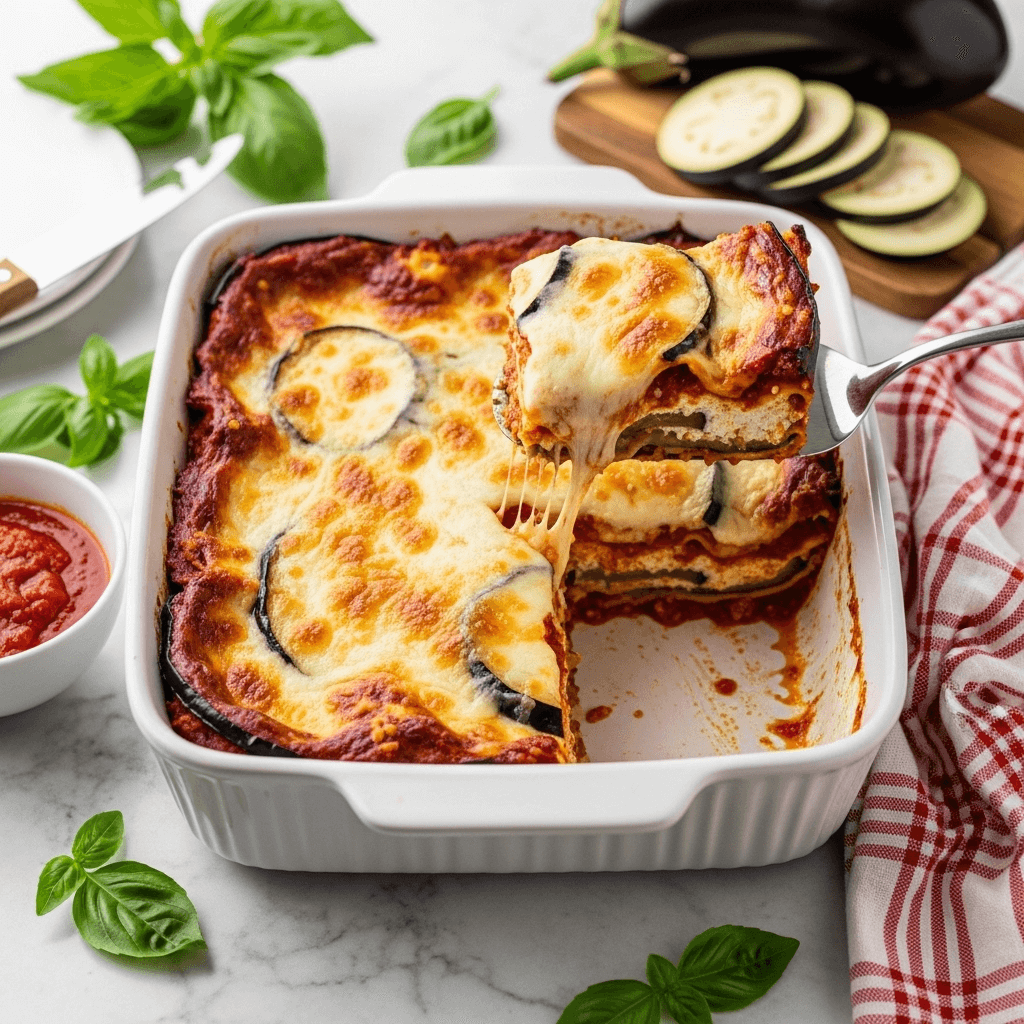

If you’re looking for a delicious, healthier twist on traditional lasagna, this eggplant lasagna recipe is about to become your new favorite comfort food! Instead of using pasta noodles, we’re layering thin slices of roasted eggplant with rich marinara sauce, creamy ricotta, and melted mozzarella cheese. The result? A hearty, satisfying dinner that’s naturally low-carb, gluten-free, and packed with flavor.
This eggplant lasagna is perfect for weeknight dinners, meal prep Sundays, or whenever you’re craving something cozy and comforting without the heaviness of traditional pasta. It’s a crowd-pleaser that even pasta lovers won’t be able to resist! Whether you’re following a keto diet, cutting back on carbs, or simply want to sneak more vegetables into your meals, this recipe delivers all the classic Italian flavors you love with a nutritious vegetable twist.
Serve this beautiful layered dish alongside a crisp green salad and some garlic bread (or cauliflower bread for a fully low-carb meal), and you’ve got yourself a restaurant-quality dinner that’s made right in your own kitchen.
History / Background
Lasagna has been a beloved Italian dish for centuries, with its origins tracing back to ancient Rome. The word “lasagna” actually refers to the pot in which the dish was cooked, and over time, it evolved to describe the layered pasta dish we know and love today. Traditional lasagna alla Bolognese hails from the Emilia-Romagna region of Northern Italy, where it’s made with rich meat sauce, béchamel, and pasta sheets.
However, the concept of using vegetables in place of pasta isn’t entirely new. In Southern Italy, particularly in regions like Sicily and Calabria where eggplants grow abundantly, cooks have been incorporating eggplant into traditional dishes for generations. Melanzane alla Parmigiana (eggplant parmesan) is a classic example of how Italians have celebrated this versatile purple vegetable.
The modern eggplant lasagna we’re making today is a beautiful marriage of these traditions with contemporary health-conscious cooking. As low-carb and gluten-free diets gained popularity in America during the 2000s, creative home cooks began experimenting with vegetable substitutes for pasta. Eggplant, with its meaty texture and mild flavor that absorbs sauces beautifully, proved to be the perfect stand-in for lasagna noodles.
Today, eggplant lasagna has become a staple in many American households, especially among health-conscious families, keto dieters, and anyone looking to increase their vegetable intake without sacrificing the comfort food experience. It’s proof that you don’t need to compromise on flavor to eat healthier!
Why You’ll Love This Recipe
This eggplant lasagna recipe is truly the best of both worlds—it gives you all the rich, cheesy, satisfying flavors of traditional lasagna while being lighter, healthier, and more nutritious. Every bite is packed with tender eggplant, savory marinara, and three types of melted cheese that create that classic lasagna experience you crave.
Here’s why this recipe will become a regular in your dinner rotation:
- Naturally Low-Carb & Gluten-Free – Perfect for keto, paleo, or gluten-free diets without any special ingredients
- Loaded with Vegetables – Each serving gives you a generous portion of nutrient-rich eggplant
- Make-Ahead Friendly – Assemble it the night before and bake when ready, perfect for busy weeknights
- Freezer-Friendly – Make a double batch and freeze one for easy future dinners
- Family-Approved – Even picky eaters and kids love this cheesy, comforting dish
- Budget-Friendly – Eggplants are inexpensive and the ingredients are simple pantry staples
- Meal Prep Winner – Makes great leftovers that taste even better the next day
- Impressive Yet Easy – Looks fancy enough for company but simple enough for a Tuesday night
- Customizable – Easily adapt it with your favorite proteins, vegetables, or cheese combinations
Whether you’re new to cooking with eggplant or you’re a seasoned pro, this recipe is foolproof and forgiving. The step-by-step instructions make it easy for anyone to create a beautiful, delicious layered masterpiece!
Ingredient Notes
Let’s talk about what goes into making this incredible eggplant lasagna. Each ingredient plays an important role in building those classic Italian flavors.
Eggplant – The star of the show! Look for firm, glossy eggplants that feel heavy for their size. Large globe eggplants work best because they give you bigger slices for layering. We’ll slice them lengthwise into ¼-inch thick planks that serve as our “noodles.” If you can only find smaller Italian eggplants, those work too—you’ll just need a few more of them.
Marinara Sauce – Use your favorite brand or homemade marinara. A good quality sauce makes a huge difference in the final dish. I prefer sauces with simple ingredients and no added sugar. You’ll need about 3-4 cups depending on how saucy you like your lasagna. Substitution: You can also use a meat sauce or bolognese if you want to add protein.
Ricotta Cheese – This provides that classic creamy lasagna layer. Whole milk ricotta gives the richest flavor, but part-skim works well too if you’re watching calories. For extra flavor, we’ll mix it with an egg, Parmesan, and fresh herbs. Substitution: Cottage cheese can work in a pinch, just blend it until smooth.
Mozzarella Cheese – You’ll need both shredded mozzarella for layering and some fresh mozzarella if you want that extra-gooey, authentic Italian experience. The shredded cheese melts beautifully and creates those gorgeous cheese pulls. I recommend shredding your own from a block rather than buying pre-shredded for the best melt and flavor.
Parmesan Cheese – Freshly grated Parmesan adds a sharp, salty, umami-rich flavor that enhances the entire dish. Don’t skip this! It goes into the ricotta mixture and gets sprinkled on top for a golden, crispy finish.
Egg – This binds the ricotta mixture so it stays creamy and doesn’t get watery during baking. Just one large egg does the trick.
Garlic – Fresh minced garlic added to the ricotta mixture brings aromatic depth. You can also sauté some garlic with olive oil and brush it on the eggplant slices before baking.
Fresh Herbs – Basil and parsley are traditional choices that brighten up the dish. I like to use fresh basil in the ricotta mixture and as a garnish. Fresh parsley adds a nice pop of color and freshness.
Italian Seasoning – A blend of dried oregano, basil, thyme, and rosemary that seasons the ricotta mixture perfectly. You can also use individual dried herbs if you prefer.
Olive Oil – Used for brushing the eggplant slices before roasting. This helps them caramelize and develop flavor while preventing them from drying out.
Salt & Black Pepper – Essential for seasoning each layer. We’ll salt the eggplant slices to draw out moisture (more on that in the instructions!).
Equipment Needed
Having the right tools makes this recipe come together smoothly. Here’s what you’ll need:
- Large Baking Sheet(s) – For roasting the eggplant slices. You’ll likely need 2-3 sheets depending on the size of your eggplants.
- 9×13-inch Baking Dish – The classic size for lasagna. A deep dish is preferred to accommodate all those gorgeous layers.
- Sharp Knife – For slicing the eggplant into even ¼-inch planks.
- Cutting Board – A large one gives you plenty of workspace.
- Mixing Bowl – Medium-sized bowl for combining the ricotta mixture.
- Paper Towels or Clean Kitchen Towels – For patting the eggplant dry after salting.
- Pastry Brush or Spoon – For brushing olive oil on the eggplant slices.
- Measuring Cups and Spoons – For accurate measurements.
- Spatula or Spoon – For spreading the ricotta mixture and sauce.
- Aluminum Foil – To cover the lasagna during the first part of baking.
- Oven Mitts – Safety first!
Eggplant Lasagna Recipe
- Total Time: 1 hour 20 minutes
- Yield: 8 servings 1x
- Diet: Gluten Free
Description
This eggplant lasagna recipe replaces traditional pasta noodles with tender roasted eggplant slices, layered with rich marinara sauce, creamy ricotta, and melted mozzarella cheese. It’s a naturally low-carb, gluten-free comfort food that delivers all the classic Italian flavors you crave in a healthier package!
Ingredients
For the Eggplant:
- 2–3 large globe eggplants (about 2½ to 3 pounds total)
- 2 teaspoons salt (for drawing out moisture)
- 3 tablespoons olive oil
- ½ teaspoon black pepper
For the Ricotta Mixture:
- 15 ounces whole milk ricotta cheese
- 1 large egg
- ½ cup grated Parmesan cheese
- 2 tablespoons fresh basil, chopped (or 1 tablespoon dried)
- 1 tablespoon fresh parsley, chopped
- 2 cloves garlic, minced
- ½ teaspoon Italian seasoning
- ½ teaspoon salt
- ¼ teaspoon black pepper
For Assembly:
- 3–4 cups marinara sauce (homemade or store-bought)
- 3 cups shredded mozzarella cheese, divided
- ¼ cup grated Parmesan cheese (for topping)
- Fresh basil leaves (for garnish)
Instructions
Step 1: Prepare the Eggplant
Preheat your oven to 400°F (200°C). Line 2-3 large baking sheets with parchment paper. Wash and dry the eggplants, then trim off the stem ends. Slice the eggplants lengthwise into ¼-inch thick planks. You should get about 5-6 slices per eggplant depending on size.
Step 2: Salt and Drain
Lay the eggplant slices on the prepared baking sheets in a single layer. Sprinkle both sides generously with salt (about 2 teaspoons total). Let them sit for 15-20 minutes. You’ll notice moisture beading up on the surface—this is good! The salt draws out excess water and any bitterness. After 15-20 minutes, pat the eggplant slices thoroughly dry with paper towels or clean kitchen towels.
Step 3: Roast the Eggplant
Brush both sides of the eggplant slices lightly with olive oil and season with black pepper. Arrange them in a single layer on the baking sheets (they can be close but shouldn’t overlap). Roast in the preheated oven for 20-25 minutes, flipping halfway through, until the eggplant is tender and lightly golden. The slices should be pliable but not mushy. Remove from oven and set aside. Reduce oven temperature to 375°F (190°C).
Step 4: Make the Ricotta Mixture
While the eggplant roasts, prepare your ricotta mixture. In a medium mixing bowl, combine the ricotta cheese, egg, grated Parmesan, chopped basil, parsley, minced garlic, Italian seasoning, salt, and black pepper. Stir until everything is well incorporated and creamy. Set aside.
Step 5: Assemble the Lasagna
Now for the fun part—building your lasagna! Spread ¾ cup of marinara sauce across the bottom of a 9×13-inch baking dish. This prevents sticking and adds moisture. Layer a third of the roasted eggplant slices over the sauce, overlapping slightly if needed. Spread half of the ricotta mixture over the eggplant layer using a spatula. Sprinkle 1 cup of shredded mozzarella over the ricotta. Spoon 1 cup of marinara sauce over the cheese and spread gently.
Step 6: Repeat Layers
Add another layer of eggplant slices (another third), followed by the remaining ricotta mixture, another cup of mozzarella cheese, and another cup of marinara sauce. For the final layer, add the remaining eggplant slices, the remaining marinara sauce, and the last cup of mozzarella cheese. Sprinkle the top with ¼ cup of Parmesan cheese for that beautiful golden crust.
Step 7: Bake
Cover the baking dish tightly with aluminum foil (spray the underside with cooking spray so the cheese doesn’t stick). Bake at 375°F for 30 minutes. Remove the foil and bake for an additional 15-20 minutes, or until the cheese is bubbly and golden brown on top and the sauce is bubbling around the edges.
Step 8: Rest and Serve
Remove the lasagna from the oven and let it rest for 10-15 minutes before slicing. This is crucial! The resting time allows the layers to set so you get beautiful, clean slices instead of a soupy mess. Garnish with fresh basil leaves, slice into 8 portions, and serve hot.
Notes
- Salting the Eggplant: Don’t skip this step! Salting removes excess moisture and any potential bitterness, resulting in tender, flavorful eggplant that won’t make your lasagna watery.
- Slice Thickness: Keep your eggplant slices uniform at about ¼-inch thick. Too thin and they’ll fall apart; too thick and they won’t cook through properly.
- Sauce Consistency: If your marinara sauce is very thin, simmer it on the stove for 10-15 minutes to thicken it up before assembling. This prevents a watery lasagna.
- Make It Meaty: Add 1 pound of cooked ground beef, Italian sausage, or ground turkey to your marinara sauce for a heartier version.
- Cheese Variations: Feel free to add provolone, fontina, or even a little goat cheese for different flavor profiles.
- Leftover Storage: Store covered in the refrigerator for up to 4 days. Reheat individual portions in the microwave or warm the whole dish covered in a 350°F oven.
- Prep Time: 30 minutes
- Cook Time: 50 minutes
- Category: Dinner
- Method: Baking
- Cuisine: Italian-American
Nutrition
- Serving Size: 1 slice (1/8 of recipe)
- Calories: 285
- Sugar: 8g
- Sodium: 745mg
- Fat: 17g
- Saturated Fat: 9g
- Unsaturated Fat: 6g
- Trans Fat: 0g
- Carbohydrates: 16g
- Fiber: 5g
- Protein: 18g
- Cholesterol: 72mg
Tips & Variations
Make It Vegan: Use vegan ricotta (made from cashews or tofu), dairy-free mozzarella, and nutritional yeast in place of Parmesan. The result is surprisingly delicious and still captures that creamy, cheesy lasagna experience.
Add More Veggies: Layer in sautéed spinach, sliced zucchini, roasted bell peppers, or mushrooms between the eggplant and cheese layers. This adds even more nutrition and flavor complexity.
Spicy Kick: Add red pepper flakes to your marinara sauce or mix some into the ricotta for a spicy eggplant lasagna that has a little heat.
White Sauce Version: Replace the marinara with a creamy béchamel or Alfredo sauce for a white eggplant lasagna. Add some sautéed garlic and spinach for a restaurant-worthy dish.
Protein Boost: Layer in cooked ground beef, Italian sausage, shredded rotisserie chicken, or even cooked ground turkey between the eggplant layers. You can also mix ricotta with cottage cheese for extra protein.
Fresh Mozzarella: Use slices of fresh mozzarella instead of shredded for an even creamier, more authentic Italian texture.
Pesto Addition: Swirl some basil pesto into your ricotta mixture or spread a thin layer between the cheese and sauce for an herby, garlicky flavor boost.
Individual Portions: Make mini eggplant lasagna portions in ramekins or muffin tins for perfect portion control and elegant presentation at dinner parties.
Pro Chef Tips
Choose the Right Eggplant: Look for eggplants that are firm with smooth, glossy skin. They should feel heavy for their size. Avoid any with soft spots, wrinkles, or brown patches. Smaller to medium eggplants tend to have fewer seeds and less bitterness than very large ones.
Salt Generously: Professional chefs always salt eggplant before cooking. This technique, called degorging, draws out moisture and concentrates flavor. Don’t be shy with the salt during this step—you’ll be wiping most of it off anyway, and it makes a dramatic difference in the final texture.
Roast, Don’t Fry: While some recipes call for frying the eggplant slices, roasting is healthier and easier. It also gives you more control and prevents the eggplant from absorbing excessive oil. The key is roasting at a high enough temperature (400°F) to get some caramelization without drying them out.
Control the Moisture: The number one complaint about eggplant lasagna is that it turns out watery. Avoid this by: 1) properly salting and drying the eggplant, 2) roasting the slices until they’re tender but not mushy, 3) using a thick marinara sauce, and 4) letting the finished lasagna rest before cutting.
Layer Strategically: Think of building lasagna like building a cake—you want even, consistent layers. Start with sauce on the bottom to prevent sticking, and try to distribute your ricotta mixture and cheese evenly throughout so every bite has the perfect ratio of eggplant, cheese, and sauce.
Resting Is Non-Negotiable: I know it’s tempting to cut into that bubbly, cheesy lasagna the second it comes out of the oven, but patience pays off! Letting it rest for 10-15 minutes allows the layers to firm up and the sauce to thicken. You’ll get much cleaner slices that hold their shape beautifully.
Quality Ingredients Matter: Since this recipe has relatively few ingredients, quality really shines through. Invest in good Parmesan cheese (Parmigiano-Reggiano if possible), fresh herbs, and a flavorful marinara sauce. Your taste buds will thank you!
Common Mistakes to Avoid
Skipping the Salting Step: This is the biggest mistake people make with eggplant lasagna. Unsalted eggplant releases water during baking, creating a soggy, watery lasagna. Always salt your eggplant slices and let them drain for at least 15 minutes, then pat them thoroughly dry.
Cutting Eggplant Too Thick or Too Thin: Slices that are too thick won’t cook through properly and will be tough to eat. Slices that are too thin will disintegrate during layering and baking. Aim for that Goldilocks zone of ¼-inch thickness—about the width of a pencil.
Using Watery Sauce: Thin, watery marinara sauce is a recipe for disaster in eggplant lasagna. If your sauce seems thin, simmer it on the stove for 10-15 minutes to reduce and thicken it before assembly. You want a sauce that coats the back of a spoon, not one that runs right off.
Over-Crowding the Baking Sheet: When roasting your eggplant, make sure the slices aren’t overlapping. They need air circulation to roast properly rather than steam. Use multiple baking sheets if necessary—it’s worth the extra cleanup for perfectly roasted eggplant.
Cutting Into It Too Soon: I cannot stress this enough—let your lasagna rest! Cutting into it immediately causes all those beautiful layers to slide apart and the cheese and sauce to run everywhere. Ten to fifteen minutes of patience gives you Instagram-worthy slices that hold their shape.
Not Seasoning Each Layer: Don’t rely on the marinara sauce alone for seasoning. Make sure your ricotta mixture is well-seasoned, and consider adding a pinch of salt and pepper to each layer as you build. Proper seasoning throughout makes the difference between bland and brilliant.
Storage & Meal Prep
Refrigerator Storage: Let your eggplant lasagna cool to room temperature, then cover the baking dish tightly with plastic wrap or transfer individual portions to airtight containers. It will keep in the refrigerator for up to 4-5 days. In fact, many people say it tastes even better the next day after the flavors have had time to meld together!
Reheating Instructions: For best results, reheat individual portions in the microwave for 2-3 minutes, covered with a damp paper towel to retain moisture. If reheating the whole dish, cover with foil and warm in a 350°F oven for about 25-30 minutes, or until heated through. You can remove the foil for the last 5 minutes to re-crisp the cheese on top.
Portioning for Meal Prep: This lasagna is perfect for weekly meal prep! After it’s baked and cooled, cut it into 8 portions and store them in individual meal prep containers. This makes it incredibly easy to grab a healthy lunch or dinner throughout the week. Just microwave and enjoy!
Room Temperature: Don’t leave eggplant lasagna sitting out at room temperature for more than 2 hours (or 1 hour if it’s over 90°F). Dairy-based dishes can develop harmful bacteria if left in the “danger zone” too long.
Make-Ahead & Freezer Notes
Make-Ahead Assembly: You can assemble this entire eggplant lasagna up to 24 hours before baking. Follow all the steps through assembly, then cover the dish tightly with plastic wrap and refrigerate. When you’re ready to bake, remove it from the fridge and let it sit at room temperature for 20-30 minutes, then bake as directed (you may need to add 5-10 minutes to the covered baking time since it’s starting cold).
Freezing Unbaked Lasagna: Assemble the lasagna in a freezer-safe baking dish (or a disposable aluminum pan for gifting). Wrap it very tightly—first with plastic wrap, then with aluminum foil—to prevent freezer burn. Label with the date and freeze for up to 3 months. To bake from frozen, remove plastic wrap, cover with foil, and bake at 375°F for 1 hour covered, then 20-25 minutes uncovered.
Freezing Baked Lasagna: You can also freeze already-baked eggplant lasagna! Let it cool completely, then wrap individual portions or the whole dish in plastic wrap and foil. Freeze for up to 3 months. Thaw overnight in the refrigerator before reheating, or reheat from frozen by covering with foil and warming at 350°F for about 45-60 minutes until heated through.
Best Freezer Practices: If you’re making this specifically for freezing, slightly underbake it (reduce the uncovered baking time by 5 minutes). This prevents the cheese from becoming too brown when you reheat it later. Also, using a high-quality marinara sauce helps maintain texture better after freezing.
Thawing Tips: For food safety and best texture, always thaw frozen lasagna in the refrigerator overnight rather than on the counter. If you’re in a pinch, you can reheat from frozen, but it will take significantly longer and may cook unevenly.
Serving Suggestions
This eggplant lasagna is a hearty, complete meal on its own, but pairing it with the right sides takes your dinner to the next level!
Fresh Salads: A crisp Caesar salad with homemade croutons and shaved Parmesan is classic for a reason. You could also serve a simple arugula salad with lemon vinaigrette, cherry tomatoes, and pine nuts to cut through the richness of the cheese.
Garlic Bread: You can’t go wrong with warm, buttery garlic bread for soaking up any extra marinara sauce. If you’re keeping it low-carb, try making keto-friendly cloud bread or almond flour garlic bread.
Roasted Vegetables: Roasted broccoli, Brussels sprouts, or green beans seasoned with garlic and olive oil make excellent vegetable sides that complement the Italian flavors without being too heavy.
Italian-Style Green Beans: Sauté fresh green beans with garlic, olive oil, and a squeeze of lemon for a light, bright side that balances the richness of the lasagna.
Soup: Start your meal with a light Italian wedding soup, minestrone, or a simple tomato bisque for an elegant multi-course dinner.
Wine Pairing: A medium-bodied red wine like Chianti, Sangiovese, or Montepulciano d’Abruzzo pairs beautifully with the tomato sauce and cheese. If you prefer white wine, try a crisp Pinot Grigio or Vermentino.
Antipasto Platter: Serve an antipasto platter as an appetizer with olives, marinated artichokes, roasted red peppers, salami, and cheese before bringing out the lasagna for a true Italian feast.
Dessert: Finish your Italian dinner with tiramisu, panna cotta, or a simple plate of biscotti with espresso for a sweet ending.
FAQs Section
Do I really need to salt the eggplant first?
Yes! While modern eggplant varieties are less bitter than older ones, salting still serves an important purpose. It draws out excess moisture that would otherwise make your lasagna watery and soggy. The salting process also helps the eggplant develop a better texture—tender but not mushy. After just 15-20 minutes, you’ll see moisture beading on the surface. Pat it dry, and you’re good to go! This simple step makes a huge difference in the final result.
Can I make eggplant lasagna without ricotta cheese?
Absolutely! There are several alternatives if you don’t have ricotta or don’t like it. You can use cottage cheese (blend it smooth first for the best texture), a mixture of cream cheese and sour cream, or even a béchamel sauce for a white lasagna version. For a vegan option, use cashew ricotta or tofu-based ricotta. Each variation brings its own unique flavor and texture, so feel free to experiment!
Why is my eggplant lasagna watery?
Watery lasagna usually comes from one of three issues: 1) Not salting and draining the eggplant properly before roasting, 2) Using marinara sauce that’s too thin, or 3) Not letting the lasagna rest before cutting. Make sure you salt your eggplant slices for at least 15 minutes and pat them very dry. If your sauce seems thin, simmer it to reduce it before assembly. And always, always let the finished lasagna rest for 10-15 minutes after baking—this allows everything to set up properly.
Can I use Japanese or Italian eggplant instead of globe eggplant?
Yes, you can definitely use other eggplant varieties! Japanese or Italian eggplants are longer and thinner, so you’ll need more of them to cover the same area. The advantage is they tend to have fewer seeds and a sweeter flavor. Slice them lengthwise just like globe eggplant and follow the same salting and roasting process. You might need 4-6 smaller eggplants instead of 2-3 large globe eggplants.
How do I know when the eggplant lasagna is done baking?
Your lasagna is done when the cheese on top is melted, bubbly, and golden brown in spots, and you can see the sauce bubbling around the edges of the dish. The internal temperature should reach 165°F if you want to check with a thermometer. The total baking time is usually 45-50 minutes (30 minutes covered, 15-20 minutes uncovered), but every oven is different. Look for visual cues—that gorgeous golden, bubbly cheese top is your friend!
Can I add meat to this eggplant lasagna?
Of course! This recipe is wonderfully adaptable. Brown 1 pound of ground beef, Italian sausage, ground turkey, or a combination in a skillet with some garlic and onion. Drain the excess fat, then stir it into your marinara sauce before assembly. You can also layer in thin slices of cooked chicken breast or leftover rotisserie chicken. The meat adds extra protein and makes it even heartier—perfect for feeding hungry families!
Is eggplant lasagna keto-friendly?
Yes! Traditional lasagna made with pasta noodles contains about 35-40 grams of carbs per serving, but this eggplant version has only about 16 grams of carbs (and 5 grams of fiber, giving you just 11 net carbs). It’s naturally low-carb, high in healthy fats from the cheese, and provides a good amount of protein. Just make sure your marinara sauce doesn’t have added sugars, or choose a keto-friendly sauce option. This makes it perfect for anyone following keto, low-carb, or diabetic-friendly diets.
Conclusion
There you have it—the ultimate guide to making absolutely delicious, healthy eggplant lasagna right in your own kitchen! This recipe proves that you don’t need pasta to create a satisfying, comforting lasagna that the whole family will love. With layers of tender roasted eggplant, rich marinara sauce, creamy ricotta, and melty mozzarella cheese, every bite delivers classic Italian flavor with a nutritious vegetable twist.
Whether you’re following a low-carb lifestyle, looking for gluten-free dinner options, or simply trying to incorporate more vegetables into your meals, this eggplant lasagna recipe is a winner. It’s perfect for meal prep, makes amazing leftovers, freezes beautifully, and is impressive enough to serve to guests at your next dinner party.
I’d love to hear how your eggplant lasagna turns out! Did you add any fun variations or extra veggies? Did your family devour it as quickly as mine does? Leave a comment below and let me know! And if you loved this recipe, please share it on Pinterest so other home cooks can discover it too. Your shares help keep this blog running and allow me to create more delicious recipes for you.
Happy cooking, and enjoy every cheesy, veggie-packed bite of your homemade eggplant lasagna!