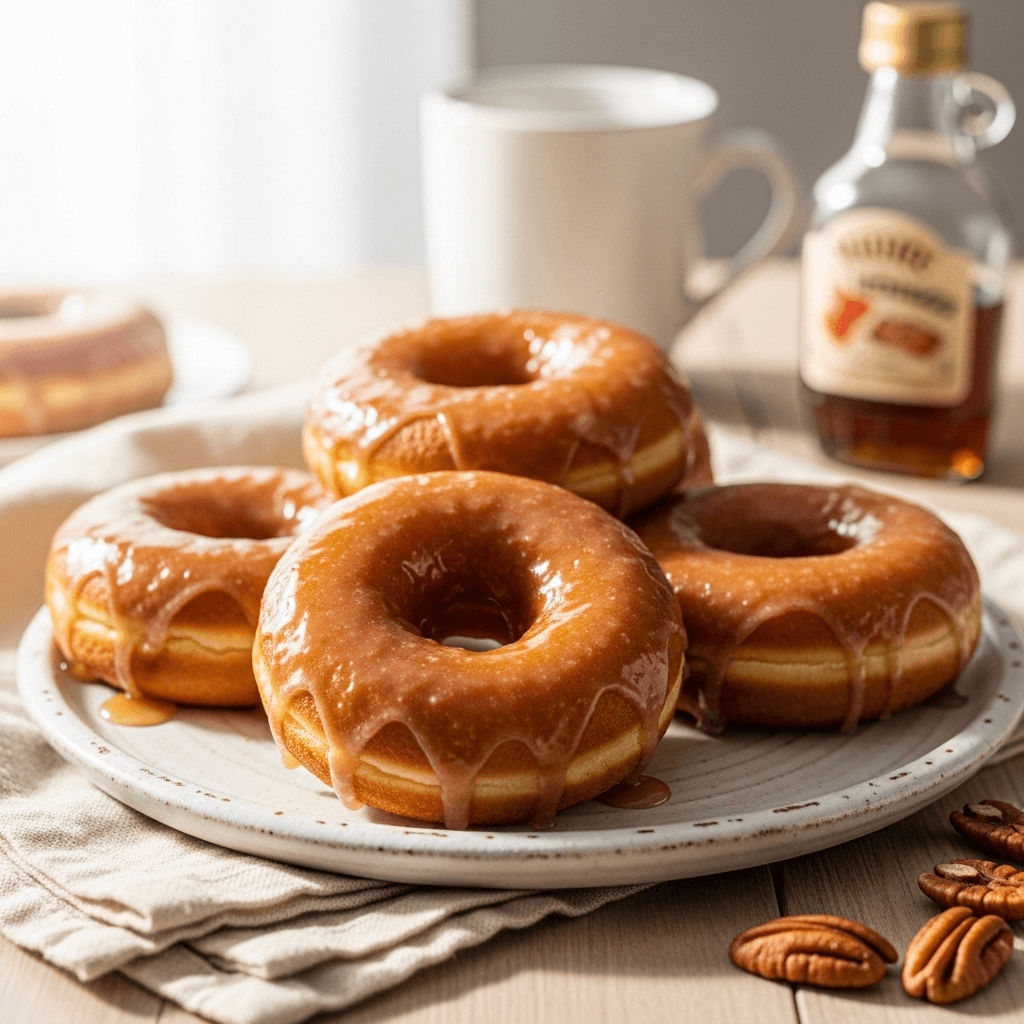

There’s something absolutely magical about biting into a freshly made maple glazed donut that’s still warm from the fryer. These homemade maple glazed donuts are pillowy soft, delicately sweet, and covered in the most incredible maple glaze that hardens to a beautiful sheen. Unlike store-bought donuts that can taste artificial or overly greasy, these homemade beauties feature real maple syrup for an authentic, rich flavor that’ll transport you straight to a cozy New England breakfast table.
Perfect for weekend brunches, special breakfast treats, holiday mornings, or whenever you’re craving something truly special, these maple glazed donuts are surprisingly approachable for home bakers. While they do require some time for the dough to rise, the actual hands-on work is minimal, and the results are absolutely worth it. Imagine serving these at your next family gathering or surprising your kids on a Saturday morning – you’ll instantly become everyone’s favorite baker!
The combination of fluffy yeast donuts with that iconic maple glaze creates a treat that’s nostalgic, comforting, and absolutely irresistible. Whether you’re a seasoned baker or trying your hand at donut-making for the first time, this recipe will guide you through every step to achieve bakery-quality results right in your own kitchen.
History / Background
Maple glazed donuts have deep roots in American culinary history, particularly in the northeastern United States and Canada where maple syrup production has been a cherished tradition for centuries. The Indigenous peoples of North America were the first to discover the process of tapping maple trees and boiling down the sap into sweet syrup, a technique they shared with European settlers in the 1600s.
As donut shops began appearing across America in the early 20th century, bakers started experimenting with different glazes beyond the traditional sugar coating. Maple glaze emerged as a regional favorite, especially in areas like Vermont, New Hampshire, Maine, and throughout Canada where maple syrup was abundant and celebrated as liquid gold. The pairing was natural – the rich, caramel-like notes of pure maple syrup complemented the tender, slightly sweet donut dough perfectly.
The popularity of maple glazed donuts exploded in the mid-1900s when major donut chains began offering them as a signature item. However, many commercial versions started using artificial maple flavoring instead of real maple syrup to cut costs. This created a divide between authentic maple glazed donuts made with pure syrup and the more common imitation versions. Home bakers who wanted that genuine maple experience began making their own, keeping the tradition of real maple donuts alive.
Today, maple glazed donuts represent comfort, nostalgia, and a connection to American food heritage. They’re especially popular during fall and winter months when the warming flavor of maple feels most appropriate, though donut lovers crave them year-round. Making them from scratch at home honors this delicious tradition while allowing you to control the quality of ingredients and create something truly special for your loved ones.
Why You’ll Love This Recipe
These homemade maple glazed donuts are everything you’ve been dreaming of and more. The dough is tender and light as air, with just the right amount of sweetness, while the maple glaze provides that perfect balance of rich flavor and beautiful presentation. Unlike dense, heavy donuts, these have that melt-in-your-mouth texture that makes them absolutely addictive.
Here’s why this recipe will become your new favorite:
- Authentically delicious – Made with real maple syrup for genuine flavor, not artificial imitations
- Bakery-quality results – Achieve professional-looking and tasting donuts right at home
- Surprisingly simple – While there’s rising time involved, the actual technique is straightforward and beginner-friendly
- Customizable – Easy to adjust the glaze thickness or add toppings like chopped pecans or bacon crumbles
- Budget-friendly – Make a dozen donuts for less than what you’d pay for a half-dozen at a bakery
- Impressive presentation – Perfect for special occasions, brunch gatherings, or gifting to neighbors
- Fresh and preservative-free – You control exactly what goes into your donuts with no artificial ingredients
- Fun to make – There’s something deeply satisfying about the donut-making process that the whole family can enjoy
- Freezer-friendly – Make a big batch and freeze extras for quick breakfast treats anytime
Whether you’re an experienced home baker or just starting your culinary journey, this recipe provides clear instructions that lead to success every single time. The aroma of frying donuts and sweet maple glaze filling your kitchen is an experience you simply have to try!
Ingredient Notes
Understanding your ingredients is key to donut success. Let’s break down what you’ll need and why each component matters:
All-Purpose Flour – The foundation of your donut dough. All-purpose flour provides the right protein content for structure while keeping the donuts tender. Bread flour will make them too chewy, while cake flour might make them too delicate. Stick with all-purpose for the perfect texture.
Active Dry Yeast – This is what gives your donuts that beautiful airy, light texture. Make sure your yeast is fresh and not expired. You can also use instant yeast if that’s what you have on hand – just skip the proofing step and mix it directly with the dry ingredients.
Whole Milk – Adds richness, flavor, and helps create that tender crumb. The fat content in whole milk contributes to the donut’s soft texture. You can substitute with 2% milk if needed, but avoid skim milk as it won’t provide enough richness.
Granulated Sugar – Sweetens the dough and feeds the yeast, helping it activate and rise properly. This creates those lovely air pockets that make donuts fluffy.
Eggs – Provide structure, richness, and help bind everything together. They also contribute to the beautiful golden color of the fried donuts.
Butter – Adds incredible flavor and creates a tender texture. Always use unsalted butter so you can control the salt level in your recipe.
Pure Maple Syrup – This is the star of your glaze! Use Grade A amber or dark maple syrup for the best flavor. Don’t substitute pancake syrup or artificial maple flavoring – the real thing makes all the difference. Canadian or Vermont maple syrup works beautifully.
Powdered Sugar – Creates that smooth, glossy glaze that hardens to a perfect finish. Also called confectioners’ sugar or icing sugar, it dissolves completely unlike granulated sugar.
Vanilla Extract – Enhances all the other flavors and adds depth to both the dough and the glaze.
Vegetable Oil – For frying. Choose a neutral oil with a high smoke point like vegetable, canola, or peanut oil. You’ll need enough to fill your pot about 2-3 inches deep.
Equipment Needed
Having the right tools makes donut-making so much easier and more enjoyable. Here’s what you’ll need:
- Large mixing bowl – For combining and kneading your dough
- Stand mixer with dough hook (optional) – Makes kneading easier, but you can absolutely knead by hand
- Measuring cups and spoons – Accurate measurements are crucial for baking success
- Kitchen scale (optional but helpful) – For the most precise measurements
- Rolling pin – To roll out your dough to the right thickness
- Donut cutter – A 3-inch cutter with a 1-inch center hole, or use two round cutters (one large, one small)
- Heavy-bottomed pot or Dutch oven – For frying. You’ll need something at least 3-4 quarts that can safely hold hot oil
- Candy/deep-fry thermometer – Essential for monitoring oil temperature and ensuring perfect frying
- Spider strainer or slotted spoon – For safely removing donuts from the hot oil
- Wire cooling rack – Set over a baking sheet to catch drips while donuts cool
- Clean kitchen towels – For covering dough while it rises
- Whisk – For making the smooth maple glaze
- Medium bowl – For mixing your glaze
- Parchment paper – To place cut donuts on while they rise, and to help transfer them to the oil
- Paper towels – For draining fried donuts initially
Maple Glazed Donuts Recipe
- Total Time: 2 hours 45 minutes
- Yield: 12 donuts plus donut holes 1x
- Diet: Vegetarian
Description
Soft, fluffy homemade maple glazed donuts that taste even better than your favorite bakery! These yeast donuts are fried to golden perfection and coated in a sweet, authentic maple glaze made with real maple syrup. Perfect for weekend breakfasts or special occasions.
Ingredients
For the Donuts:
- 3 ½ cups all-purpose flour, plus more for dusting
- ¼ cup granulated sugar
- 1 packet (2 ¼ teaspoons) active dry yeast
- 1 teaspoon salt
- ¾ cup whole milk, warmed to 110°F
- ¼ cup unsalted butter, melted and slightly cooled
- 2 large eggs, room temperature
- 1 teaspoon vanilla extract
- Vegetable oil for frying (about 8 cups)
For the Maple Glaze:
- 3 cups powdered sugar
- ½ cup pure maple syrup
- 2 tablespoons whole milk
- 1 teaspoon vanilla extract
- Pinch of salt
Instructions
- Activate the yeast: In your stand mixer bowl or large mixing bowl, combine the warm milk (make sure it’s between 105-110°F), sugar, and yeast. Stir gently and let sit for 5-10 minutes until foamy and bubbly. This means your yeast is alive and ready to work its magic.
- Mix the wet ingredients: Once the yeast is foamy, add the melted butter, eggs, and vanilla extract to the bowl. Whisk together until well combined and smooth.
- Add the dry ingredients: Add the flour and salt to the wet mixture. If using a stand mixer, attach the dough hook and mix on low speed for about 5-7 minutes until a soft, slightly sticky dough forms. If mixing by hand, stir with a wooden spoon until combined, then turn out onto a floured surface and knead for 8-10 minutes until smooth and elastic.
- First rise: Place the dough in a greased bowl, turning once to coat all sides. Cover with a clean kitchen towel and let rise in a warm, draft-free place for 1 to 1.5 hours, or until doubled in size. The dough should be puffy and soft.
- Roll and cut: Once risen, punch down the dough gently to release air bubbles. Turn it out onto a lightly floured surface and roll to about ½-inch thickness. Using your donut cutter or two round cutters, cut out donuts. Gather scraps, re-roll once, and cut more donuts. Save the donut holes!
- Second rise: Place cut donuts on parchment-lined baking sheets, spacing them about 2 inches apart. Cover lightly with a kitchen towel and let rise for 30-45 minutes until puffy and nearly doubled. They should spring back slowly when gently poked.
- Heat the oil: While donuts rise, pour oil into your heavy pot to a depth of 2-3 inches. Heat over medium heat to 350-365°F on your thermometer. This temperature is crucial for perfectly cooked donuts.
- Fry the donuts: Carefully slide 2-3 donuts into the hot oil (don’t overcrowd). Fry for about 1-2 minutes per side until golden brown. The donuts will puff up beautifully. Use your spider strainer to flip them and then remove them. Place on a wire rack to cool slightly. Repeat with remaining donuts and donut holes (holes cook faster, about 45 seconds per side).
- Make the glaze: While donuts cool slightly, whisk together powdered sugar, maple syrup, milk, vanilla, and salt in a medium bowl until completely smooth. The glaze should be thick but pourable. If too thick, add milk one teaspoon at a time; if too thin, add more powdered sugar.
- Glaze the donuts: Once donuts have cooled for about 5 minutes (still slightly warm but not hot), dip the top of each donut into the maple glaze, letting excess drip off. Place back on the wire rack and let the glaze set for 10-15 minutes. For extra coverage, you can dip them twice!
- Serve and enjoy: Serve these beauties fresh for the best texture and flavor. They’re absolutely incredible while still slightly warm!
Notes
- Oil temperature is critical – too hot and donuts burn outside while staying raw inside; too cool and they absorb too much oil and become greasy.
- Don’t skip the second rise! This is what makes your donuts incredibly light and fluffy.
- Real maple syrup is essential for authentic flavor – don’t substitute pancake syrup.
- Donuts taste best the day they’re made, but can be stored in an airtight container for up to 2 days.
- You can add a teaspoon of maple extract to the glaze for even more intense maple flavor.
- Prep Time: 30 minutes
- Cook Time: 2 hours
- Category: Breakfast
- Method: Frying
- Cuisine: American
Nutrition
- Serving Size: 1 donut
- Calories: 285
- Sugar: 22g
- Sodium: 210mg
- Fat: 12g
- Saturated Fat: 3g
- Unsaturated Fat: 8g
- Trans Fat: 0g
- Carbohydrates: 41g
- Fiber: 1g
- Protein: 4g
- Cholesterol: 40mg
Tips & Variations
Maple Bacon Donuts: Sprinkle crumbled crispy bacon on top of the wet glaze for a sweet and savory combination that’s absolutely addictive.
Maple Pecan Donuts: Add ½ cup finely chopped toasted pecans to the glaze, or sprinkle chopped pecans on top of freshly glazed donuts.
Cinnamon Maple Donuts: Add 1 teaspoon of ground cinnamon to the donut dough for a warm, spiced flavor that pairs beautifully with maple.
Chocolate Drizzle: After the maple glaze sets, drizzle melted dark or milk chocolate over the top for an extra decadent treat.
Baked Version: While not quite as traditional, you can bake these in donut pans at 350°F for 10-12 minutes. The texture will be more cake-like than fluffy, but still delicious.
Brown Butter Maple Glaze: Brown your butter before adding it to the glaze for an incredible nutty, caramelized flavor dimension.
Gluten-Free Option: Substitute with a 1:1 gluten-free baking flour blend, though texture may vary slightly.
Vegan Adaptation: Use non-dairy milk, vegan butter, and replace eggs with flax eggs (2 tablespoons ground flaxseed mixed with 6 tablespoons water).
Pumpkin Spice Maple: Add 2 tablespoons of pumpkin puree and 1 teaspoon pumpkin pie spice to the dough for a fall-inspired twist.
Pro Chef Tips
Temperature matters for yeast: Your milk should be between 105-110°F when activating yeast. Too hot kills the yeast; too cool won’t activate it. Think of it as warm baby bottle temperature.
Don’t over-knead the dough: Once the dough comes together and becomes smooth and elastic, stop. Over-kneading develops too much gluten, resulting in tough, chewy donuts instead of tender ones.
Create a proofing box: If your kitchen is cool, create a warm environment for rising by turning your oven on to the lowest setting for just 1 minute, then turning it off. Place your covered dough inside with the oven light on.
Maintain consistent oil temperature: After each batch of donuts, give the oil a minute to come back up to temperature. Invest in a good thermometer – it’s the difference between soggy and perfect donuts.
Use a gentle hand when cutting: Press your donut cutter straight down without twisting. Twisting seals the edges and prevents proper rising.
Glaze at the right moment: Glaze donuts while they’re still slightly warm but not hot. This allows the glaze to set properly with that beautiful shiny finish without sliding off completely or soaking in.
Rest your oil between batches: Don’t rush the frying process. Letting the oil recover between batches ensures every donut cooks evenly and beautifully.
Toast your nuts: If adding pecans or other nuts, toast them first in a 350°F oven for 5-7 minutes. This intensifies their flavor and adds a wonderful crunch.
Sift your powdered sugar: For the smoothest, lump-free glaze, sift your powdered sugar before whisking it with the maple syrup and milk.
Common Mistakes to Avoid
Mistake 1: Using old or expired yeast. Always check your yeast’s expiration date. If it doesn’t foam and bubble during proofing, it’s dead and your donuts won’t rise. Invest in fresh yeast for guaranteed success.
Mistake 2: Skipping the thermometer. Guessing your oil temperature leads to inconsistent results. A candy or deep-fry thermometer is an inexpensive tool that makes all the difference between perfectly golden donuts and burnt or greasy ones.
Mistake 3: Rolling the dough too thin. If your dough is thinner than ½ inch, your donuts will be flat and dense. Proper thickness ensures fluffy, airy donuts with enough structure to hold that glaze.
Mistake 4: Overcrowding the pot. Adding too many donuts at once drops the oil temperature dramatically and causes uneven cooking. Stick to 2-3 donuts at a time, depending on your pot size.
Mistake 5: Using imitation maple syrup. Artificial pancake syrup simply doesn’t compare to real maple syrup in flavor. It’s worth the investment for authentic, delicious results that taste truly special.
Mistake 6: Not letting donuts cool enough before glazing. If donuts are too hot, the glaze will melt right off. Wait about 5 minutes so they’re warm but not steaming hot for the best glaze adhesion.
Mistake 7: Making the glaze too thin. A runny glaze won’t coat your donuts properly. It should be thick enough to coat the back of a spoon but still pourable. Add powdered sugar gradually until you reach the right consistency.
Storage & Meal Prep
Room Temperature Storage: Store glazed donuts in an airtight container at room temperature for up to 2 days. Place parchment paper between layers to prevent sticking. Keep in mind that homemade donuts are always best fresh, as they don’t contain the preservatives found in commercial varieties.
Refrigeration: I don’t recommend refrigerating donuts as the cold temperatures can dry them out and make the texture less appealing. Room temperature storage is best for maintaining that soft, tender crumb.
Reheating: If your donuts have lost some of their softness, you can refresh them in the microwave for 8-10 seconds. Be careful not to overheat, as this can make them tough. Alternatively, place them in a 300°F oven for 3-5 minutes.
Unglazed Donuts: If you want to prepare ahead, you can fry donuts and store them unglazed in an airtight container for up to 24 hours, then make fresh glaze and dip them just before serving.
Dough Storage: You can prepare the dough through the first rise, punch it down, wrap tightly in plastic wrap, and refrigerate for up to 24 hours. Let it come to room temperature before rolling and cutting.
Glaze Storage: Leftover maple glaze can be stored in an airtight container in the refrigerator for up to 1 week. Bring to room temperature and whisk well before using. You may need to add a splash of milk to thin it out again.
Make-Ahead & Freezer Notes
Freezing Unglazed Donuts: This is the best method for long-term storage. Fry your donuts, let them cool completely, then place them in a single layer on a baking sheet and freeze for 1 hour. Once frozen solid, transfer to a freezer-safe bag or container. They’ll keep for up to 3 months. To serve, thaw at room temperature for 30 minutes, then make fresh glaze and dip.
Freezing Glazed Donuts: While possible, I don’t recommend freezing glazed donuts as the glaze can become sticky and lose its beautiful appearance during thawing. If you must freeze glazed donuts, place them on a parchment-lined baking sheet until frozen solid, then transfer to a container with parchment between layers.
Freezing Donut Dough: After the first rise, you can shape the dough into a disk, wrap it tightly in plastic wrap and then in aluminum foil, and freeze for up to 2 months. Thaw overnight in the refrigerator, then proceed with rolling, cutting, and the second rise. The texture may be slightly less fluffy than fresh dough but still delicious.
Make-Ahead Cut Donuts: You can cut your donuts the night before, place them on parchment-lined baking sheets, cover loosely with plastic wrap, and refrigerate. In the morning, let them come to room temperature and rise for about 45 minutes to an hour before frying. This is perfect for weekend brunch planning!
Reheating Frozen Donuts: For the best results, thaw frozen unglazed donuts at room temperature for about 30 minutes, then warm them in a 300°F oven for 5 minutes. Make fresh glaze and dip while they’re still warm for that just-made experience.
Best Practice: If you know you’ll want donuts throughout the week, fry a full batch but only glaze what you’ll eat that day. Store the rest unglazed and make fresh glaze for each serving. This keeps them tasting bakery-fresh every time!
Serving Suggestions
Maple glazed donuts are incredible on their own, but here are some delicious ways to serve them:
Classic Coffee Pairing: Serve with freshly brewed coffee, cappuccino, or a maple latte that echoes the donut’s flavor. The slight bitterness of coffee perfectly balances the sweet glaze.
Brunch Board: Create a stunning brunch spread with your donuts alongside fresh berries, yogurt parfaits, crispy bacon, scrambled eggs, and fresh orange juice.
Ice Cream Sandwiches: Slice donuts in half horizontally and fill with vanilla or butter pecan ice cream for an indulgent dessert.
Hot Chocolate Station: During fall and winter, serve warm donuts alongside hot chocolate, whipped cream, and marshmallows for the ultimate cozy treat.
Maple Breakfast Platter: Embrace the maple theme with maple sausage links, maple bacon, and fresh fruit drizzled with a bit of extra maple syrup.
Tea Time: These donuts are sophisticated enough for an afternoon tea service. Pair with Earl Grey, English Breakfast, or spiced chai tea.
Milk Varieties: Offer cold whole milk, chocolate milk, or even warm spiced milk as beverage options, especially if serving to children.
Fresh Fruit: Balance the richness with fresh apple slices, pear wedges, or a berry medley on the side.
Donut Holes Separate: Serve the donut holes in a small basket lined with a napkin as a separate treat, perhaps dusted with cinnamon sugar or given their own maple glaze treatment.
FAQs Section
Q: Can I make these donuts without a stand mixer?
A: Absolutely! While a stand mixer makes the process easier, you can easily make these by hand. Mix the dough with a wooden spoon until combined, then knead on a floured surface for about 8-10 minutes until smooth and elastic. Your arm might get a workout, but the results will be just as delicious.
Q: Why are my donuts greasy?
A: Greasy donuts usually mean your oil temperature was too low. When oil isn’t hot enough (below 350°F), donuts absorb excess oil instead of forming a quick seal. Always use a thermometer and maintain the temperature between 350-365°F. Also, don’t let donuts sit too long during the second rise, as over-proofed donuts can become greasy when fried.
Q: Can I bake these instead of frying them?
A: Yes, though the texture will be different. Baked donuts have a more cake-like texture rather than the light, airy quality of fried donuts. Use donut pans, fill each cavity about ⅔ full, and bake at 350°F for 10-12 minutes until lightly golden and springy to the touch. Glaze as directed.
Q: My donuts turned out dense instead of fluffy. What happened?
A: Dense donuts typically result from one of three issues: dead or insufficient yeast (always check your expiration date and proof properly), not enough rising time (make sure dough truly doubles in both rises), or over-working the dough (knead just until smooth and elastic). Also ensure your oil is hot enough – undercooked donuts can seem dense.
Q: What’s the best maple syrup to use?
A: Use Grade A amber or dark pure maple syrup for the best flavor balance. Darker syrups have a more robust, complex maple flavor that really shines in the glaze, while amber is a bit lighter and more delicate. Both work beautifully. Canadian and Vermont maple syrups are excellent choices. Never use “pancake syrup” or artificial maple flavoring as these won’t give you authentic maple flavor.
Q: How do I know when the oil is the right temperature without a thermometer?
A: While I strongly recommend using a thermometer for consistent results, you can test oil temperature by dropping a small piece of dough into it. If it sizzles immediately and rises to the surface within a few seconds, your oil is ready. If it sinks and slowly bubbles, it’s too cool. If it browns immediately, it’s too hot.
Q: Can I make these donuts ahead of time for a party?
A: For the best texture and flavor, donuts are always best served fresh. However, you can fry them up to 24 hours ahead, store unglazed in an airtight container, and make fresh glaze the morning of your event. Warm the donuts slightly in a 300°F oven for 3-5 minutes, then glaze and serve. Alternatively, freeze fried donuts for up to 3 months and thaw the morning of your party.
Q: Why is my glaze not hardening properly?
A: If your glaze stays sticky and won’t set, it’s likely too thin. Add more powdered sugar a tablespoon at a time until you reach a thicker consistency that coats the back of a spoon. Also make sure your maple syrup and milk are at room temperature before mixing. If your kitchen is very humid, the glaze may take longer to set – you can place glazed donuts in front of a fan to speed up the process.
Conclusion
There you have it – the complete guide to making absolutely perfect maple glazed donuts right in your own kitchen! These homemade beauties are so much better than anything you’ll find at a store or chain bakery, with real maple flavor, fluffy tender texture, and that satisfying feeling of creating something truly special with your own hands.
I know the process might seem a bit involved if you’ve never made yeast donuts before, but I promise you that once you take that first bite of a warm, freshly glazed maple donut, you’ll understand why it’s absolutely worth every minute. The look on your family’s faces when they see these gorgeous golden donuts on the breakfast table? Priceless.
Don’t be intimidated by the frying process – with a good thermometer and a little attention, you’ll be turning out professional-quality donuts in no time. And remember, even if your first batch isn’t picture-perfect, they’re still going to taste absolutely amazing!
I’d love to hear how your maple glazed donuts turn out! Drop a comment below sharing your experience, any creative variations you tried, or photos of your beautiful creations. Did you add bacon? Go for the pecan topping? Make them for a special occasion? Share your story!
And if you loved this recipe, please consider pinning it to your favorite Pinterest board so you can find it easily next time that donut craving hits. Share it with your fellow breakfast-loving friends who would appreciate a truly special homemade treat. Your support means the world and helps me continue creating detailed, tested recipes for home cooks like you!
Now get in that kitchen and start making some magic. Your kitchen will smell incredible, your house will be filled with the happy sounds of people enjoying something delicious, and you’ll have officially leveled up your baking game. Happy donut making, friends!