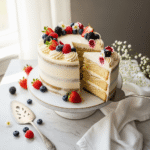
Description
This homemade vanilla cake is incredibly soft, moist, and bursting with rich vanilla flavor. Perfect for birthdays, celebrations, or any time you’re craving a classic, delicious cake that tastes better than any bakery version. The tender crumb and buttery taste make this the ultimate vanilla cake recipe.
Ingredients
Scale
- 2 ¾ cups (345g) all-purpose flour
- 2 cups (400g) granulated sugar
- ¾ cup (170g) unsalted butter, softened to room temperature
- ½ cup (120ml) vegetable oil
- 4 large eggs, room temperature
- 1 cup (240ml) buttermilk, room temperature
- ½ cup (120g) sour cream, room temperature
- 2 tablespoons pure vanilla extract
- 1 tablespoon baking powder
- ½ teaspoon baking soda
- ¾ teaspoon salt
Instructions
- Preheat and prepare pans: Preheat your oven to 350°F (175°C). Grease two 9-inch round cake pans with butter or non-stick spray, then line the bottoms with parchment paper circles. Grease the parchment paper as well. This double-greasing ensures your cakes release perfectly every time.
- Mix dry ingredients: In a large bowl, whisk together the flour, baking powder, baking soda, and salt. Set this aside. Whisking aerates the flour and ensures the leavening agents are evenly distributed.
- Cream butter and sugar: In the bowl of your stand mixer fitted with the paddle attachment (or using a hand mixer), beat the softened butter and sugar together on medium-high speed for 4-5 minutes until light, fluffy, and pale in color. This creaming process incorporates air into the batter, which helps create a light texture. Stop to scrape down the sides of the bowl at least once.
- Add oil: With the mixer running on medium speed, slowly pour in the vegetable oil and continue beating for another minute until well combined. The mixture should look smooth and glossy.
- Add eggs one at a time: Add the eggs one at a time, beating well after each addition (about 30 seconds per egg). This ensures proper emulsification. Add the vanilla extract with the last egg.
- Combine wet ingredients: In a measuring cup or small bowl, whisk together the buttermilk and sour cream until smooth.
- Alternate adding dry and wet ingredients: With the mixer on low speed, add the flour mixture in three additions, alternating with the buttermilk mixture in two additions. Start and end with the flour mixture. The pattern should be: flour, buttermilk, flour, buttermilk, flour. Mix just until combined after each addition. Don’t overmix or your cake will be tough.
- Final mix: Once everything is added, stop the mixer and scrape down the bottom and sides of the bowl with a rubber spatula. Give it a few final folds by hand to make sure no pockets of flour remain, but be gentle and don’t overmix.
- Divide and bake: Divide the batter evenly between your prepared pans. Use a kitchen scale for precision if you have one. Smooth the tops with your spatula and gently tap the pans on the counter a few times to release any air bubbles.
- Bake: Bake for 30-35 minutes, or until a toothpick inserted into the center comes out clean or with just a few moist crumbs (not wet batter). The tops should spring back when lightly pressed, and the edges should just start pulling away from the pan. Start checking at 30 minutes.
- Cool properly: Let the cakes cool in the pans for 15 minutes, then run a knife around the edges to loosen. Carefully turn the cakes out onto wire cooling racks, peel off the parchment paper, and let them cool completely before frosting (at least 1-2 hours). Rushing this step will cause your frosting to melt.
- Frost and serve: Once completely cool, level the tops if needed using a serrated knife or cake leveler, then frost with your favorite frosting. For a classic presentation, spread frosting between the layers, over the top, and around the sides.
Notes
- Room temperature ingredients are essential – Cold ingredients don’t emulsify properly and can result in a dense cake. Set everything out 1-2 hours before baking.
- Don’t overmix – Mix just until ingredients are combined. Overmixing develops too much gluten, making the cake tough instead of tender.
- Oven temperature matters – Use an oven thermometer to ensure your oven is accurate. Too hot and your cake will dome and crack; too cool and it will be dense.
- Test for doneness – Every oven is different. Start checking at 30 minutes, but yours might need up to 35 minutes.
- Cool completely before frosting – This is non-negotiable. Warm cake will make frosting slide right off.
- Prep Time: 20 minutes
- Cook Time: 30 minutes
- Category: Dessert
- Method: Baking
- Cuisine: American
Nutrition
- Serving Size: 1 slice (1/12 of cake, unfrosted)
- Calories: 385
- Sugar: 34g
- Sodium: 285mg
- Fat: 18g
- Saturated Fat: 8g
- Unsaturated Fat: 9g
- Trans Fat: 0g
- Carbohydrates: 51g
- Fiber: 1g
- Protein: 6g
- Cholesterol: 95mg